Severe Winter Weather and Hazardous Air Quality Index in Delhi
Source:The Hindu ↗
Why It Matters
Delhi's winter air pollution is a recurring environmental and public health crisis. Understanding the interplay between meteorological factors (like temperature inversion and fog) and anthropogenic causes (like vehicular emissions) is critical for answering questions on urban pollution in GS3 and climatic phenomena in GS1. It also contextualizes the application of the National Clean Air Programme (NCAP) and WHO Air Quality Guidelines.
Summary
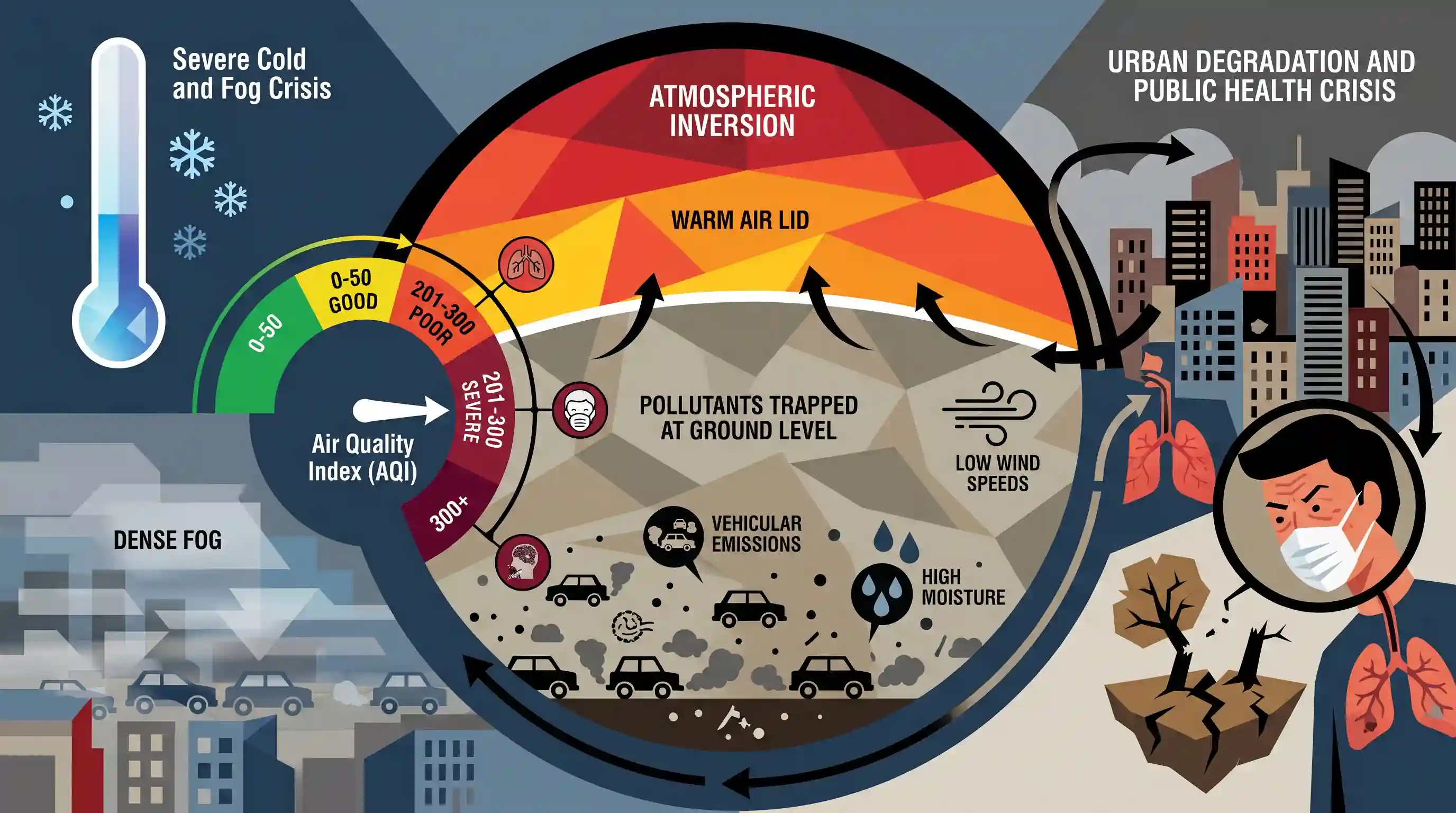
The article reports on the severe winter conditions engulfing Delhi, characterized by the season's first cold wave, dense fog, and a dangerous spike in air pollution. According to the Central Pollution Control Board (CPCB), the Air Quality Index (AQI) has plunged into the "severe" and "very poor" categories across various monitoring stations. The combination of low temperatures, high moisture, and low wind speeds creates an atmospheric inversion that traps local pollutants—particularly vehicular emissions—near the ground. This dual challenge of extreme weather and hazardous air quality highlights the persistent environmental and public health crisis faced by the national capital during the winter months.
Key Points
- Delhi experienced its first cold wave of the season, marked by plummeting temperatures, dense fog, and deteriorating air quality.
- The Air Quality Index (AQI) dropped into the 'severe' and 'very poor' categories across multiple monitoring stations in the capital.
- Data from the Central Pollution Control Board (CPCB) indicated hazardous pollution levels exceeding an AQI of 400 in areas like Jawaharlal Nehru Stadium and ITO.
- Winter meteorological conditions, specifically temperature inversions and low wind speeds, effectively trapped particulate matter close to the surface.
- Research indicates that local traffic emissions and stagnant winter weather are major contributors to daily pollution spikes, compounding the effects of regional agricultural fires.
Important Terms
Air Quality Index (AQI)

A numerical tool used by government agencies to communicate the level of air pollution to the public. In India, it monitors eight pollutants and classifies air quality into six color-coded categories.
UPSC context
GS Paper 3: Environmental Pollution. Tests understanding of pollution metrics, health impacts, and the 'One Number-One Color-One Description' framework.
Central Pollution Control Board (CPCB)
A statutory organization under the Ministry of Environment, Forest and Climate Change (MoEFCC). It is the apex body for coordinating State Pollution Control Boards and setting air and water quality standards.
UPSC context
GS Paper 2: Statutory Bodies. Tests knowledge of environmental governance, regulatory powers under the Water and Air Acts.
Atmospheric Inversion
A meteorological phenomenon where temperature increases with altitude, reversing the normal lapse rate. This creates a stable layer that traps smoke and pollutants near the ground.
UPSC context
GS Paper 1: Climatology. Tests understanding of local weather dynamics, urban heat islands, and their role in seasonal smog episodes.
Cold Wave
A condition marked by a sudden, significant drop in temperature below the normal average for a region. The IMD defines specific criteria based on actual minimums and deviations from the norm.
UPSC context
GS Paper 1: Geography. Tests knowledge of Indian winter patterns, Western Disturbances, and the IMD's warning thresholds for public safety.
Indian Agricultural Research Institute (IARI)
India's premier agricultural research body under ICAR. It monitors farm fires via satellite and developed technologies like the Pusa Decomposer to manage crop residue and reduce air pollution.
UPSC context
GS Paper 3: Agriculture and Environment. Tests awareness of institutional roles in solving stubble burning and technological interventions in farming.
PM2.5
Atmospheric particles with a diameter of less than 2.5 micrometers. These are a primary component of winter smog in Delhi due to their ability to penetrate deep into human lungs.
UPSC context
GS Paper 3: Science and Technology/Environment. Tests understanding of specific pollutants, their health hazards, and sources like vehicular exhaust and biomass burning.
Prelims Trap
"The Central Pollution Control Board (CPCB) is a statutory body established under the Air (Prevention and Control of Pollution) Act, 1981."
CPCB was actually established under the Water (Prevention and Control of Pollution) Act, 1974. It was only later entrusted with powers under the Air Act, 1981.
Static Concepts Connected
What is Temperature Inversion and how does it worsen urban smog?
- Mechanism: The normal lapse rate (temperature falling with height) reverses. Warm air acts as a lid over cold air near the ground.
- Pollutant Trapping: This highly stable atmospheric layer prevents vertical dispersion, trapping particulate matter, vehicular exhaust, and dust close to the surface.
- Winter Factors: Long winter nights, clear skies, and low wind speeds in landlocked regions like Delhi create the ideal conditions for severe surface inversions.
Which 8 pollutants are measured under the National Air Quality Index (AQI)?
- Particulates & Gases: Particulate Matter (PM10 and PM2.5), Nitrogen Dioxide (NO2), Sulphur Dioxide (SO2), Carbon Monoxide (CO), and Ozone (O3).
- Other Pollutants: Ammonia (NH3) and Lead (Pb) complete the list of 8 tracked pollutants.
- Common Exclusion: Carbon Dioxide (CO2) and Methane (CH4) are greenhouse gases that cause global warming, but they are NOT criteria pollutants measured in the AQI.
Cross-Topic Patterns
Agricultural fires + CAQM jurisdiction
Local vehicular emissions compound with cross-border stubble burning. The Commission for Air Quality Management (CAQM) was created specifically to override state pollution boards and tackle this NCR-wide airshed crisis.
Urban Topography + Microclimates
Delhi's bowl-like, landlocked geography prevents coastal breeze dispersion. Its heavy concrete infrastructure creates microclimates that trap heat in summer and surface-level aerosols during winter inversions.

Expect a combined Prelims question linking Temperature Inversion (Geography) with the specific 8 pollutants tracked in the National AQI.
Linked PYQs · 3
Linked PYQs · 3
- 2021MainsGS3
Describe the key points of the revised Global Air Quality Guidelines (AQGs) recently released by the World Health Organisation (WHO). How are these different from its last update in 2005? What changes in India's National Clean Air Programme are required to achieve these revised standards?
- 2022PrelimsGS1
In the context of WHO Air Quality Guidelines, consider the following statements: 1. The 24-hour mean of PM2.5 should not exceed 15 µg/m³ and annual mean of PM2.5 should not exceed 5 µg/m³. 2. In a year, the highest levels of ozone pollution occur during the periods of inclement weather. 3. PM10 can penetrate the lung barrier and enter the bloodstream. 4. Excessive ozone in the air can trigger asthma. Which of the statements given above are correct?
- 2025PrelimsGS1
Artificial way of causing rainfall to reduce air pollution makes use of
