Delhi reviews Heat Action Plan amid severe heatwave warnings
Source:The Hindu ↗
Why It Matters
Heatwaves have emerged as a severe, recurring climate disaster in Indian cities, profoundly impacting informal workers and vulnerable groups. This article serves as a strong case study for GS-3 Disaster Management and GS-2 Public Health answers, illustrating how local governments (through structured Heat Action Plans, DDMA coordination, and primary healthcare mobilization via ASHAs) can proactively mitigate climate-induced health crises.
Summary
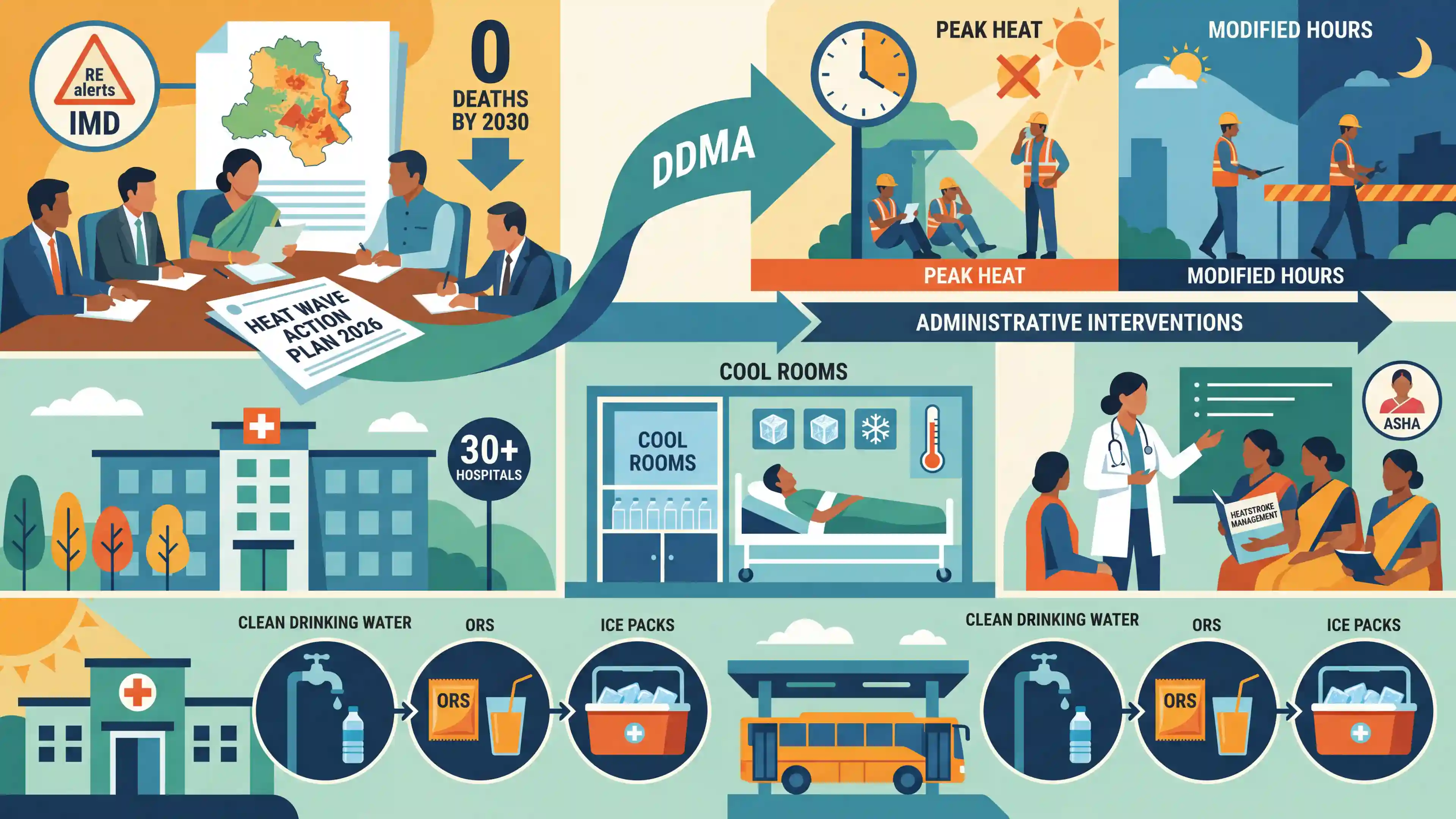
Delhi Chief Minister Rekha Gupta reviewed preparations for the Heat Wave Action Plan 2026 following an IMD heatwave warning. The comprehensive plan, spearheaded by the Delhi Disaster Management Authority (DDMA), aims to reduce heatwave-related deaths to zero by 2030. Key administrative interventions include modifying working hours for vulnerable populations like construction workers, establishing "cool rooms" in over 30 hospitals, and training ASHA workers in heatstroke management. Additional measures guarantee the availability of clean drinking water, ORS, and ice packs across health centers and major public locations.
Key Points
- Delhi's Heat Wave Action Plan 2026, implemented by the DDMA alongside NGOs and knowledge partners, targets zero heatwave-related deaths by 2030.
- The IMD issued a heatwave warning, prompting comprehensive city-wide health and infrastructure reviews chaired by the Chief Minister.
- Healthcare preparedness includes dedicated "cool rooms" in hospitals, 330 equipped ambulances, and the distribution of ORS and ice packs across 339 health centres.
- Frontline health workers, including 174 medical officers and ASHAs, received specialized training for heatstroke management.
- Preventive measures for vulnerable demographics include modifying working hours for construction workers to avoid peak heat and ensuring clean drinking water at public sites like transit stands and schools.
Important Terms
Heat Action Plan (HAP)

A strategic framework designed to mitigate heat-related health risks through early warning systems, inter-departmental coordination, public awareness, and targeted interventions for vulnerable populations like outdoor workers.
UPSC context
GS Paper 3 (Disaster Management) and GS Paper 1 (Climate Change); tests knowledge of climate adaptation and urban governance.
India Meteorological Department (IMD)
The national agency under the Ministry of Earth Sciences responsible for meteorological observations, weather forecasting, and setting official criteria for natural hazards like heatwaves and cyclones.
UPSC context
GS Paper 1 (Geography) and GS Paper 3 (S&T/Disaster Management); essential for understanding institutional roles in weather monitoring.
Delhi Disaster Management Authority (DDMA)
A statutory body under the Disaster Management Act, 2005, responsible for disaster preparedness and response in Delhi. It coordinates between various government agencies and knowledge partners.
UPSC context
GS Paper 3 (Disaster Management); tests understanding of decentralized institutional structures for crisis management under the 2005 Act.
Accredited Social Health Activist (ASHA)
Community health workers under the National Health Mission who serve as grassroots links to the public health system, facilitating maternal care, immunization, and heatstroke surveillance.
UPSC context
GS Paper 2 (Health & Social Justice); vital for understanding frontline health delivery and community-based disaster response.
Heatwave (Criteria)
A weather phenomenon where maximum temperatures reach at least 40°C in plains or deviate 4.5°C to 6.4°C above normal, posing severe health and environmental risks.
UPSC context
GS Paper 1 (Geography); tests awareness of climatic thresholds, causes, and spatial patterns of extreme weather in India.
Urban Heat Island (UHI)
An urban area significantly warmer than its rural surroundings due to concentrated concrete, asphalt, and human activity, which trap heat and reduce natural cooling.
UPSC context
GS Paper 1 (Geography/Urbanization) and GS Paper 3 (Environment); relevant for urban planning and sustainable development strategies.
Prelims Trap
Heatwaves are a notified national disaster under the Disaster Management Act, 2005, making them eligible for NDRF funding.
Heatwaves are NOT notified national disasters under the DM Act. However, states can use up to 10% of their SDRF allocation for localized disasters, including heatwaves.
Static Concepts Connected
What are the IMD criteria for declaring a heatwave in India?
- Plains: Maximum temperature reaches at least 40°C.
- Hilly Regions: Maximum temperature reaches at least 30°C.
- Coastal Stations: Maximum temperature reaches at least 37°C.
- Normal Departure: It is also declared when the departure from the normal temperature is 4.5°C to 6.4°C.
What causes the Urban Heat Island (UHI) effect in metropolitan areas?
- Thermal Mass: Concrete and asphalt have high thermal mass, absorbing and retaining solar radiation longer than natural landscapes.
- Low Albedo: Urban surfaces generally have lower surface reflectivity compared to vegetation, absorbing more heat.
- Anthropogenic Heat: Heat is constantly released from vehicles, air conditioners, and industrial activities.
- Urban Canyon Effect: Tall buildings trap thermal radiation and prevent it from escaping into the night sky.
Cross-Topic Patterns
Climate Change & Occupational Safety
Modifying working hours for construction workers highlights the intersection of climate adaptation and labor rights, directly linking Urban Heat Island impacts to economic productivity and occupational safety (GS2/GS3).
Primary Healthcare in Climate Disasters
Training ASHA workers for heatstroke management shifts disaster response to the grassroots, connecting public health infrastructure (GS2) with decentralized disaster management (GS3).

Expect a 2026 Prelims multi-statement question combining IMD heatwave criteria, UHI mechanisms, and SDRF funding eligibility rules.
Linked PYQs · 4
Linked PYQs · 4
- 2013MainsGS1
Bring out the causes for the formation of heat islands in the urban habitat of the world.
- 2019MainsGS3
Disaster preparedness is the first step in any disaster management process. Explain how hazard zonation mapping will help disaster mitigation in the case of landslides.
- 2022MainsGS1
Discuss the meaning of colour-coded weather warnings for cyclone prone areas given by India Meteorological Department.
- 2021MainsGS2
“Besides being a moral imperative of a Welfare State, primary health structure is a necessary precondition for sustainable development.” Analyze.
