Delhi finalizes action plans for summer and monsoon
Source:Indian Express ↗
Why It Matters
The article provides a practical case study of cooperative administration in Delhi—a Union Territory often characterized by administrative friction between the elected government and the Lieutenant-Governor. It is highly relevant for GS2 (Center-UT relations, role of ULBs) and GS3 (urban flooding, disaster preparedness, and energy infrastructure), demonstrating the multi-agency coordination required to manage complex urban ecosystems.
Summary
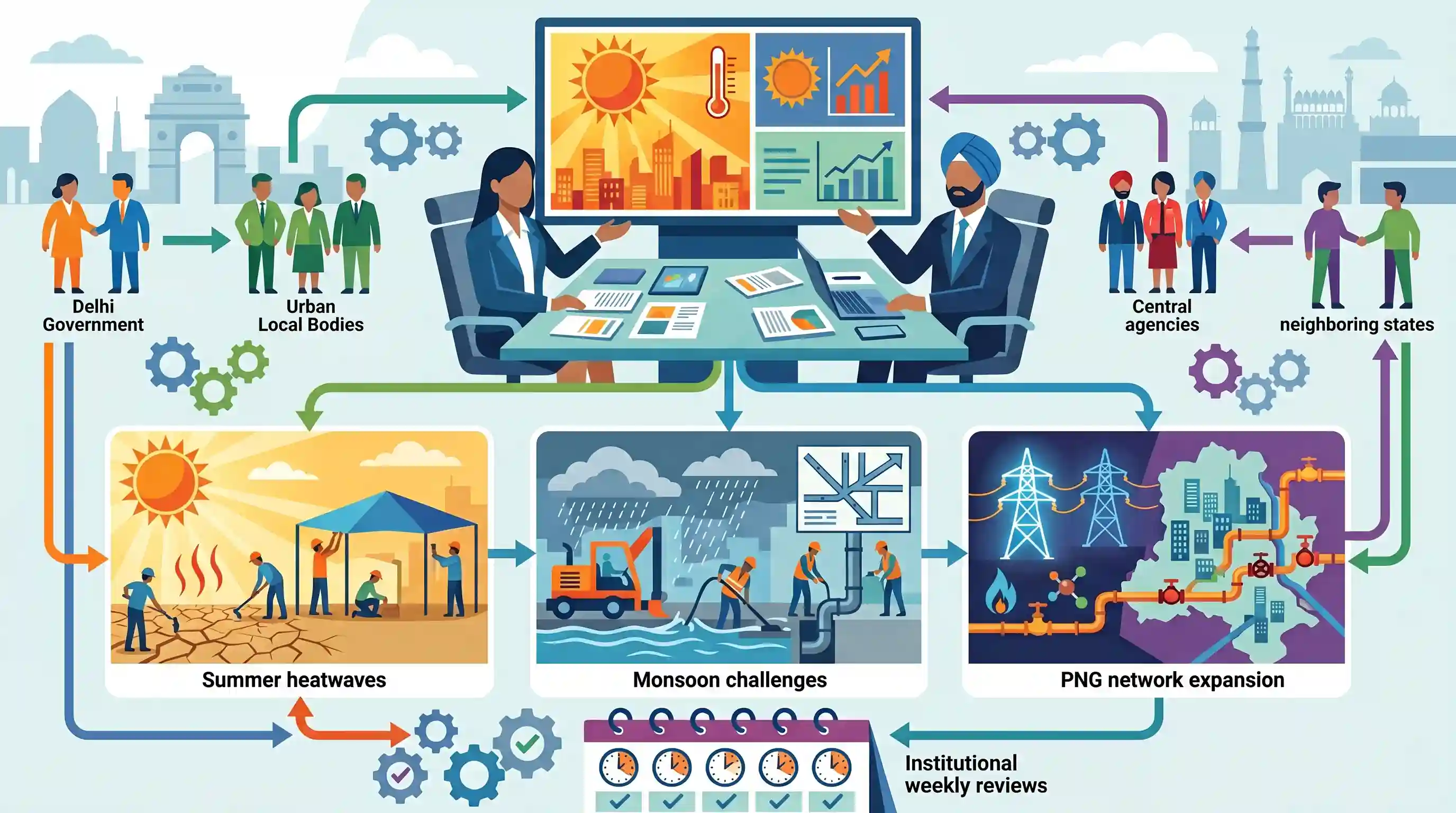
Delhi Chief Minister Rekha Gupta and Lieutenant-Governor Taranjit Singh Sandhu held a high-level meeting to proactively address urban challenges, focusing on summer heatwaves, monsoon flooding, and power supply. The meeting underscored the importance of early preparation, including the timely execution of the drainage master plan and desilting of drains. Enhancing energy security through the expansion of the Piped Natural Gas (PNG) network was also a key agenda item. Crucially, the leaders emphasized seamless coordination between the Delhi Government, Urban Local Bodies (ULBs), Central agencies, and neighboring states, institutionalizing weekly review meetings to ensure efficient governance and preemptive disaster management.
Key Points
- Delhi CM Rekha Gupta and LG Taranjit Singh Sandhu held a high-level review meeting to finalize proactive measures for the upcoming summer and monsoon seasons.
- Key priorities included advancing the drainage master plan, timely desilting of drains to mitigate urban flooding, and strengthening heatwave preparedness.
- The expansion of the Piped Natural Gas (PNG) network was discussed to ensure energy security and address LPG supply chain shortages.
- Both leaders emphasized the need for seamless coordination among Delhi Government departments, ULBs, Central agencies, and neighboring states, establishing a framework for weekly CM-LG review meetings.
Important Terms
Lieutenant-Governor (LG)

The administrative head of a Union Territory appointed by the President. In Delhi, the LG acts on the Council of Ministers' advice except on reserved subjects: public order, police, and land.
UPSC context
GS Paper 2: Indian Polity. Tests federalism, Union Territory administration, and Article 239AA provisions.
Urban Local Bodies (ULBs)
Constitutional local self-government institutions (74th Amendment) responsible for managing urban areas. They handle 18 subjects in the 12th Schedule, including urban planning, sanitation, and water supply.
UPSC context
GS Paper 2: Governance. Tests democratic decentralization and local body functionality.
Drainage Master Plan
A strategic framework for city-wide stormwater and sewage management. Delhi’s plan aims to replace the 1976 version to address modern urbanization and persistent waterlogging via basin-level interventions.
UPSC context
GS Paper 3: Infrastructure and Disaster Management. Tests urban planning and flood mitigation strategies.
Summer Action Plan
A policy strategy (often called Heat Action Plan) to mitigate extreme heat impacts. It involves early warning systems, health advisories, and inter-agency coordination to reduce heat-related morbidity.
UPSC context
GS Paper 3: Disaster Management. Tests climate change adaptation and disaster resilience.
Monsoon Action Plan
A seasonal framework for flood prevention, focusing on desilting drains, managing waterlogging hotspots, and ensuring inter-agency coordination to protect urban infrastructure during the rainy season.
UPSC context
GS Paper 3: Disaster Management. Tests preparedness for seasonal hazards and urban flooding.
Piped Natural Gas (PNG) network
Natural gas delivered via pipelines for domestic and industrial use. It enhances energy security by providing a cleaner, more efficient alternative to LPG and reducing fuel import dependence.
UPSC context
GS Paper 3: Economy/Energy. Tests energy security and clean energy transitions.
Prelims Trap
The Delhi LG is bound by the aid and advice of the Council of Ministers on all State List subjects.
Under Article 239AA, the LG retains discretionary executive power over Police, Public Order, and Land, exempting them from the elected government's purview.
Static Concepts Connected
What are the key constitutional provisions under Article 239AA for Delhi?
- 69th Amendment: Inserted Article 239AA in 1991, designating Delhi as the National Capital Territory with a legislative assembly.
- Reserved Subjects: The elected assembly cannot legislate on Police, Public Order, and Land; these remain under LG/Centre control.
- Parliamentary Supremacy: Parliament retains overriding power to make laws for Delhi on any subject in the State List.
How does NDMA approach Urban Flooding differently from river floods?
- Separate Disaster: NDMA delinked urban flooding from riverine flooding in 2010 due to distinct causes like impermeable catchments.
- Nodal Ministry: The Ministry of Housing and Urban Affairs (MoHUA) is the nodal ministry, unlike Jal Shakti for river floods.
- Proactive Mitigation: Mandates ward-level vulnerability mapping, watershed-based drainage master plans, and pre-monsoon desilting of major stormwater drains.
Cross-Topic Patterns
Fragmented Governance & Urban Floods
Overlapping jurisdictions in UTs (e.g., MCD, DDA, PWD in Delhi) often paralyze disaster response, making administrative friction a direct driver of climate vulnerability.
City Gas & Energy Transition
Expanding PNG networks under the City Gas Distribution (CGD) framework is central to India’s goal of raising natural gas to 15% of its energy mix by 2030.

Expect a Mains GS2/GS3 intersection question on how fragmented UT administration (Article 239AA) exacerbates urban climate disasters.
Linked PYQs · 4
Linked PYQs · 4
- 2024MainsGS3
Flooding in urban areas is an emerging climate-induced disaster. Discuss the causes of this disaster. Mention the features of two such major floods in the last two decades in India. Describe the policies and frameworks in India that aim at tackling such floods.
- 2024MainsGS2
Analyse the role of local bodies in providing good governance at local level and bring out the pros and cons merging the rural local bodies with the urban local bodies.
- 2018MainsGS2
Whether the Supreme Court Judgement (July 2018) can settle the political tussle between the Lt. Governor and elected government of Delhi? Examine.
- 2018MainsGS3
“Access to affordable, reliable, sustainable and modern energy is the sine qua non to achieve Sustainable Development Goals (SDGs).” Comment on the progress made in India in this regard.
