Delhi Lakshmi Yojna Portal and Direct Benefit Transfer for Women
Source:The Hindu ↗
Why It Matters
State-level direct cash transfer programs for women are a major pillar of contemporary social welfare policy in India. The Delhi Lakshmi Yojna is a significant case study because of its 'hybrid cash-plus-savings' design (mandatory fixed deposit component) and highly stringent exclusionary filters, which reflect the evolving administrative attempts to balance universal-style basic income demands with target-oriented fiscal discipline.
Summary
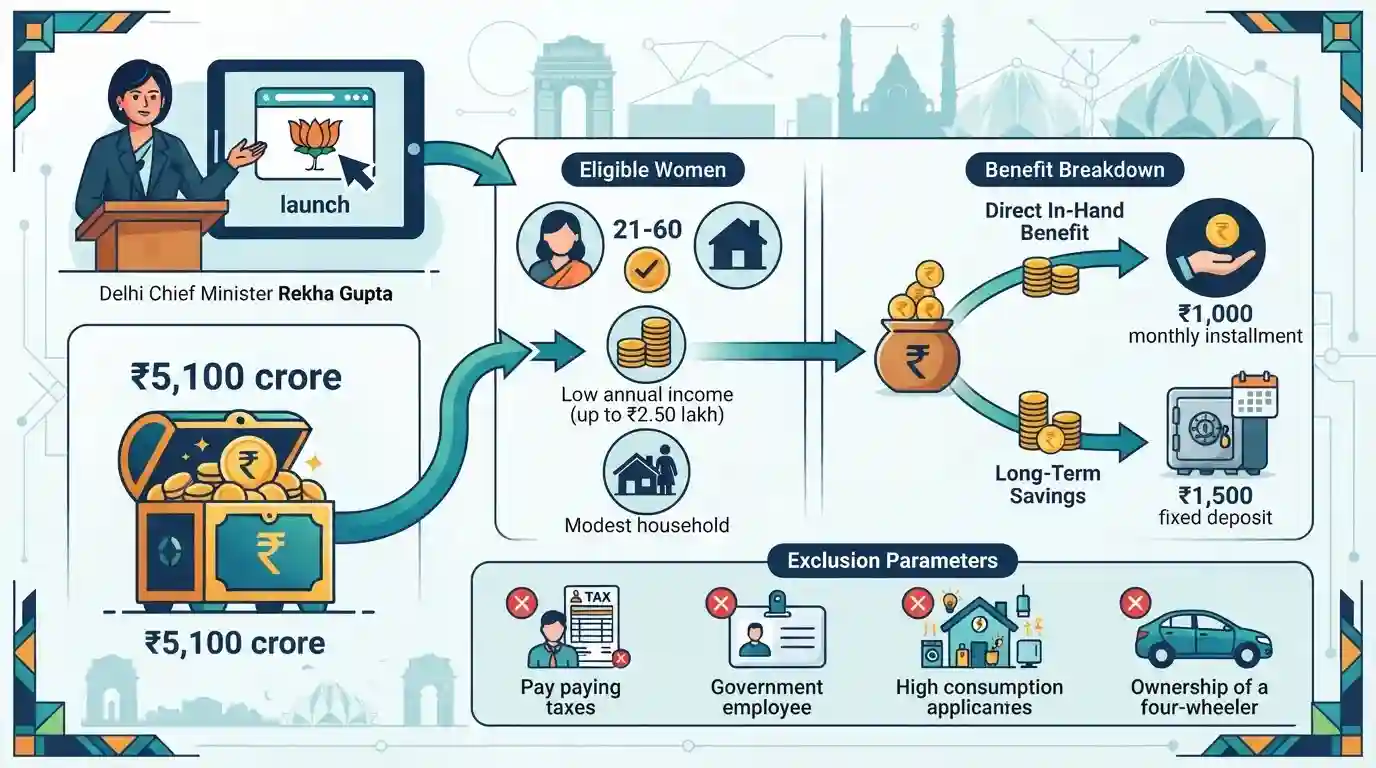
Delhi Chief Minister Rekha Gupta launched the online portal for the 'Delhi Lakshmi Yojna' (or Delhi Laxmi Yojna), a direct benefit transfer welfare scheme. The scheme allocates ₹5,100 crore to provide eligible women aged 21 to 60 from low-income households (income up to ₹2.50 lakh per annum) a monthly financial assistance of ₹2,500. Notably, the scheme utilizes a dual-structure model where ₹1,500 is put into a three-year locked-in fixed deposit to foster long-term savings, while ₹1,000 is given in hand. It implements stringent exclusion parameters, barring taxpayers, government employees, households with high electricity consumption, and families owning four-wheelers.
Key Points
- Delhi Chief Minister Rekha Gupta launched the online portal for the 'Delhi Lakshmi Yojna' to provide monthly financial assistance to eligible women.
- The scheme has a total budgetary allocation of ₹5,100 crore.
- Under the scheme, beneficiaries receive ₹2,500 per month, of which ₹1,500 goes into a fixed deposit with a 3-year lock-in period to encourage savings, and the remaining ₹1,000 is handed over as cash.
- Eligibility is restricted to women aged 21 to 60 with an annual family income of up to ₹2.50 lakh.
- Strict exclusions are in place: taxpayers, government employees, families owning a four-wheeler, families consuming more than 2,400 units of electricity annually, women already receiving other government financial aid, and mothers of more than three living children are excluded.
Important Terms
Delhi Lakshmi Yojana

A welfare scheme of the Delhi government providing eligible low-income women aged 21-60 with monthly financial assistance of ₹2,500 to promote economic empowerment, savings, and financial independence.
UPSC context
GS Paper II: Welfare schemes for vulnerable sections. Tests understanding of targeted fiscal transfers, gender-centric policy interventions, and safety nets.
Direct Benefit Transfer (DBT)
A governance mechanism to transfer subsidies and cash benefits directly into the bank accounts of beneficiaries, reducing leakages, administrative delays, and target errors.
UPSC context
GS Paper III: Inclusive growth and technology. Tests knowledge of public distribution reforms, governance leakage reduction, and financial technology application.
Central Bank Digital Currency (CBDC)
A digital token representing the virtual form of a country's fiat currency, issued and regulated by the central bank (e.g., RBI's Digital Rupee) to ease transactions.
UPSC context
GS Paper III: Indian Economy and technology. Tests understanding of digital economy growth, monetary policy implementation, and sovereign digital currency systems.
Financial Inclusion
The process of ensuring affordable and timely access to essential financial services, such as bank accounts and credit, particularly for vulnerable and low-income segments of society.
UPSC context
GS Paper III: Inclusive growth. Tests knowledge of banking penetration strategies, savings promotion, and formalization of the household economy.
Government of NCT of Delhi
The administrative authority for the National Capital Territory of Delhi, functioning under Article 239AA of the Constitution with unique federal divisions of legislative power.
UPSC context
GS Paper II: Indian Constitution and Federalism. Tests understanding of asymmetric federalism, Union Territory administration, and center-state executive relations.
Prelims Trap
The Delhi Lakshmi Yojna enforces a standard two-child limit, barring any beneficiary with more than two living children.
The scheme actually excludes mothers of *more than three* living children, a deliberate policy choice to mitigate the societal pressure to conceive male heirs.
Static Concepts Connected
What are the core pillars and benefits of India's Direct Benefit Transfer (DBT) mechanism?
- JAM Foundation: Leverages Jan Dhan accounts, Aadhaar biometric verification, and Mobile connectivity to eliminate financial leakages.
- Welfare Efficiency: Minimizes intermediaries, reduces administrative overheads, and ensures targeted delivery of state subsidies.
- Public Finance: Enhances fiscal transparency by maintaining real-time digital audit trails of public expenditures.
How do targeted cash transfers (Quasi-UBI) differ from pure Universal Basic Income?
- Targeting Efficiency: Restricts benefits to vulnerable demographics rather than a universal rollout to reduce fiscal strain.
- Behavioral Incentives: Often features conditionalities (like lock-ins or immunization linkages) to nudge positive socioeconomic outcomes.
- Fiscal Sustainability: Prevents resource dissipation by implementing strict exclusion criteria, such as asset ownership or taxpaying status.
Cross-Topic Patterns
CBDC integration in social welfare
Leveraging the digital rupee (e-Rupee) for targeted cash transfers reduces traditional banking sector reliance and enables offline, programmable welfare delivery.
Policy diffusion via state databases
Delhi's Family Card, modeled on Haryana's Parivar Pehchan Patra, highlights how subnational administrative innovations diffuse horizontally to improve welfare targeting.

State welfare shifts toward dual-savings DBT models and CBDC wallet integrations will likely be tested under digital public infrastructure.
Linked PYQs · 4
Linked PYQs · 4
- 2019MainsGS2
Performance of welfare schemes that are implemented for vulnerable sections is not so effective due to absence of their awareness and active involvement at all stages of policy process. Discuss.
- 2015MainsGS3
In what way could replacement of price subsidy with Direct Benefit Transfer (DBT) change the scenario of subsidies in India ? Discuss.
- 2022MainsGS2
Besides the welfare schemes, India needs deft management of inflation and unemployment to serve the poor and the underprivileged sections of the society. Discuss.
- 2020PrelimsGS1
Which part of the Constitution of India declares the ideal of Welfare State?
