Delhi Government Launches Digital Portal for EV Subsidies
Source:The Hindu ↗
Why It Matters
This development demonstrates a practical intersection of digital governance (paperless portals, DBT) and ecological governance (green urban mobility). It highlights the institutional efforts to overcome adoption friction in electric vehicles by ensuring financial incentives are delivered seamlessly and transparently, while establishing long-term charging infrastructure to address urban air quality concerns.
Summary
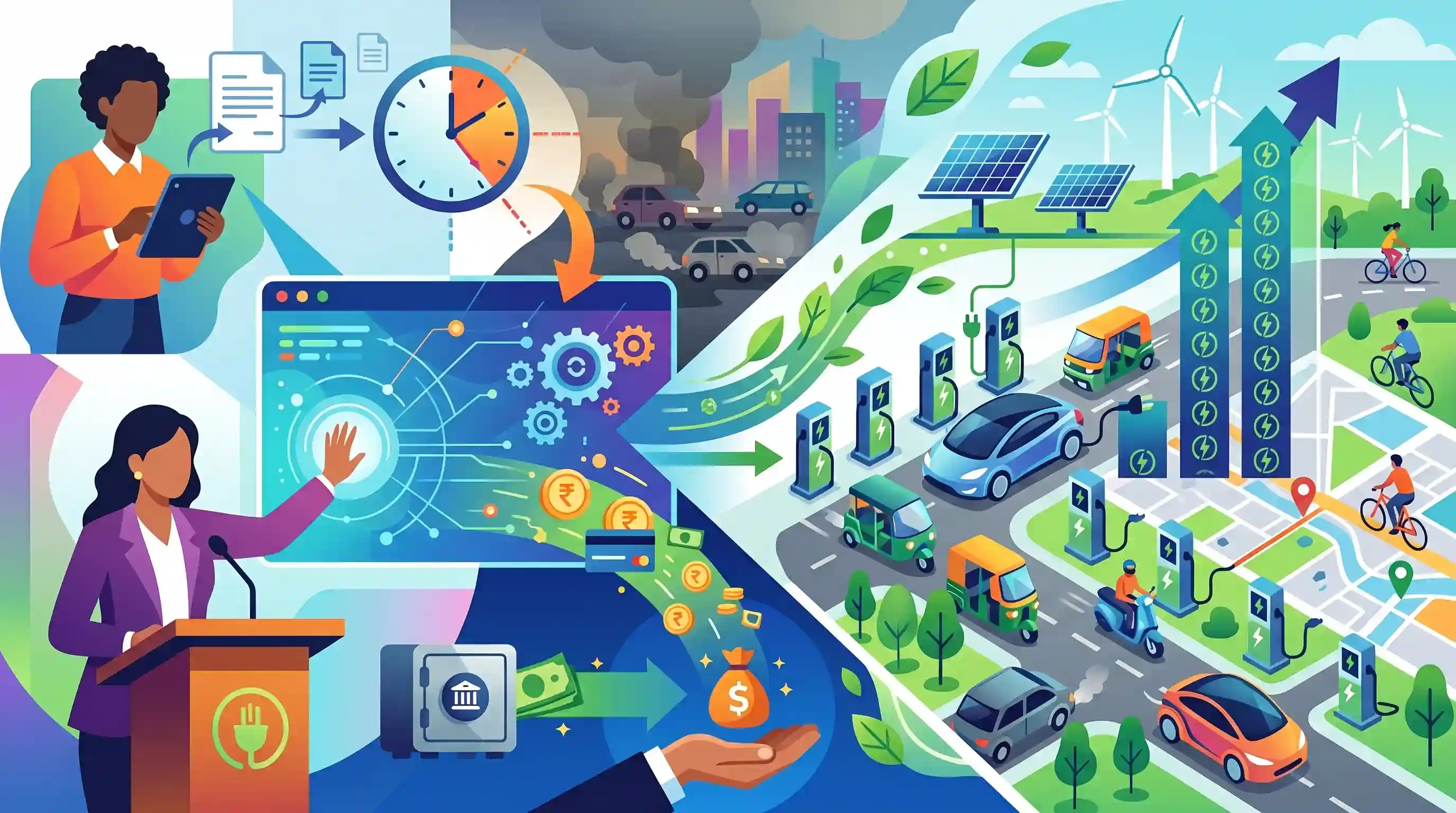
Delhi Chief Minister Rekha Gupta launched the Delhi EV Subsidy Portal to streamline the implementation of the Delhi Electric Vehicle Policy 2026. The fully digital, paperless, and citizen-centric portal enables users to apply for EV subsidies within 30 days of vehicle registration. Under this initiative, the state government aims to disburse subsidies via Direct Benefit Transfer (DBT) directly into beneficiaries' bank accounts within 60 days of application. Furthermore, the portal serves as a unified source for policy guidelines, and the CM announced a target of establishing over 32,000 public EV charging points in the capital by 2030 to bolster the green transition and reduce urban pollution.
Key Points
- Delhi CM Rekha Gupta launched the Delhi EV Subsidy Portal under the Delhi Electric Vehicle Policy 2026, creating a completely digital and paperless platform for EV incentives.
- Eligible beneficiaries can apply for subsidies online within 30 days of vehicle purchase and receiving the Registration Certificate (RC), with real-time tracking of applications.
- The government aims to disburse the subsidies directly into the bank accounts of beneficiaries via Direct Benefit Transfer (DBT) within 60 days of applying.
- The portal acts as a single-window platform for key information on the policy, such as eligibility criteria, approved models, and guidelines for different vehicle categories.
- To resolve charging anxiety and support sustainable mobility, the Delhi Government has committed to developing over 32,000 public EV charging points across the city by 2030.
Important Terms
Direct Benefit Transfer (DBT)

A governance reform mechanism designed to transfer subsidies, pensions, and welfare benefits directly into the Aadhaar-seeded bank accounts of intended beneficiaries, curbing leakages, intermediaries, and administrative delays.
UPSC context
GS Paper II (Welfare schemes, e-governance) and GS Paper III (Indian Economy). Tests understanding of digital delivery reforms.
Delhi Electric Vehicle Policy 2026
A policy framework (2026–2030) that combines purchase incentives, scrapping benefits, and registration mandates to phase out new non-electric two/three-wheelers, aiming to accelerate green mobility transition and reduce urban air pollution.
UPSC context
GS Paper III (Infrastructure, Environment, Energy). Tests comprehension of sub-national policy measures addressing urban emissions.
Delhi EV Subsidy Portal
A citizen-centric, paperless digital portal launched to streamline online applications, verification, and Direct Benefit Transfer (DBT) disbursement of EV incentives to buyers in a time-bound manner under the capital’s 2026 EV policy.
UPSC context
GS Paper II (e-Governance, Citizen charters). Tests application of digital public infrastructure in implementing welfare-incentive systems.
Prelims Trap
The Delhi EV Policy 2026 provides proportional financial subsidies for both hybrid electric vehicles (HEVs) and battery electric vehicles (BEVs).
Unlike central FAME incentives or some state policies, Delhi's EV Policy 2026 completely excludes hybrid models from subsidies to focus purely on battery electric vehicles (BEVs).
Static Concepts Connected
What are the vehicle categories (L, M, N) used under Indian Central Motor Vehicle Rules?
- Category L: Refers to motor vehicles with less than four wheels, including two-wheelers (L1/L2) and three-wheelers like auto-rickshaws (L5).
- Category M: Covers power-driven vehicles with at least four wheels used for carrying passengers, including standard cars (M1) and buses.
- Category N: Represents power-driven vehicles with at least four wheels used for carrying goods, including light (N1) and medium (N2) trucks.
How does Extended Producer Responsibility (EPR) apply to EV batteries?
- Legal Framework: Governed by the Battery Waste Management Rules, 2022, making producers responsible for the collection and recycling of waste batteries.
- Material Recovery: Mandates specific minimum recovery percentages for valuable materials like lithium, cobalt, and nickel from old EV batteries.
- Landfill Ban: Strictly prohibits the disposal of waste batteries in landfills or through incineration, encouraging a circular economy.
Cross-Topic Patterns
EV Transition vs. Fiscal Federalism
State-level EV subsidies and tax exemptions create fiscal pressure, testing the balance between sub-national environmental goals and GST-dependent state revenues.
EV Infrastructure and Grid Integration
Massive expansion of public charging networks intersects with power grid management, requiring smart-charging integrations to avoid localized distribution transformer failures.

State-level EV policies excluding hybrids and mandating ICE phase-out timelines likely to be framed alongside central FAME schemes in 2026.
Linked PYQs · 3
Linked PYQs · 3
- 2023MainsGS3
The adoption of electric vehicles is rapidly growing worldwide. How do electric vehicles contribute to reducing carbon emissions and what are the key benefits they offer compared to traditional combustion engine vehicles?
- 2024MainsGS2
e-governance is not just about the routine application of digital technology in service delivery process. It is as much about multifarious interactions for ensuring transparency and accountability. In this context evaluate the role of the 'Interactive Service Model' of e-governance.
- 2023MainsGS2
e-governance, as a critical tool of governance, has ushered in effectiveness, transparency and accountability in governments. What inadequacies hamper the enhancement of these features ?
