Delhi Blast and NIA Analysis on Online Radicalisation Risks
Source:Indian Express ↗
हे का महत्त्वाचे आहे
It provides crucial analytical depth on the modern manifestation of terrorism in India, shifting from traditional group dynamics to decentralized silent radicalisation via digital channels, which is central to GS3 Internal Security syllabus.
सारांश
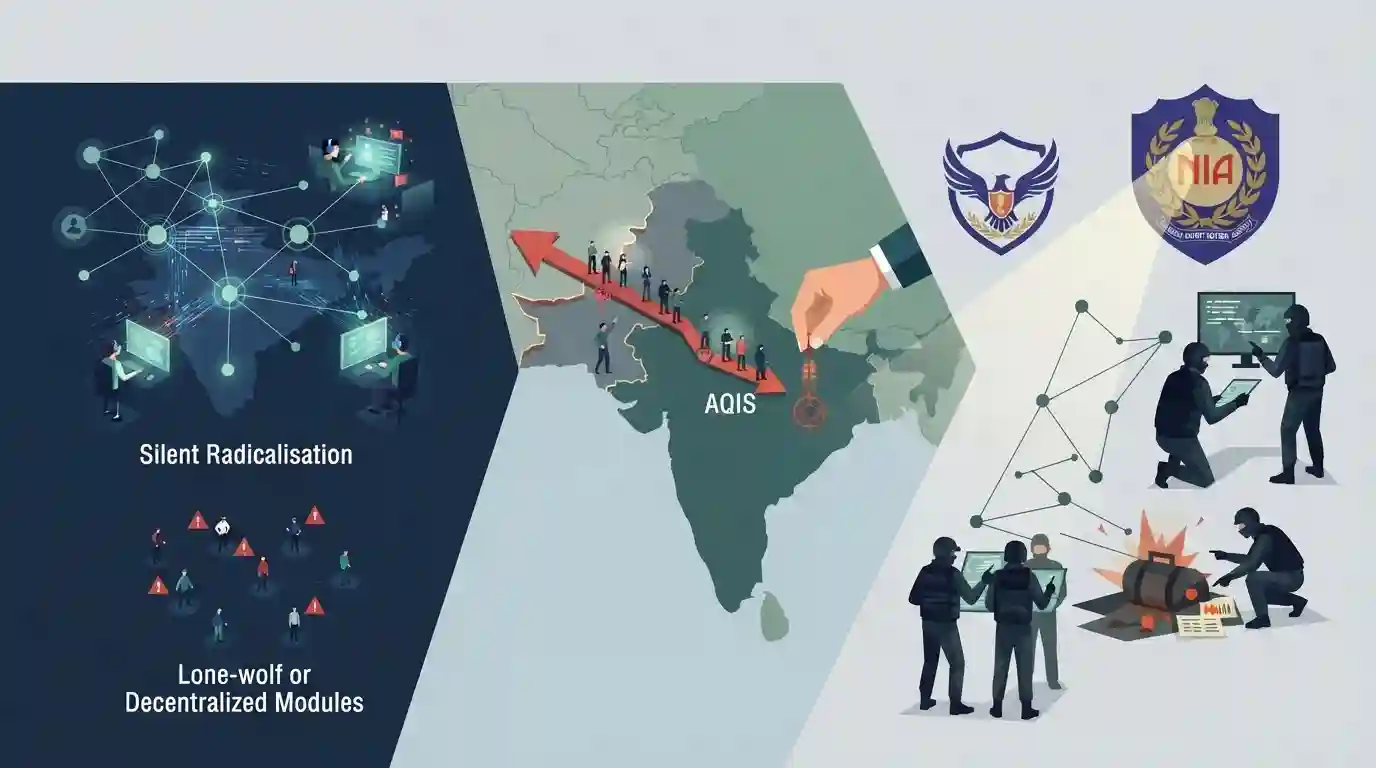
This article discusses the National Investigation Agency's (NIA) findings regarding the Delhi bomb blast, highlighting the evolving nature of internal security threats in India, particularly silent radicalisation, lone-wolf or decentralized modules, and the persistent threat posed by groups like AQIS backed from across the border in Pakistan.
मुख्य मुद्दे
- Analysis of the Delhi bomb blast and findings by the National Investigation Agency (NIA).
- Emergence of silent, self-driven, and online radicalisation posing a grave internal security challenge.
- The role of external terrorist entities like AQIS and cross-border elements based in Pakistan in orchestrating and inspiring terror modules.
- Need for enhanced counter-terrorism mechanisms, coordination among central and state agencies, and monitoring of encrypted digital platforms.
महत्त्वाच्या संज्ञा
National Investigation Agency (NIA)

India's premier federal counter-terrorism investigative agency, established under the NIA Act of 2008 with nationwide jurisdiction to investigate terror-related crimes without requiring prior state government consent.
UPSC context
GS Paper III (Internal Security - Counter-Terrorism Architecture and Role of Federal Agencies).
Al-Qaeda in the Indian Subcontinent (AQIS)
A militant Islamist organization and regional branch of Al-Qaeda established in 2014 to expand jihadist influence and target state actors across South Asia.
UPSC context
GS Paper III (Internal Security - Role of External and Non-State Actors in Cross-Border Terrorism).
Al-Qaeda
A global Sunni Islamist militant extremist network founded by Osama bin Laden in the late 1980s, designated globally as a transnational terrorist entity.
UPSC context
GS Paper III (Internal Security - Global Terrorism Networks and Counter-Terrorism Strategies).
संबंधित स्थिर संकल्पना
What are the primary statutory powers and jurisdiction of the National Investigation Agency (NIA)?
- Statutory Origin: Created under the NIA Act, 2008 in the wake of the 2008 Mumbai terror attacks as a federal counter-terrorism agency.
- Jurisdiction: Empowered to investigate scheduled offences (terror, atomic energy, human trafficking, counterfeit currency) across state boundaries without explicit state consent.
- Special Courts: Enables the constitution of Special Courts for speedy trial of scheduled offences with provisions for safeguarding witnesses.
आंतर-विषय नमुने
Online Radicalisation Meets Digital Privacy Debates
Online radicalisation connects internal security counter-terrorism protocols with IT Act intermediary liability debates and regulatory challenges of encrypted messaging apps.
Cross-Border Terrorism and Neighborhood Security Policy
AQIS and Pakistan-backed cross-border networks link direct counter-terrorism kinetic operations with India's broader neighborhood-first security doctrine and intelligence diplomacy.

Expect a mains analytical question linking digital-era silent radicalisation to the evolving role of central agencies like the NIA.
संबंधित PYQ · 4
संबंधित PYQ · 4
- 2025MainsGS3
Terrorism is a global scourge. How has it manifested in India? Elaborate with contemporary examples. What are the counter measures adopted by the State? Explain.
- 2023MainsGS3
What are the internal security challenges being faced by India? Give out the role of Central Intelligence and Investigative Agencies tasked to counter such threats.
- 2021MainsGS3
Analyse the multidimensional challenges posed by external state and non-state actors, to the internal security of India. Also discuss measures required to be taken to combat these threats.
- 2024MainsGS3
Social media and encrypting messaging services pose a serious security challenge. What measures have been adopted at various levels to address the security implications of social media? Also suggest any other remedies to address the problem.
