Silent Radicalisation and Transnational Terrorism Threats
Source:Indian Express ↗
Why It Matters
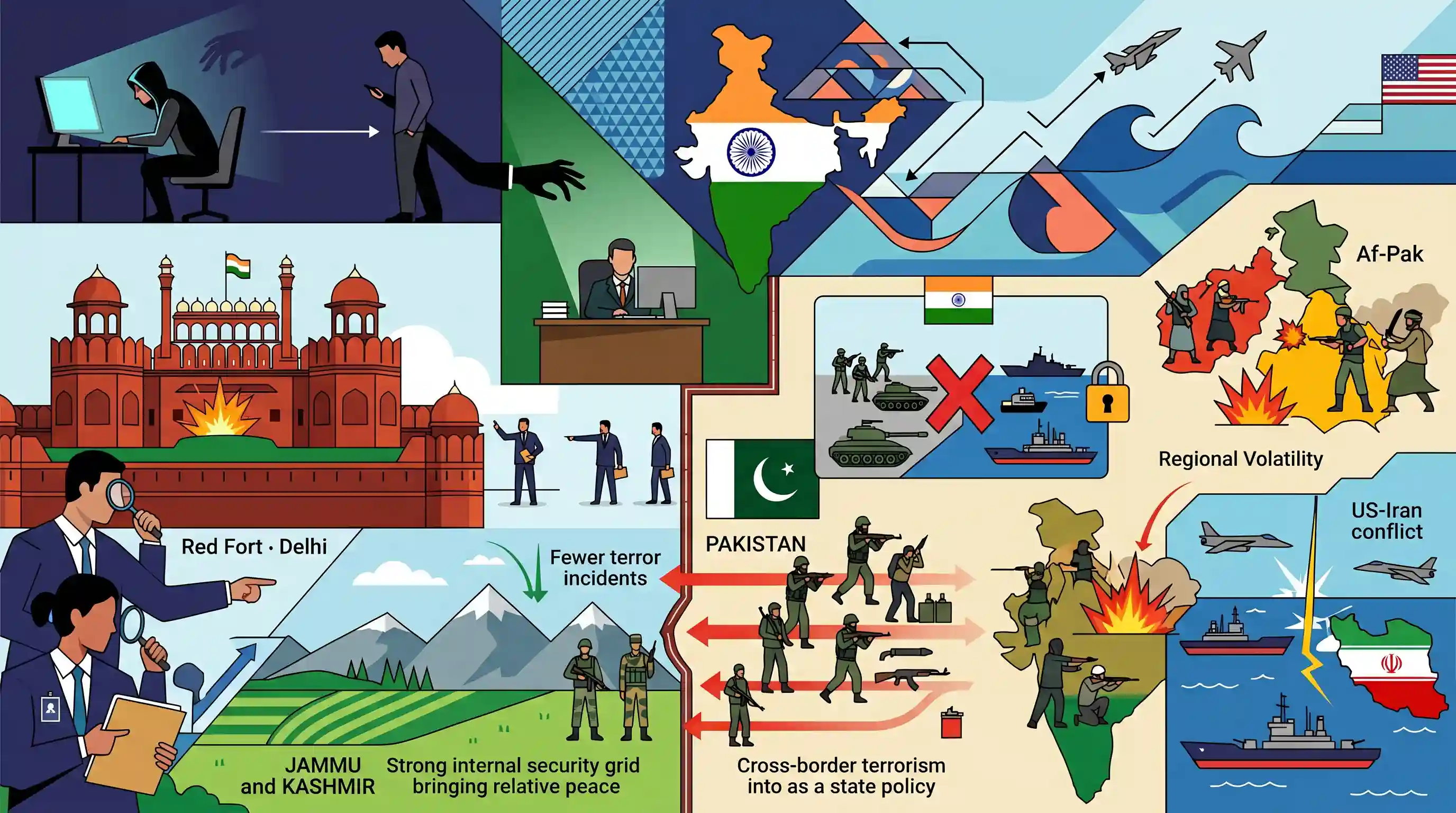
The article provides crucial insights into the evolving nature of proxy warfare, emphasizing the shift towards 'silent radicalisation' and lone-wolf attacks. It also illustrates how domestic security threats in India are deeply intertwined with complex geopolitical developments in South Asia and the Middle East, which is vital for both GS3 (Internal Security) and GS2 (International Relations).
Summary
The National Investigation Agency (NIA) has charged members of an AQIS offshoot for the Delhi Red Fort blast, highlighting the growing challenge of 'silent radicalisation' and lone-wolf attacks orchestrated by Pakistan-based handlers. Despite India's improved internal security grid bringing down terror incidents in Jammu and Kashmir, cross-border terrorism continues as a tool of Pakistan's state policy. The article outlines how broader regional volatility, including the Af-Pak conflict and the US-Iran war, has added complex layers to India's geo-security calculus, forcing India to navigate tricky geopolitical waters and put military responses like 'Operation Sindoor' on hold.
Key Points
- The NIA filed a chargesheet regarding the Red Fort blast, linking the attack to AGuH (an AQIS offshoot), which underscores the threat of silent radicalisation among sections of Kashmiris.
- Pakistan-sponsored groups are increasingly relying on local affiliates to carry out attacks—such as the Pahalgam killings—to polarise India's multi-faith society and provoke disproportionate responses.
- India's diplomatic and internal security measures have effectively reduced terror incidents in J&K, but Pakistan remains committed to its proxy war, including planning hard-to-detect lone-wolf attacks.
- India has put its military response, Operation Sindoor, on hold, as wider geopolitical conflicts—such as the US-Iran war and Pakistan's conflict with Afghanistan—complicate the regional security matrix.
- Pakistan is actively shaping a narrative of being a victim of terrorism from Afghan soil to deflect pressure on its military and leverage its recent diplomatic prominence.
Important Terms
National Investigation Agency (NIA)

India's premier counter-terror law enforcement agency, established under the NIA Act, 2008, following the 26/11 attacks to investigate and prosecute offences affecting national sovereignty, security, and integrity.
UPSC context
GS Paper 3: Internal Security. Crucial for understanding the role of central agencies in countering organized terror modules and inter-state investigations.
Operation Sindoor
A major 2025 tri-service military offensive launched by India targeting terrorist infrastructure in Pakistan and PoJK, following a high-casualty attack in Pahalgam, marking a strategic shift toward 'pre-emptive' multi-domain strikes.
UPSC context
GS Paper 3: Internal Security / GS Paper 2: International Relations. Represents the evolution of India’s counter-terrorism doctrine and cross-border military response strategies.
Ansar Ghazwat-ul-Hind (AGuH)
An Al-Qaeda-affiliated terrorist group active in Jammu and Kashmir, established in 2017 by Zakir Musa; it is an offshoot of AQIS and seeks to establish Sharia rule through violent jihad.
UPSC context
GS Paper 3: Internal Security. Tests knowledge of specific regional terror outfits and their linkages with global extremist organizations like Al-Qaeda.
al Qaeda in the Indian Subcontinent (AQIS)
The regional branch of Al-Qaeda established in 2014, operating across South Asia (India, Pakistan, Afghanistan, etc.) to recruit cadres and coordinate attacks, often through local proxies and 'lone-wolf' radicalisation.
UPSC context
GS Paper 3: Internal Security. Relevant for global terror networks' influence on South Asian security and India's internal threat landscape.
Silent Radicalisation
The process by which individuals, including professionals, adopt extremist ideologies through subtle online/clandestine means without displaying overt radical traits, often culminating in 'lone-wolf' or 'white-collar' terror activities.
UPSC context
GS Paper 3: Challenges to internal security through communication networks and the role of social media in radicalisation.
Tehrik-i-Taliban Pakistan (TTP)
An umbrella organization of various Islamist militant groups based in the Afghan-Pakistani border regions, seeking to overthrow the Pakistani state and impose Sharia, frequently impacting regional security and India's geopolitical interests.
UPSC context
GS Paper 2: International Relations. Critical for understanding South Asian geopolitics, the 'Af-Pak' security dynamic, and its secondary impacts on India.
Prelims Trap
The NIA requires prior consent from the State Government to investigate terror cases like the Delhi blast.
Under the NIA Act, 2008, the agency can take suo motu cognizance of scheduled offences across India without state consent. The 2019 amendment also granted extraterritorial jurisdiction.
Static Concepts Connected
What are the key powers granted by the NIA (Amendment) Act, 2019?
- Extraterritorial reach: Empowered to investigate scheduled offences committed outside India against Indian citizens or affecting India's interests.
- New scheduled offences: Included human trafficking, counterfeit currency, cyber terrorism, and the Explosive Substances Act to its schedule of offenses.
- Special Courts: Allowed the Central government to designate standard Sessions Courts as Special Courts for speedy trials.
How does "Lone Wolf" terrorism overlap with "Hybrid" militancy in Kashmir?
- Lone Wolf: Unaffiliated individuals executing attacks independently, often self-radicalised online without a formal command structure.
- Hybrid Terrorist: Unlisted individuals (students, workers) given a weapon by a handler for a specific targeted attack, then returning to normal life to evade radar.
- The Overlap: Both rely on 'silent radicalisation' and lack prior criminal records, making preventive intelligence gathering exceptionally difficult.
Cross-Topic Patterns
Af-Pak volatility limiting India's strategic options
Rising instability in Afghanistan (Taliban-TTP conflict) and US-Iran tensions restrict India's kinetic retaliatory measures (like Operation Sindoor), forcing a reliance on cautious diplomatic maneuvering over immediate military strikes.
Cyber-security and Silent Radicalisation
The shift towards 'silent radicalisation' highlights the role of encrypted communications and cross-border handlers, bridging traditional border management with modern cyber security challenges.

Expect a 2026 Mains question linking 'silent radicalisation' to hybrid militancy, or a Prelims statement on NIA's expanded powers.
Linked PYQs · 2
Linked PYQs · 2
- 2023MainsGS3
What are the internal security challenges being faced by India? Give out the role of Central Intelligence and Investigative Agencies tasked to counter such threats.
- 2016MainsGS2
Increasing cross-border terrorist attacks in India and growing interference in the internal affairs of several member-states by Pakistan are not conducive for the future of SAARC (South Asian Association for Regional Cooperation)." Explain with suitable examples.
