Delhi Assembly Adopts Solar Power for Sustainable Governance
Source:The Hindu ↗
Why It Matters
Provides an excellent case study for Mains answers on sustainable public infrastructure, e-governance (e-Vidhan), and the decentralization of renewable energy (rooftop solar/net metering) within democratic institutions.
Summary
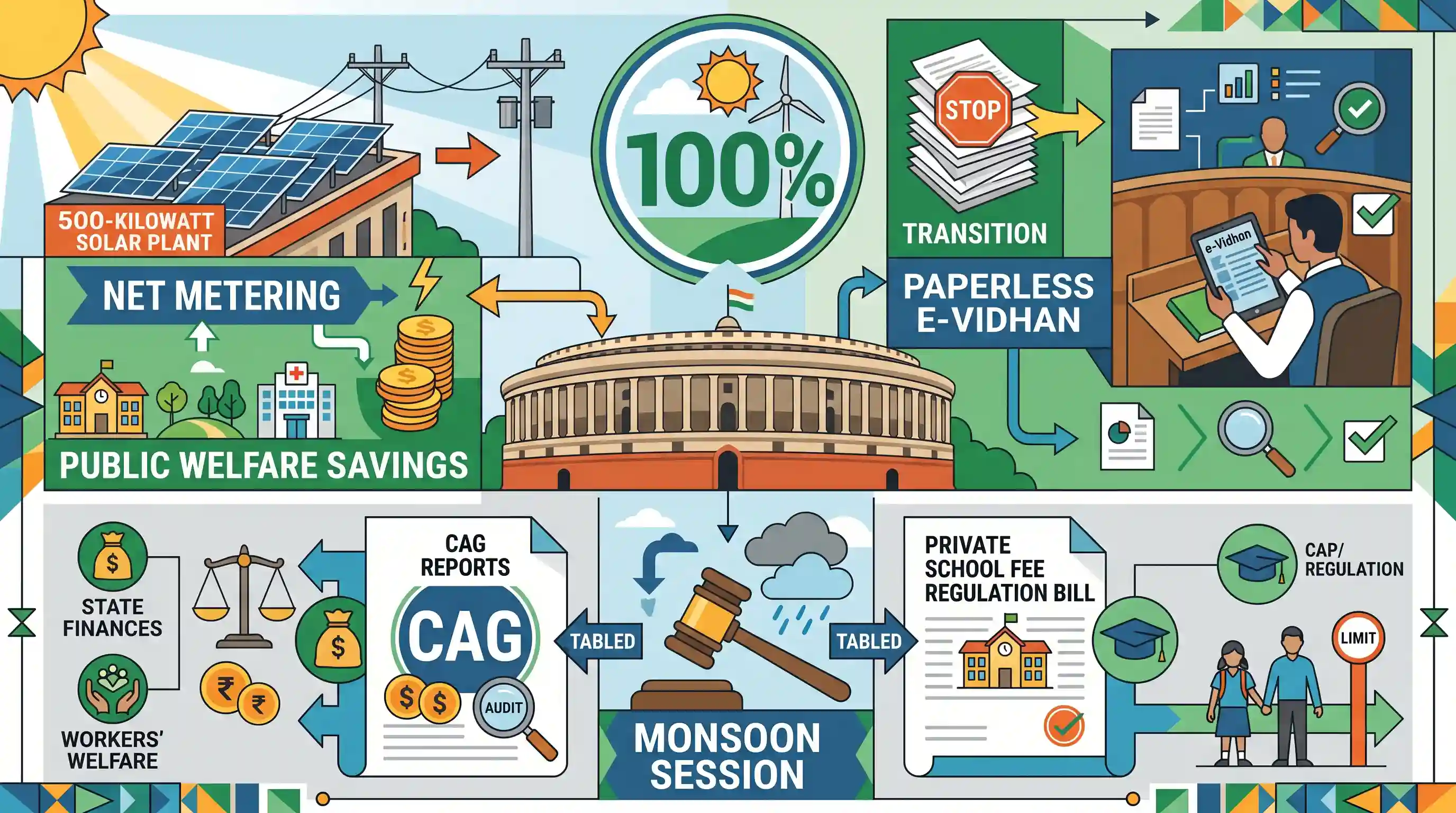
The Delhi Legislative Assembly's Monsoon Session will run entirely on renewable energy, marking a historic first for any legislative body in India. Supported by a new 500-kilowatt rooftop solar plant and net metering, the initiative is expected to generate significant annual savings for public welfare. Coupled with the rollout of the paperless e-Vidhan system, the move highlights a strong push toward sustainable governance and digital empowerment. The session will also feature the tabling of crucial CAG reports and a new bill aimed at regulating private school fees in the Capital.
Key Points
- The Delhi Legislative Assembly is set to become the first in India to operate entirely on solar power, utilizing a new 500-kW rooftop solar plant.
- The solar energy initiative uses net metering and is expected to save ₹1.75 crore annually, with funds to be redirected toward public welfare.
- The Assembly is also adopting the e-Vidhan system to transition into a paperless legislature, merging digital empowerment with climate responsibility.
- CAG reports on State Finances (2023-24) and the Welfare of Building and Construction Workers will be tabled during the session.
- The Delhi School Education (Transparency in Fixation and Regulation of Fees) Bill, 2025, will be introduced to regulate fee hikes in private schools.
Important Terms
National e-Vidhan Application (NeVA)

A Digital India mission-mode project aimed at making all Indian legislatures paperless. It enables digital management of legislative business, including bills, notices, and reports, on a unified platform.
UPSC context
GS Paper 2 (Governance/E-Governance). Tests understanding of digital reforms in legislative transparency and efficiency.
Delhi School Education (Transparency in Fixation and Regulation of Fees) Bill, 2025
Legislation aimed at preventing arbitrary private school fee hikes in Delhi. It mandates prior government approval for increases and establishes a three-tier oversight system involving parents and officials.
UPSC context
GS Paper 2 (Education/Social Justice). Relevant for regulatory frameworks and government oversight of private service providers.
Comptroller and Auditor General of India (CAG)
A constitutional authority (Article 148) responsible for auditing all government receipts and expenditures. Reports on state accounts are submitted to the Governor to be tabled in the State Legislature.
UPSC context
GS Paper 2 (Constitutional Bodies). Fundamental for financial accountability and the legislature's power over the executive.
Net Metering
A billing mechanism allowing solar energy users to feed surplus electricity into the grid. Users receive credits that offset their consumption costs, promoting decentralized renewable energy adoption.
UPSC context
GS Paper 3 (Energy/Environment). Important for renewable energy policy and India's transition to green energy.
Delhi Legislative Assembly
The legislative body of Delhi; recently became the first in India to run entirely on solar power via a 500-kW rooftop plant and implemented paperless proceedings.
UPSC context
GS Paper 2 (State Legislature). Contextualized as a model for green governance and digital transformation.
Prelims Trap
"The CAG submits Delhi's audit reports directly to the Chief Minister or Assembly Speaker."
Under Article 151 and the GNCTD Act, the CAG submits audit reports relating to Delhi's finances to the Lieutenant Governor (LG), who is then mandated to lay them before the Assembly.
Static Concepts Connected
What is 'Net Metering' in the context of renewable energy?
- Grid integration: A billing mechanism that credits solar energy system owners for the surplus electricity they add to the public grid.
- Financial incentive: Consumers pay only for the net electricity drawn from the grid, significantly reducing utility bills and incentivizing rooftop solar adoption.
How does the National e-Vidhan Application (NeVA) function?
- Nodal Ministry: It is a Mission Mode Project under the Digital India Programme, implemented centrally by the Ministry of Parliamentary Affairs.
- Core Objective: Aims to transform all State Legislatures into 'paperless' assemblies on a single, unified digital platform, promoting legislative transparency.
Cross-Topic Patterns
E-Governance meets Climate Action
The transition to NeVA (paperless) combined with 100% solar operations demonstrates how Digital India missions are actively converging with India's UNFCCC 'Panchamrit' targets at the sub-national level.
Education in the Concurrent List
Delhi's private school fee bill invokes Entry 25 of the Concurrent List. State legislation on such subjects often triggers Article 254 (repugnancy), an enduring UPSC polity theme.

Net Metering mechanisms paired with sub-national climate targets or NeVA nodal ministry details are prime multi-statement prelims targets.
Linked PYQs · 4
Linked PYQs · 4
- 2024MainsGS2
e-governance is not just about the routine application of digital technology in service delivery process. It is as much about multifarious interactions for ensuring transparency and accountability. In this context evaluate the role of the 'Interactive Service Model' of e-governance.
- 2023MainsGS2
e-governance, as a critical tool of governance, has ushered in effectiveness, transparency and accountability in governments. What inadequacies hamper the enhancement of these features ?
- 2016MainsGS3
Give an account of the current status and the targets to be achieved pertaining to renewable energy sources in the country. Discuss in brief the importance of National Programme on Light Emitting Diodes (LEDs).
- 2022MainsGS3
Do you think India will meet 50 percent of its energy needs from renewable energy by 2030 ? Justify your answer. How will the shift of subsidies from fossil fuels to renewables help achieve the above objective ? Explain.
