Delhi assembly budget session cancellation and education bill
Source:The Hindu ↗
Why It Matters
It highlights the procedural aspects of legislative assembly sessions (prorogation and deferment) and showcases state-level governance efforts to regulate the private education sector through legislative bills.
Summary
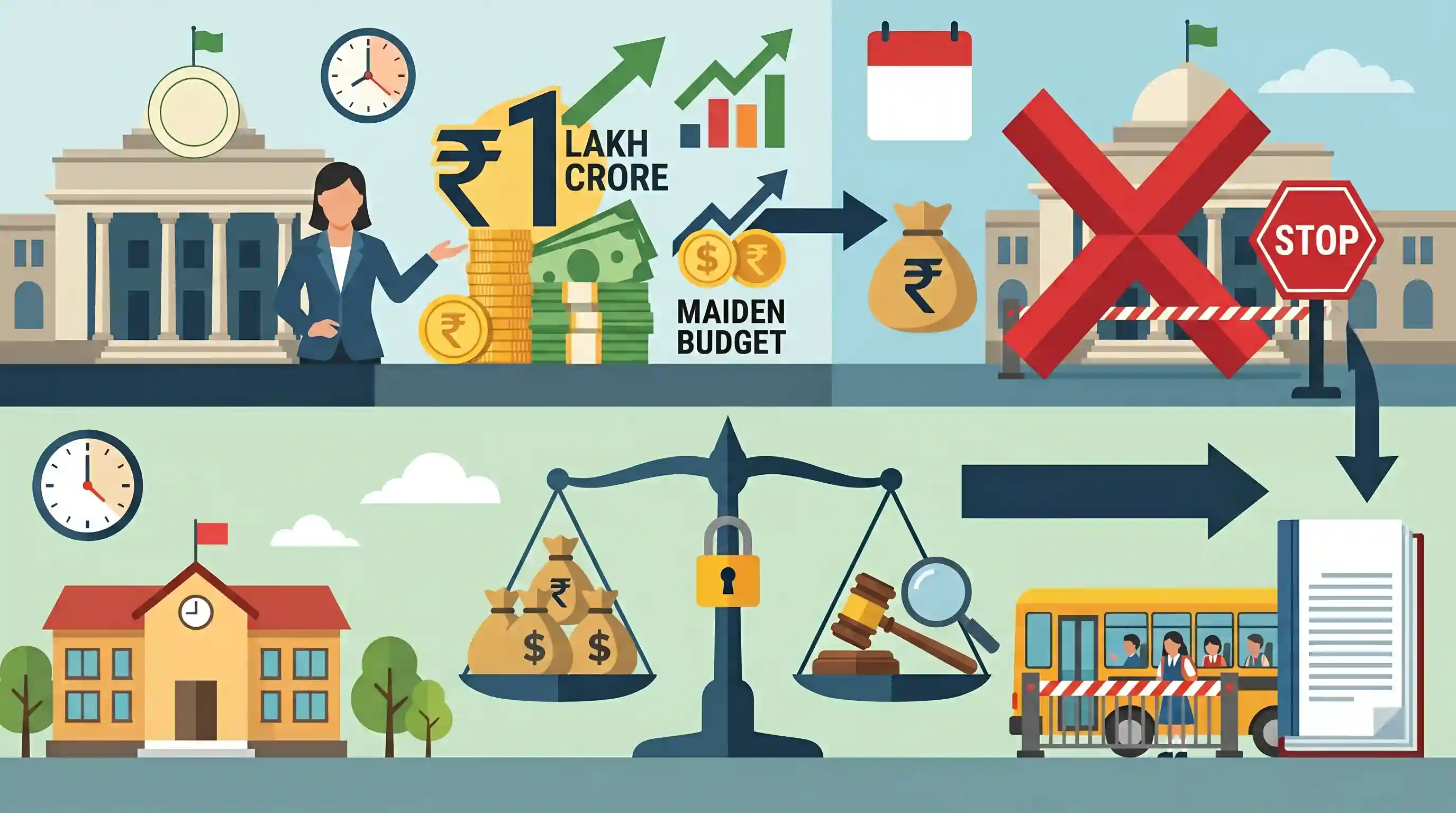
The Delhi Assembly has cancelled the second part of its budget session, which was scheduled to begin on May 13, 2025. The session was poised to introduce the Delhi School Education Transparency in Fixation and Regulation of Fees Bill, 2025, a crucial piece of legislation aimed at regulating private school fees. Previously, during the first part of the session in March, Chief Minister Rekha Gupta presented a maiden budget with a significant ₹1 lakh crore outlay. The deferment impacts immediate legislative actions regarding education regulation and public finance in the Union Territory.
Key Points
- The Delhi Assembly cancelled the second part of its budget session scheduled to start on May 13.
- The session was intended to table the Delhi School Education Transparency in Fixation and Regulation of Fees Bill, 2025 to regulate private school fees.
- The first part of the budget session took place in March, where Chief Minister Rekha Gupta presented her maiden budget.
- The 2025-26 budget for Delhi featured an outlay of ₹1 lakh crore, reflecting a 31.5% increase.
Important Terms
Delhi School Education Transparency in Fixation and Regulation of Fees Bill, 2025

Proposed legislation to regulate private school fees via a three-tier oversight system, aiming to prevent arbitrary hikes and ensure financial transparency in Delhi's education sector.
UPSC context
GS II: Social Justice/Education; tests understanding of government regulation in the private sector and legislative attempts to ensure affordable education.
Delhi Legislative Assembly
The elected law-making body of the National Capital Territory of Delhi, established under Article 239AA with powers to legislate on State and Concurrent List subjects except land, police, and public order.
UPSC context
GS II: Indian Constitution/Union Territories; crucial for understanding the special federal status and jurisdictional powers of the NCT government.
Article 239AA
Inserted by the 69th Amendment Act, 1991, this provision grants special status to Delhi, providing it with a Legislative Assembly and a Council of Ministers headed by a Chief Minister.
UPSC context
GS II: Indian Constitution; a core topic regarding the division of powers between the Union-appointed LG and the elected Delhi government.
Budget Session
The primary legislative session where the government presents the Annual Financial Statement (Budget) for the upcoming fiscal year for debate, scrutiny, and approval by the house.
UPSC context
GS II: Parliament and State Legislatures; involves legislative procedures, financial control over the executive, and the passage of Appropriation Bills.
Lieutenant Governor (LG) of Delhi
The constitutional head of the NCT of Delhi, appointed by the President, who acts on the 'aid and advice' of the Council of Ministers except in matters of land, police, and public order.
UPSC context
GS II: Executive/Federalism; focuses on the dual-governance model of Delhi and frequent administrative conflicts between the LG and the elected executive.
Consolidated Fund of the Union Territory
A fund established for Union Territories with a legislature (like Delhi), where all revenue, loans, and grants are credited and from which expenditure is authorized by law.
UPSC context
GS III: Public Finance/Budgeting; tests knowledge of fiscal federalism and the financial autonomy of Union Territories with their own legislatures.
Prelims Trap
"Delhi's budget session is summoned on the binding advice of the Council of Ministers."
Under the GNCTD (Amendment) Act 2023, the LG exercises sole discretionary power in summoning and proroguing the Assembly, bypassing binding Cabinet advice.
Static Concepts Connected
How does Delhi's budget process differ from a standard State budget?
- Prior Approval: Unlike full-fledged states, Delhi's Annual Financial Statement mandates prior approval from the President (via MHA) before presentation to the Assembly.
- LG's Discretion: The LG holds sole discretionary power over summoning, proroguing, and dissolving the Assembly, completely bypassing the aid and advice of the Delhi Cabinet.
Can the State legally regulate private unaided school fees?
- Constitutional Autonomy: Private unaided educational institutions enjoy autonomy to determine their fees under Article 19(1)(g) of the Constitution.
- Regulatory Limits: Supreme Court rulings (e.g., TMA Pai) allow state governments to regulate fees solely to prevent 'profiteering' and the charging of 'capitation fees'.
- Legislative Competence: Education falls under Entry 25 of the Concurrent List, empowering State/UT legislatures to enact laws on school fee regulation.
Cross-Topic Patterns
Asymmetric Federalism & Article 239AA
Delhi's administrative limitations often feature in comparative questions against standard gubernatorial powers under Article 163 and the broader theme of asymmetric federalism.
Budget Process & DRSCs
Canceling the second part of a budget session bypasses the traditional recess meant for detailed scrutiny of Demands for Grants by Departmentally Related Standing Committees.

Expect a 2026 prelims question combining LG's discretionary summoning powers and the prior-approval mandate for Delhi's budget.
Linked PYQs · 4
Linked PYQs · 4
- 2019PrelimsGS1
With reference to the Legislative Assembly of a State in India, consider the following statements : 1. The Governor makes a customary address to Members of the House at the commencement of the first session of the year. 2. When a State Legislature does not have a rule on a particular matter, it follows the Lok Sabha rule on that matter. Which of the statements given above is/are correct?
- 2025MainsGS2
Discuss the nature of Jammu and Kashmir Legislative Assembly after the Jammu and Kashmir Reorganization Act, 2019. Briefly describe the powers and functions of the Assembly of the Union Territory of Jammu and Kashmir.
- 2022MainsGS2
The Right of Children to Free and Compulsory Education Act, 2009 remains inadequate in promoting incentive-based system for children's education without generating awareness about the importance of schooling. Analyse.
- 2021MainsGS3
Distinguish between Capital Budget and Revenue Budget. Explain the components of both these Budgets.
