Delhi Air Pollution Reaches Hazardous Levels Triggering GRAP Stage IV
Source:Indian Express ↗
Why It Matters
Air pollution in Northern India, particularly in the Delhi-NCR region, is a recurring and severe environmental crisis. It is directly linked to the UPSC syllabus regarding environmental conservation, pollution, and its immense impact on public health and the economy. The recurring failure to mitigate this crisis underscores the challenges of governance, inter-state coordination, and policy execution (like GRAP and NCAP), making it a high-probability topic for both Prelims and Mains.
Summary
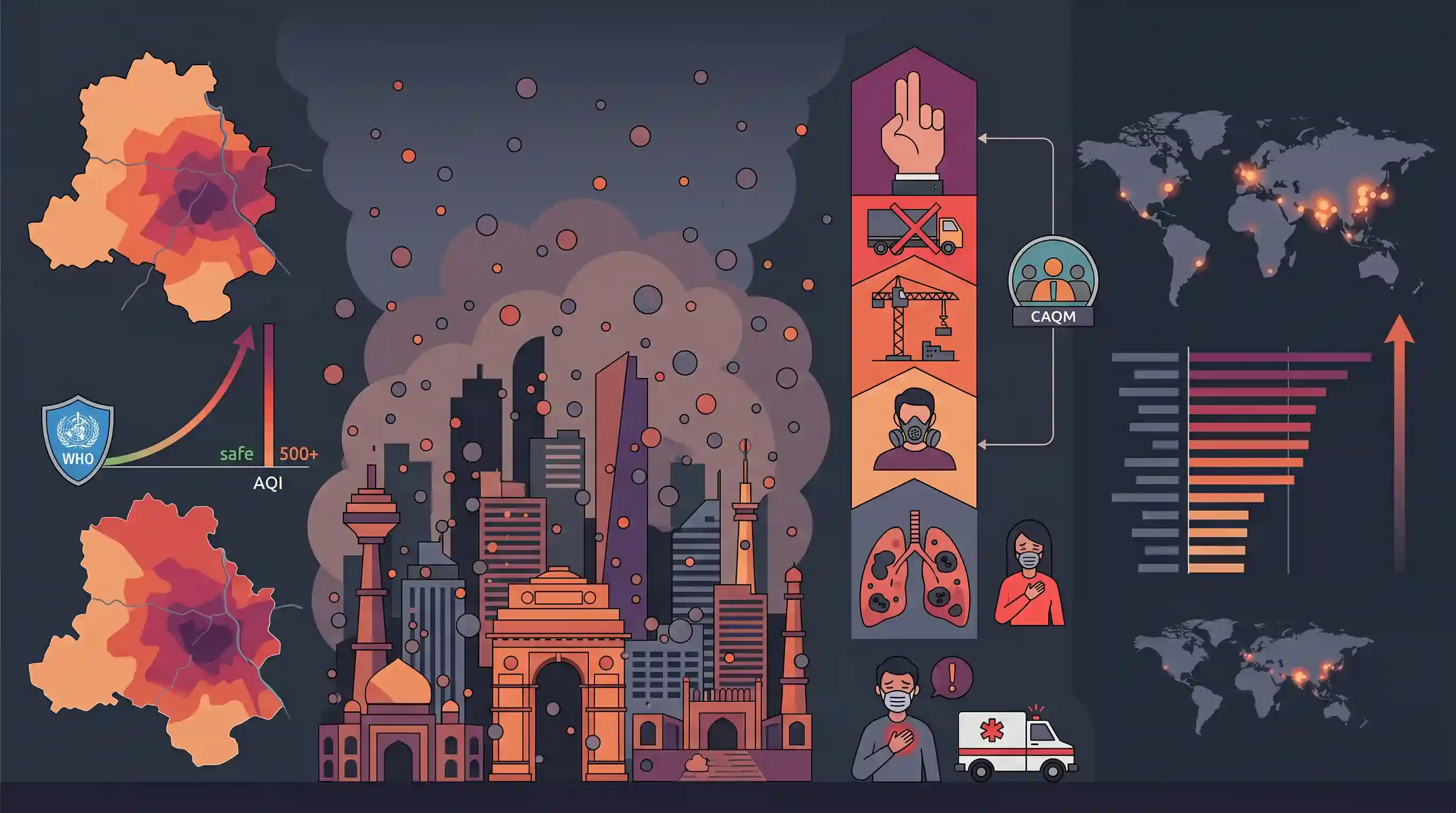
Delhi and its surrounding National Capital Region (NCR) are experiencing a severe and hazardous surge in air pollution, with the Air Quality Index (AQI) crossing the 500 mark and particulate matter (PM 2.5 and PM 10) levels far exceeding World Health Organization (WHO) safety guidelines. In response to the crisis, the Commission for Air Quality Management (CAQM) has implemented Stage IV of the Graded Response Action Plan (GRAP-4). Health experts warn of a critical public health emergency as the toxic air is causing severe, life-threatening conditions. Data indicates that Indian cities heavily dominate the list of the world's most polluted urban areas.
Key Points
- Air quality in Delhi-NCR plummeted to hazardous levels on November 19, 2025, with PM 2.5 and PM 10 readings massively exceeding WHO safety limits.
- The Commission for Air Quality Management (CAQM) has enforced the highest level of emergency measures, Graded Response Action Plan Stage IV (GRAP-4), in Delhi to mitigate pollution.
- Medical professionals at AIIMS labeled the situation a severe public health emergency, reporting an increase in life-threatening cases affecting multiple organs.
- Real-time trackers revealed that 59 of the top 60 most polluted cities in the world were in India, with Nagli Bahrampur in UP topping the list with an AQI of 1030.
Important Terms
Graded Response Action Plan (GRAP)

An emergency framework for Delhi-NCR that mandates specific anti-pollution measures based on Air Quality Index (AQI) thresholds. Stage IV (Severe+) triggers strict bans on construction and heavy vehicle entry.
UPSC context
GS Paper III: Environment (Pollution). Relevant for emergency environmental governance and judicial interventions in the National Capital Region.
Commission for Air Quality Management (CAQM)
A statutory body established in 2021 to oversee and coordinate air quality management in Delhi-NCR and adjoining states. It has binding powers over state and central authorities.
UPSC context
GS Paper II: Governance (Statutory Bodies) and GS Paper III: Environment. Tests knowledge of institutional frameworks for environmental regulation.
National Capital Region (NCR)
A multi-state planning region centered on Delhi, including districts from Haryana, Uttar Pradesh, and Rajasthan. It was established for coordinated urban development and infrastructure planning.
UPSC context
GS Paper I: Urbanization and GS Paper II: Federalism. Relevant for regional planning and inter-state coordination challenges.
Air Quality Index (AQI)
A numerical scale (0–500) used to communicate daily air quality. In India, it monitors eight pollutants (e.g., PM2.5, SO2, CO) using a "one number, one color, one description" format.
UPSC context
GS Paper III: Environment. Tests ability to interpret environmental indicators and health-related pollution metrics.
Particulate Matter (PM 2.5 & PM 10)
Microscopic inhalable particles suspended in the air. PM 2.5 (≤2.5 micrometers) is especially dangerous because it can penetrate the lung barrier and enter the bloodstream.
UPSC context
GS Paper III: Environment and Science. Fundamental for understanding health impacts and scientific measurement of urban pollution.
WHO Air Quality Guidelines
Global health-based recommendations for pollutant limits established by the WHO. These benchmarks are significantly stricter than India’s national standards and guide international public health policies.
UPSC context
GS Paper II: Global Institutions and GS Paper III: Environment. Tests comparative understanding of national vs. international standards.
Prelims Trap
"Carbon dioxide (CO2) and Methane (CH4) are included in the calculation of India's National Air Quality Index (AQI)."
India's AQI measures 8 specific pollutants: PM10, PM2.5, NO2, SO2, CO, O3, NH3, and Lead (Pb). Greenhouse gases like CO2 are NOT part of AQI.
Static Concepts Connected
What is the mandate and authority of the Commission for Air Quality Management (CAQM)?
- Statutory Body: CAQM is a statutory body created under the CAQM in NCR and Adjoining Areas Act, 2021.
- Replaced EPCA: It replaced the Supreme Court-mandated Environment Pollution (Prevention and Control) Authority (EPCA).
- Overriding Powers: Its orders supersede those of the Central Pollution Control Board (CPCB) and State Pollution Control Boards in cases of conflict regarding NCR air quality.
How do India's National Ambient Air Quality Standards (NAAQS) compare with WHO limits?
- WHO Guidelines: The 2021 WHO guidelines set the safe annual limit for PM2.5 at 5 µg/m³ and the 24-hour limit at 15 µg/m³.
- Indian Standards: India's standards are far more relaxed, capping PM2.5 limits at 40 µg/m³ (annual) and 60 µg/m³ (24-hour).
Cross-Topic Patterns
Stubble Burning & MSP Regime
Crop residue burning in Punjab and Haryana is heavily tied to paddy cultivation, which is largely driven by India's MSP regime, open-ended procurement, and state-subsidized electricity policies.
Physical Geography & Temperature Inversion
Delhi's winter pollution severity is exacerbated by physical geography, specifically winter temperature inversion, a landlocked continental location, and wind patterns carrying particulate matter from adjacent agricultural states.

Expect a 2026 multi-statement Prelims question contrasting India's NAAQS parameters with WHO's 2021 limits and the statutory powers of CAQM.
Linked PYQs · 2
Linked PYQs · 2
- 2022PrelimsGS1
In the context of WHO Air Quality Guidelines, consider the following statements: 1. The 24-hour mean of PM2.5 should not exceed 15 µg/m³ and annual mean of PM2.5 should not exceed 5 µg/m³. 2. In a year, the highest levels of ozone pollution occur during the periods of inclement weather. 3. PM10 can penetrate the lung barrier and enter the bloodstream. 4. Excessive ozone in the air can trigger asthma. Which of the statements given above are correct?
- 2021MainsGS3
Describe the key points of the revised Global Air Quality Guidelines (AQGs) recently released by the World Health Organisation (WHO). How are these different from its last update in 2005? What changes in India's National Clean Air Programme are required to achieve these revised standards?
