Delhi Air Quality Index Deterioration and Winter Smog Crisis
Source:Indian Express ↗
Why It Matters
The annual air pollution crisis in Delhi-NCR is a recurring case study for UPSC, illustrating the intersection of geography (winter temperature inversion), agriculture (stubble burning), urban planning (vehicular emissions), and environmental governance (NCAP, GRAP, CPCB standards).
Summary
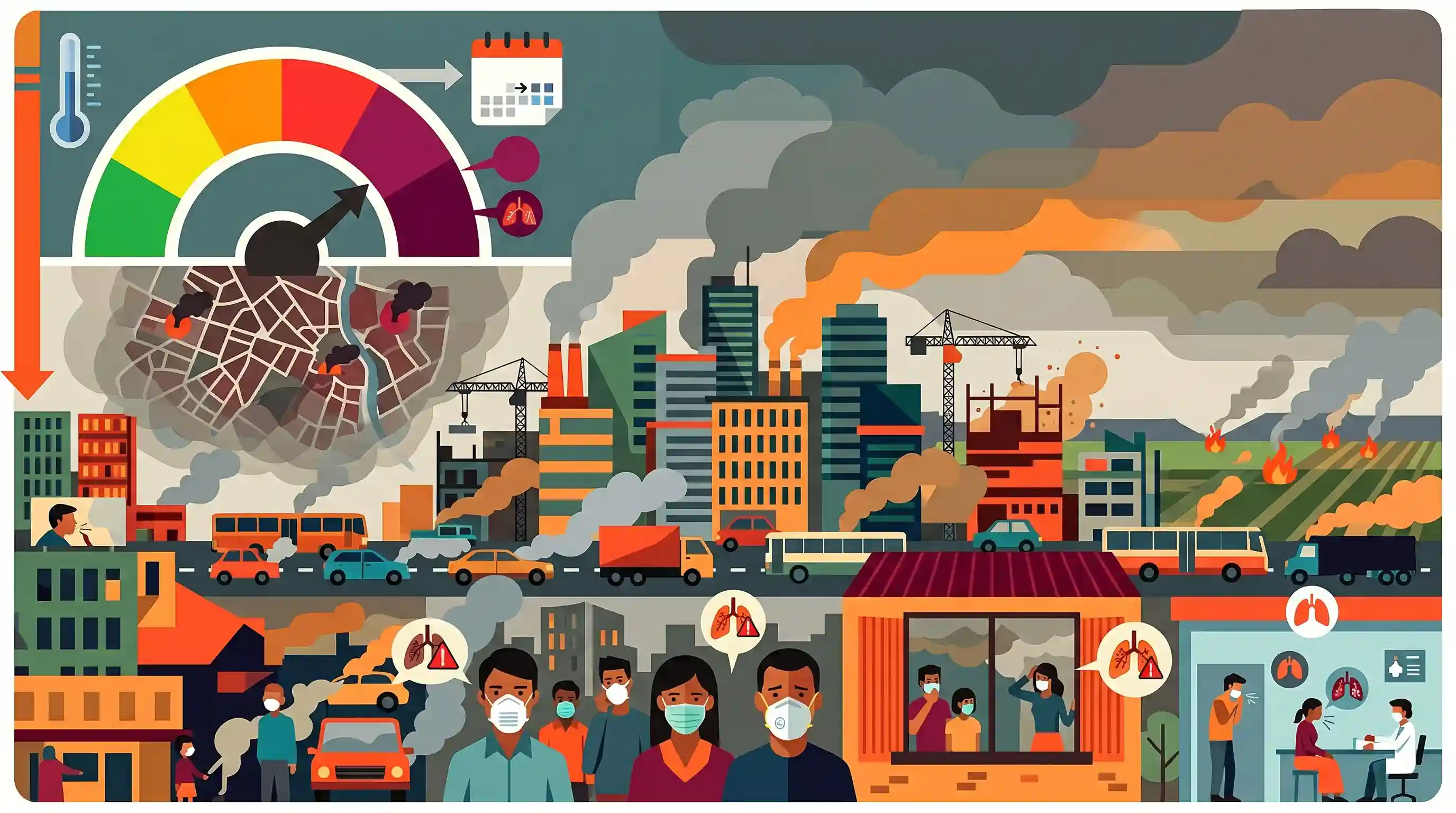
Delhi's Air Quality Index (AQI) has rapidly deteriorated, with several areas including Anand Vihar and Wazirpur crossing the 300 mark into the 'very poor' category. The overall city AQI hit 242 ('poor') amid cooler October temperatures. Health advisories urge residents to wear masks and limit outdoor activities. The spike in pollution levels across Delhi and the wider NCR region marks the beginning of the annual winter smog crisis, raising critical concerns regarding urban environmental management and public health.
Key Points
- Delhi's overall Air Quality Index (AQI) dropped to the 'poor' category (242) on October 17, exacerbated by dropping temperatures (18.2°C).
- Several major localities, including Anand Vihar (370), Wazirpur (328), and Jahangirpuri (324), breached the 300 mark, falling into the 'very poor' category.
- Neighbouring National Capital Region (NCR) cities such as Ghaziabad (347), Noida (335), and Gurugram (312) also recorded 'very poor' air quality levels.
- Health advisories recommend vulnerable populations and general residents wear masks and avoid outdoor exercises to minimize exposure to toxic particulate matter.
- The recurring winter air pollution crisis highlights the chronic environmental degradation in northern India, linking to broader policy frameworks like the National Clean Air Programme (NCAP) and Graded Response Action Plan (GRAP).
Prelims Trap
The National Air Quality Index calculates overall air quality by measuring major greenhouse gases including Carbon Dioxide.
AQI measures 8 specific pollutants based on localized health impacts, not global warming potential. CO2 and Methane are explicitly excluded from the index.
Static Concepts Connected
What are the 8 pollutants measured under the National Air Quality Index (AQI)?
- Particulate Matter: PM10 and PM2.5 are the primary particulates monitored, responsible for severe respiratory distress during smog episodes.
- Toxic Gases: Nitrogen Dioxide (NO2), Sulphur Dioxide (SO2), Carbon Monoxide (CO), Ozone (O3), and Ammonia (NH3).
- Heavy Metals: Lead (Pb) is the sole heavy metal included in the National AQI measurement.
How does 'Temperature Inversion' exacerbate winter pollution in North India?
- Thermal Lid: During winter, cold, dense air stays near the surface while warmer air sits above it, preventing normal vertical mixing and atmospheric dispersion.
- Trapped Pollutants: Emissions from vehicles, industries, and biomass burning get trapped near the ground rather than dissipating higher into the atmosphere.
- Topographical Sink: The Himalayas act as a physical barrier, turning the Indo-Gangetic Plain into a massive basin where trapped polluted air stagnates for days.
Cross-Topic Patterns
Environmental governance vs. Federalism
The overarching enforcement powers of the Commission for Air Quality Management (CAQM) over multiple NCR states frequently spark Centre-State friction, blending GS3 environmental conservation with GS2 federalism disputes.
Water policies, crop cycles, and stubble burning
Winter pollution peaks are structurally tied to the paddy-wheat cycle. Groundwater conservation laws (delaying sowing) push the harvest into the unfavorable winter wind window, linking agriculture policies directly to urban smog.

Expect a multi-statement question on the statutory backing of CAQM, GRAP stages, and the explicit exclusion of CO2/Methane from AQI metrics.
Linked PYQs · 3
Linked PYQs · 3
- 2022PrelimsGS1
In the context of WHO Air Quality Guidelines, consider the following statements: 1. The 24-hour mean of PM2.5 should not exceed 15 µg/m³ and annual mean of PM2.5 should not exceed 5 µg/m³. 2. In a year, the highest levels of ozone pollution occur during the periods of inclement weather. 3. PM10 can penetrate the lung barrier and enter the bloodstream. 4. Excessive ozone in the air can trigger asthma. Which of the statements given above are correct?
- 2020MainsGS3
What are the key features of the National Clean Air Programme (NCAP) initiated by the Government of India?
- 2025PrelimsGS1
Artificial way of causing rainfall to reduce air pollution makes use of
