CAQM Action on Stubble Burning and Delhi Air Pollution
Source:Indian Express ↗
Why It Matters
It highlights the institutional challenges, inter-state coordination failures, and regulatory measures implemented by bodies like CAQM to control seasonal smog and air pollution in northern India.
Summary
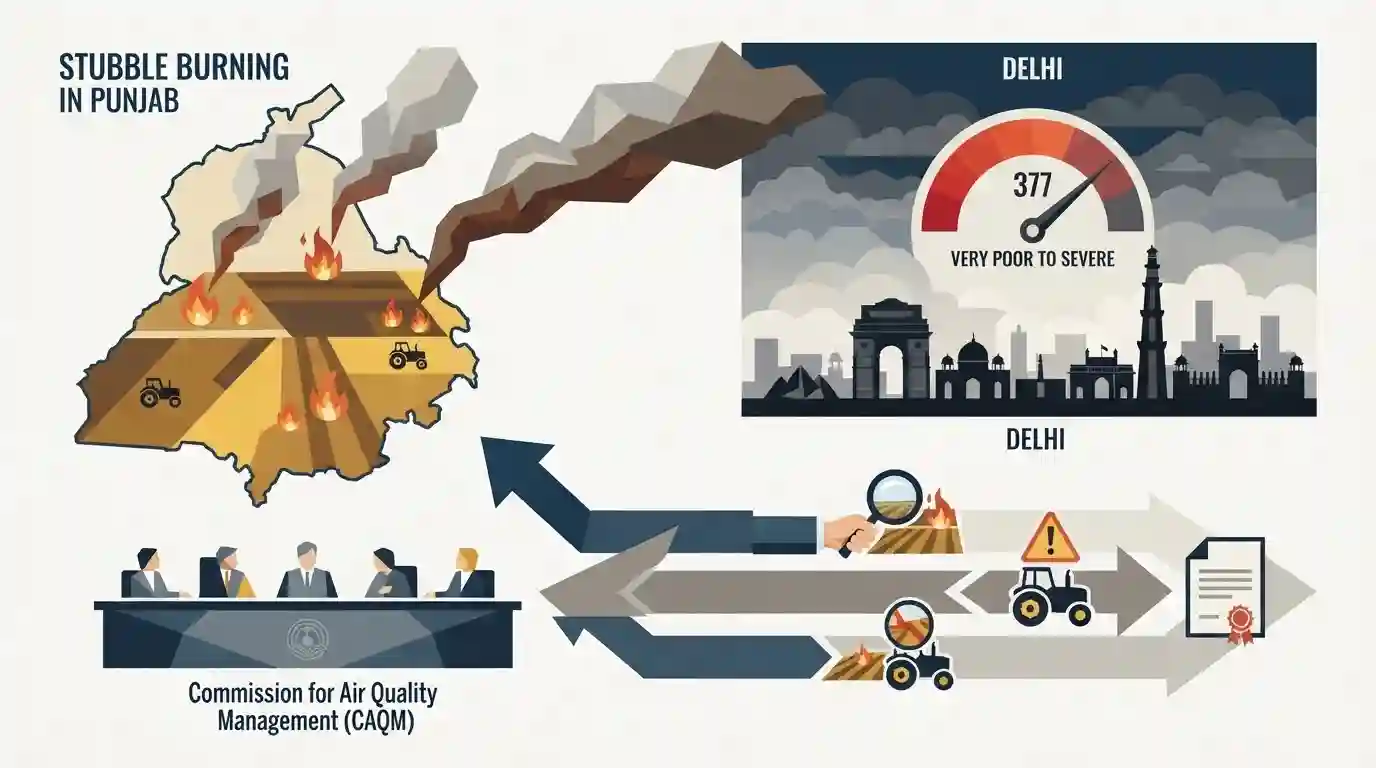
Delhi's air quality index deteriorated to 377 (very poor to severe category), prompting the Commission for Air Quality Management (CAQM) to step up enforcement and crack down on paddy stubble burning in Punjab. The situation underscores ongoing challenges in inter-state air pollution governance and enforcement mechanisms in the Indo-Gangetic plain.
Key Points
- Delhi's AQI reached severe levels (377), prompting strict administrative measures.
- The Commission for Air Quality Management (CAQM) cracked down on stubble burning incidents in Punjab.
- Coordinated inter-state governance is required to combat seasonal air pollution spikes in the National Capital Region.
Important Terms
Commission for Air Quality Management (CAQM)

A statutory body established in 2021 to coordinate, monitor, and regulate air quality management in the National Capital Region and adjoining areas, replacing the earlier EPCA.
UPSC context
UPSC GS Paper III (Environment Pollution and Degradation): Tests statutory bodies, transboundary air pollution governance, and stubble-burning mitigation mechanisms.
Static Concepts Connected
What is the legal status, composition, and mandate of the Commission for Air Quality Management (CAQM)?
- Statutory Basis: Established under the Commission for Air Quality Management in National Capital Region and Adjoining Areas Act, 2021 as a statutory body.
- Composition: Chaired by a government nominee with secretaries, expert members, and representatives from NCR and adjoining states.
- Overriding Powers: Supersedes state pollution control boards and central/state committees on air quality matters in the NCR region with binding directions.
Cross-Topic Patterns
CAQM statutory powers and cooperative federalism
CAQM exercises statutory powers over multiple states, testing federal coordination principles under Article 263 and cooperative federalism versus state-level agricultural priorities in the Indo-Gangetic plain.
Indo-Gangetic air shed and statutory pollution control
Severe winter AQI spikes highlight how geography, low wind speeds, and seasonal crop residue burning interact with the Air (Prevention and Control of Pollution) Act.

Expect statement-based questions on the CAQM's statutory mandate, its composition, and powers overriding state pollution control boards.
Linked PYQs · 2
Linked PYQs · 2
- 2020MainsGS3
What are the key features of the National Clean Air Programme (NCAP) initiated by the Government of India?
- 2021MainsGS3
Describe the key points of the revised Global Air Quality Guidelines (AQGs) recently released by the World Health Organisation (WHO). How are these different from its last update in 2005? What changes in India's National Clean Air Programme are required to achieve these revised standards?
