CAQM Crackdown on Stubble Burning Amid Worsening Delhi AQI
Source:Indian Express ↗
Why It Matters
Addresses the recurring issue of winter air pollution in northern India, the operational efficacy of statutory bodies like CAQM, and policy interventions required for managing stubble burning.
Summary
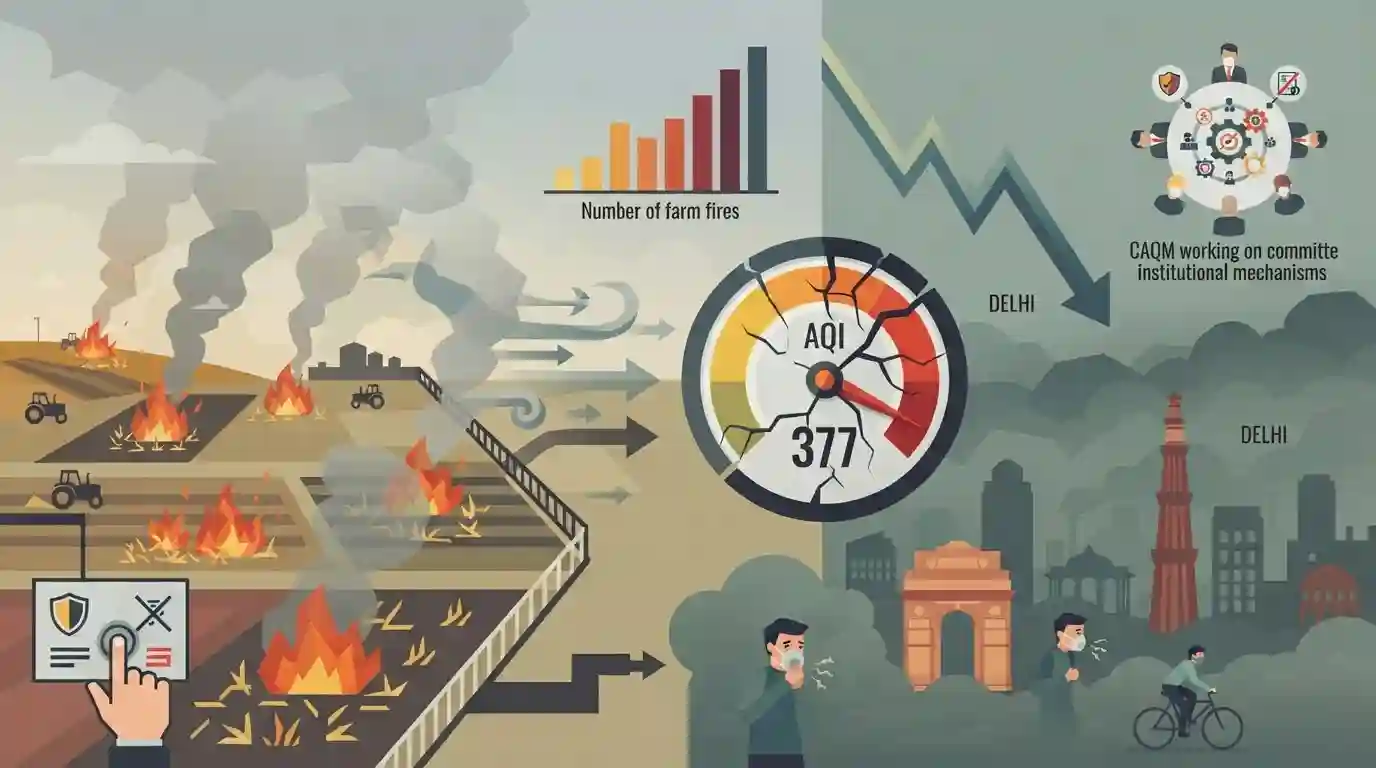
Delhi's AQI dropped to 377 ('very poor') amid rising stubble burning incidents in Punjab. The Commission for Air Quality Management (CAQM) intensified enforcement actions against farm fires, highlighting the perennial challenge of stubble burning, inter-state coordination, and institutional mechanisms required to combat severe air pollution in the National Capital Region.
Key Points
- Delhi's Air Quality Index (AQI) worsened to 377, entering the very poor category as winter approaches and meteorological conditions turn unfavorable.
- The Commission for Air Quality Management (CAQM) stepped up enforcement and crackdowns on farm fires (stubble burning) in Punjab and neighboring states.
- Stubble burning remains a major seasonal contributor to the Indo-Gangetic Plain's severe air pollution, necessitating multi-agency coordination, crop diversification, and in-situ/ex-situ management support.
- Institutional frameworks like CAQM play a crucial statutory role in issuing directions, reviewing mitigation strategies, and penalizing lapses across state boundaries.
Important Terms
Commission for Air Quality Management (CAQM)

A statutory body established in 2021 to coordinate, monitor, and resolve air pollution issues across the National Capital Region (NCR) and adjoining states.
UPSC context
Important for GS Paper III (Environmental Pollution and Degradation, Statutory Bodies, Institutional Mechanisms).
National Clean Air Programme (NCAP)
India's flagship national framework launched by MoEF&CC to systematically tackle air pollution across non-attainment cities with defined particulate reduction targets.
UPSC context
Important for GS Paper III (Environmental Policies, Conservation, and Pollution Control Schemes).
Supreme Court of India
The apex judicial authority in India whose binding directives and oversight guide executive enforcement on environmental crises like stubble burning and Delhi's air pollution.
UPSC context
Important for GS Paper II (Indian Judiciary, Judicial Activism) and GS Paper III (Environmental Governance).
Static Concepts Connected
What are the statutory powers and composition of the Commission for Air Quality Management (CAQM)?
- Statutory Origin: Statutory Status: Established under the CAQM Act, 2021, superseding the EPCA (Environment Pollution (Prevention and Control) Authority).
- Territorial Scope: Jurisdiction: NCR and adjoining areas in Punjab, Haryana, Rajasthan, and Uttar Pradesh, with overriding powers on air pollution matters.
- Executive Overreach: Penal Powers: Empowered to impose environmental compensation and issue binding directions, superseding state government orders in case of conflict.
Cross-Topic Patterns
Cooperative Federalism vs Statutory Environmental Governance
CAQM's statutory mandate over multiple states demonstrates how cooperative federalism often requires statutory override mechanisms for interstate environmental commons like the Indo-Gangetic air basin.
Geography of Pollution and Topographical Traps
Winter temperature inversions trap particulate matter, transforming seasonal agricultural practices into acute public health and governance crises across the Indo-Gangetic Plain.

CAQM statutory powers vs state executive authority will be tested via a multi-statement assertion question in Prelims 2025.
Linked PYQs · 2
Linked PYQs · 2
- 2021MainsGS3
Describe the key points of the revised Global Air Quality Guidelines (AQGs) recently released by the World Health Organisation (WHO). How are these different from its last update in 2005? What changes in India's National Clean Air Programme are required to achieve these revised standards?
- 2020MainsGS3
What are the key features of the National Clean Air Programme (NCAP) initiated by the Government of India?
