India Germany Strategic Ties Amid Global Geopolitical Turbulence
Source:Indian Express ↗
Why It Matters
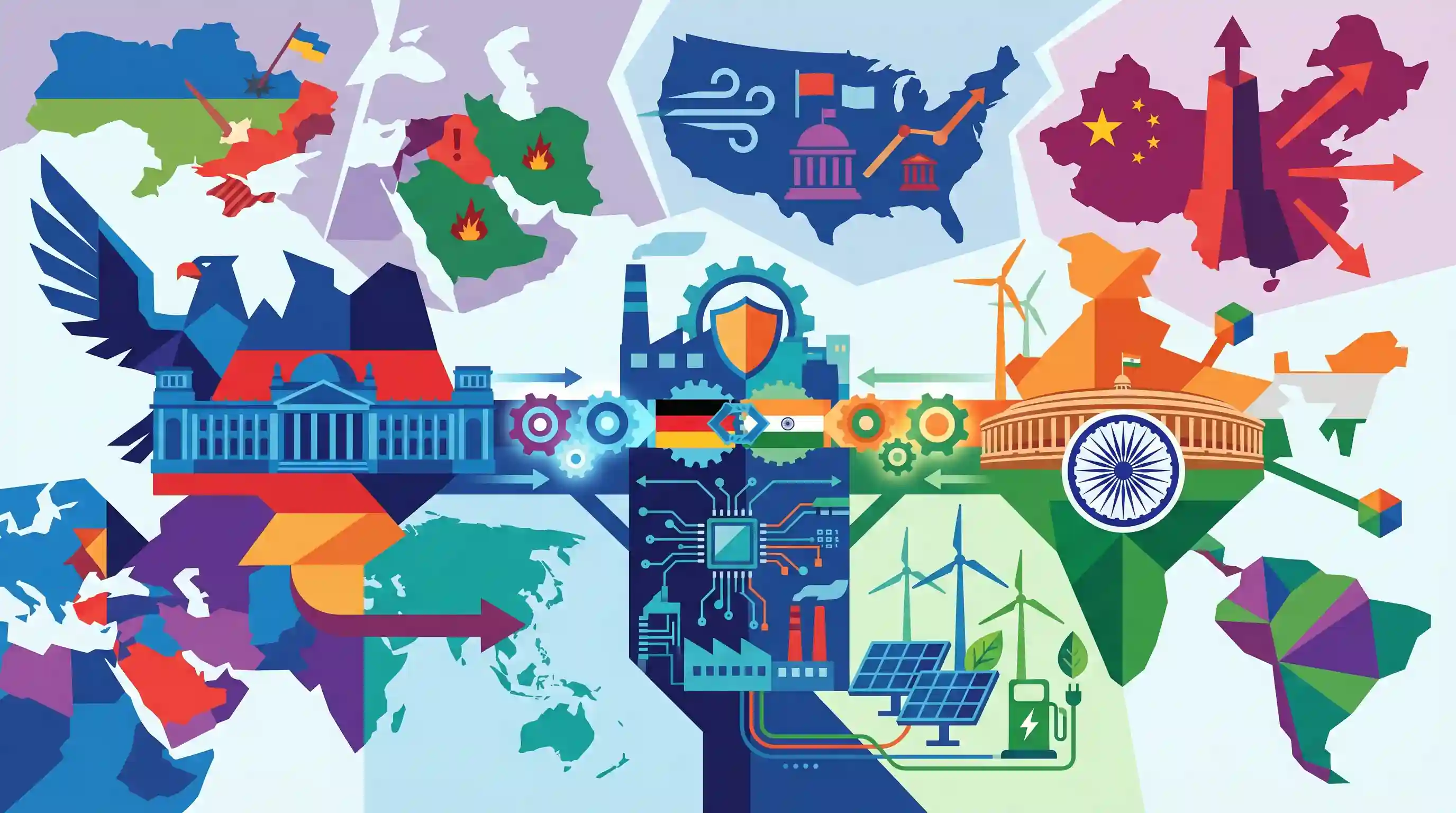
Germany is Europe's largest economy and a pivotal player in the EU. As Europe 'de-risks' from China and navigates the fallout of the Ukraine war, a robust partnership with Germany is crucial for India's access to advanced technology, defense capabilities, and green investments. It forms a key pillar of India's multi-aligned foreign policy and efforts to shape a multipolar Indo-Pacific.
Summary
The article highlights the growing strategic partnership between India and Germany (Delhi and Berlin) as a stabilizing force amidst current global geopolitical turbulence. Driven by conflicts in Ukraine and the Middle East, along with shifts in US politics and a more assertive China, both nations are deepening ties across multiple sectors. Key focus areas include enhanced defense cooperation, robust economic and technological engagement, and a shared commitment to green energy transitions. Germany’s strategic pivot towards the Indo-Pacific and India’s multi-aligned foreign policy complement each other, enabling the two countries to act as a vital bridge between the Global North and the Global South while fostering a multipolar world order.
Key Points
- India and Germany are deepening their strategic partnership to navigate and mitigate global geopolitical turbulence, notably conflicts in Europe and the Middle East.
- Germany's evolving foreign policy features a strategic recalibration toward the Indo-Pacific, aligning with India's vision of a free, open, and multipolar region.
- Defense cooperation is transitioning toward co-development and co-production, supporting India's defense indigenization and Europe's pivot away from over-reliance on traditional security paradigms.
- Economic engagement is driven by technological collaboration, supply chain diversification (de-risking), and the Green and Sustainable Development Partnership for climate action.
- The Delhi-Berlin axis serves as a crucial bridge between the Global North and the Global South, acting as an anchor of stability in a fragmented world order.
Important Terms
Green and Sustainable Development Partnership (GSDP)

A 2022 bilateral agreement where Germany committed €10 billion by 2030 to support India's climate goals, focusing on green hydrogen, renewables, and agroecology.
UPSC context
GS Paper II (Bilateral Relations); tests knowledge of climate diplomacy and sustainable development financing between major economies.
European Union (EU)
A political and economic union of 27 European member states; Germany is India’s largest trading partner within this bloc and a key advocate for the India-EU FTA.
UPSC context
GS Paper II (International Relations); relevant for trade negotiations and the 'Gateway to Europe' strategy.
Inter-Governmental Consultations (IGC)
A unique biennial mechanism established in 2011 where the Prime Minister of India and the German Chancellor meet alongside their respective cabinets to review strategic cooperation.
UPSC context
GS Paper II; highlights the high-level institutional depth and unique diplomatic architecture of India-Germany ties.
Indo-Pacific Policy Guidelines (Germany)
Germany's 2020 strategic pivot aimed at diversifying partnerships in Asia, upholding a rules-based order, and securing maritime trade routes, with India as a central partner.
UPSC context
GS Paper II (Geopolitics); essential for understanding European engagement in the Indo-Pacific and maritime security.
Zeitenwende
German for 'epochal shift'; refers to Germany's 2022 policy transformation following the Ukraine war, involving increased defense spending and a move toward more assertive global security partnerships.
UPSC context
GS Paper II (Global Geopolitics); explains the external drivers behind Germany’s deepened strategic and defense engagement with India.
G4 Nations
A group comprising India, Germany, Japan, and Brazil that collaborates to advocate for urgent reform and permanent membership in the United Nations Security Council.
UPSC context
GS Paper II (International Organizations); tests understanding of multilateral diplomacy and UN reform initiatives.
Defense Industrial Cooperation Roadmap
A strategic framework to shift the India-Germany defense relationship from a buyer-seller model toward co-development and co-production of advanced technologies like submarines and UAVs.
UPSC context
GS Paper III (Internal Security/Defense); critical for topics on defense indigenization and 'Atmanirbhar Bharat'.
Prelims Trap
"The Green and Sustainable Development Partnership is a UN-led climate finance initiative."
The GSDP is actually a bilateral agreement between India and Germany launched in 2022, not a multilateral UN or broad EU framework.
Static Concepts Connected
What is Air-Independent Propulsion (AIP) in submarines?
- Core Function: Allows non-nuclear (diesel-electric) submarines to operate their engines without surfacing or using a snorkel to access atmospheric oxygen.
- Strategic Edge: Significantly enhances underwater endurance and acoustic stealth, making detection much harder for adversaries compared to conventional submarines.
- Project-75I Context: India mandates fuel-cell-based AIP for its new class of six indigenous submarines under Project-75I, acting as a major tech-transfer goal.
De-risking vs. Decoupling in international supply chains
- De-risking: Diversifying supply chains and reducing critical vulnerabilities to a single country (like China) without severing all trade ties entirely.
- Decoupling: Complete dismantlement of economic integration and bilateral trade, a drastic strategy largely rejected by the EU and Germany.
- India's Benefit: De-risking drives European capital and technology transfer toward India's manufacturing sector as an alternative 'China-plus-one' hub.
Cross-Topic Patterns
Project-75I + Make in India
Shifting from direct imports to co-development models like Project-75I links GS2 (Bilateral Relations) directly with GS3 (Indigenization of Technology), helping secure vital defense supply chains.
Demographic Dividend + EU Migration Pacts
India's surplus skilled labor meets Europe's aging workforce needs. The Indo-German Mobility Partnership mirrors similar recent strategic migration agreements signed with the UK, Australia, and Italy.
Bilateral Climate Finance + Green Hydrogen
Germany’s €10 billion GSDP commitment bridges GS2 (Bilateral ties) and GS3 (Green Hydrogen Mission), offering a tangible template for Global North-to-South climate finance transfers.

Expect a GS2 mains question linking Germany's 'de-risking' strategy and Indo-Pacific pivot to India's Project-75I defense indigenization.
Linked PYQs · 3
Linked PYQs · 3
- 2023MainsGS2
‘The expansion and strengthening of NATO and a stronger US-Europe strategic partnership works well for India.’ What is your opinion about this statement ? Give reasons and examples to support your answer.
- 2022MainsGS2
‘Clean energy is the order of the day.’ Describe briefly India's changing policy towards climate change in various international fora in the context of geopolitics.
- 2019MainsGS2
‘The time has come for India and Japan to build a strong contemporary relationship, one involving global and strategic partnership that will have a great significance for Asia and the world as a whole.’ Comment.
