Indo-German Convergence on Supply Chains Free Trade and Defense
Source:Indian Express ↗
Why It Matters
Understanding India-Germany relations is vital for UPSC aspirants as it touches upon core GS2 themes like bilateral partnerships, EU relations, and strategic balancing against China. It also provides contemporary examples of how India is leveraging its demographic dividend and managing its defence modernization (GS3) through technology transfers.
Summary
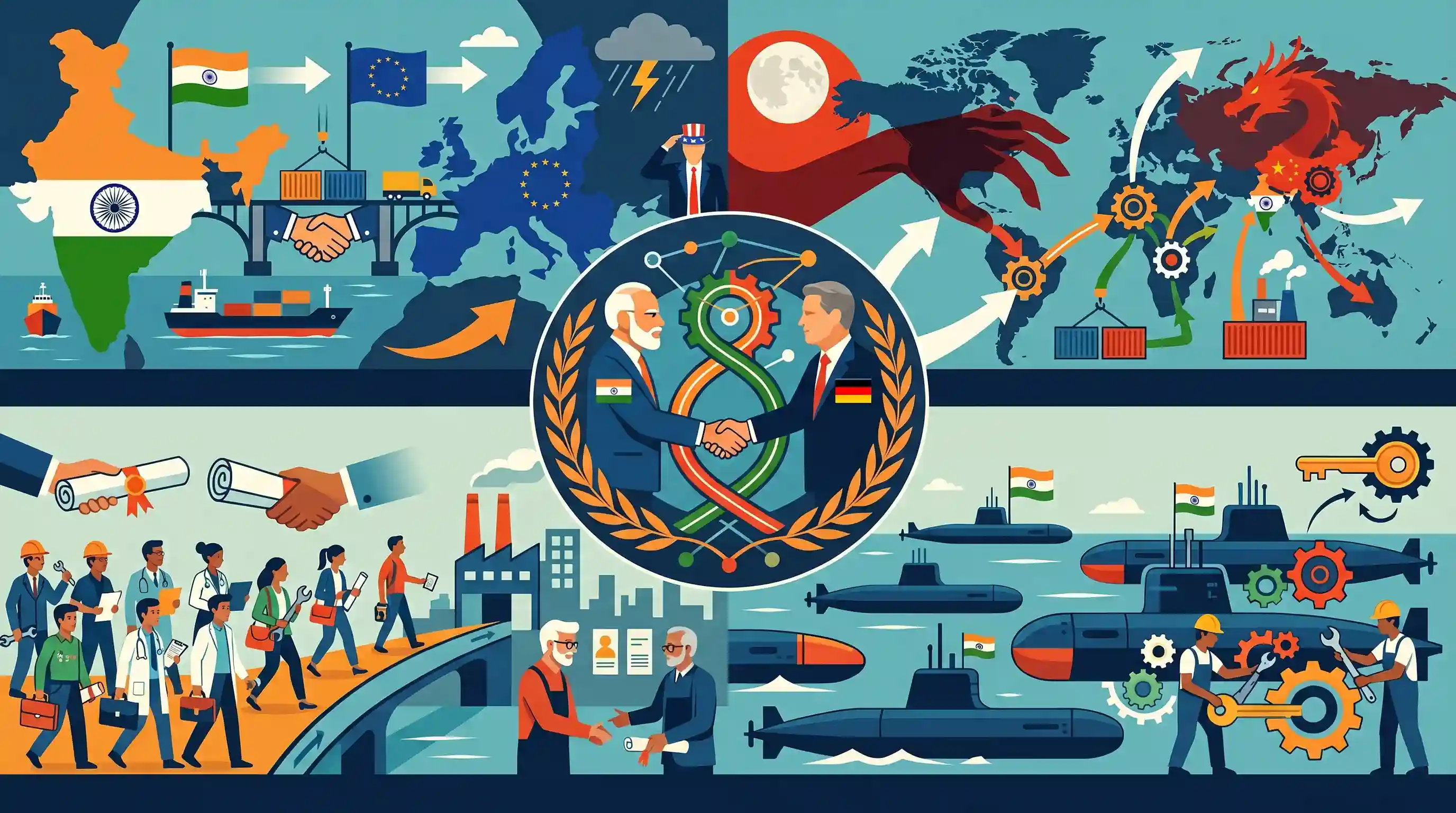
The editorial discusses the strengthening of bilateral ties between India and Germany, underscored by German Chancellor Friedrich Merz's recent visit to Delhi. The strategic partnership focuses on reducing supply chain dependence on China, finalizing the long-pending India-EU Free Trade Agreement, and addressing Germany's labour shortages through a Global Skills Partnership. Defence cooperation is also highlighted, particularly the negotiations for six diesel submarines under Project 75I. The alignment between Delhi and Berlin is framed as a critical response to broader geopolitical uncertainties, including US unpredictability and an increasingly assertive China, despite differences over their approaches to Russia.
Key Points
- German Chancellor Friedrich Merz's first Asia visit to India signifies deepening of the India-Germany strategic partnership amid changing global dynamics.
- Both nations advocate for finalizing the India-EU Free Trade Agreement (FTA) to diversify supply chains and facilitate technology transfers and green transition.
- The Global Skills Partnership aims to address Germany's demographic challenges and labour shortage by tapping into India's skilled workforce.
- Defence cooperation is a key pillar, with ongoing negotiations for six diesel-electric submarines under Project 75I with Germany's Thyssenkrupp.
- The partnership serves as a strategic hedge against China's economic dominance and the unpredictability of US foreign policy.
Important Terms
India-EU Free Trade Agreement (FTA)

A comprehensive trade pact (re-launched in 2022) aimed at reducing tariffs and non-tariff barriers to enhance market access for goods, services, and investment between India and the EU.
UPSC context
GS Paper II/III: Trade diplomacy, economic integration, and the evolution of the Broad-based Trade and Investment Agreement (BTIA).
Project 75I
A follow-on to Project 75, this Indian Navy program aims to indigenously build six advanced conventional submarines equipped with Air Independent Propulsion (AIP) under the Strategic Partnership model.
UPSC context
GS Paper III: Defense indigenization, maritime security in the Indian Ocean, and "Make in India" in high-tech manufacturing.
Global Skills Partnership
A bilateral framework designed to facilitate the fair and ethical migration of skilled Indian professionals to Germany, addressing German labor shortages while leveraging India's demographic dividend.
UPSC context
GS Paper II: International relations, human capital mobility, and the impact of developed-nation policies on Indian interests.
European Union (EU)
A supranational political and economic union of 27 member states; it is India's largest trading partner as a bloc and a key partner for strategic and climate cooperation.
UPSC context
GS Paper II: Multilateralism, regional groupings, and India's strategic autonomy in a multipolar world.
Thyssenkrupp
A German defense manufacturer (TKMS) and a key bidder for India’s Project 75I submarine deal, offering technology transfer for domestic production in collaboration with Indian shipyards.
UPSC context
GS Paper III: Strategic partnerships with foreign Original Equipment Manufacturers (OEMs) and defense technology transfer mechanisms.
Prelims Trap
"Project 75I involves the direct procurement of six nuclear-powered submarines from Germany."
Project 75I focuses on the indigenous construction of conventional diesel-electric submarines with Air-Independent Propulsion (AIP), not nuclear submarines or direct imports.
Static Concepts Connected
What is the Strategic Partnership Model (SPM) in Defence Procurement?
- Core Objective: To build domestic defense manufacturing capacity and reduce reliance on direct imports.
- Mechanism: Indian private companies form joint ventures or tie-ups with foreign Original Equipment Manufacturers (OEMs).
- Tech Transfer: Ensures deep technology transfer and the establishment of local supply chains for major defense platforms (e.g., submarines, fighter jets).
How does 'De-risking' differ from 'De-coupling' in trade?
- De-coupling: Completely severing economic and trade ties with a specific nation to isolate its economy.
- De-risking: Reducing critical dependencies (like critical minerals or tech) and diversifying supply chains without fully ending trade.
- Current Context: India and the EU have actively adopted 'de-risking' rather than 'de-coupling' as their core strategy regarding China.
Cross-Topic Patterns
P-75I and the 'Make in India' Pivot
India's shift to the Strategic Partnership Model under P-75I mirrors the broader transition towards Aatmanirbhar Bharat in defense, linking GS3 Security (indigenization) to GS3 Economy (manufacturing).
Demographic Dividend meets Ageing Europe
Germany’s Global Skills Partnership operationalizes India’s demographic dividend, directly linking GS1 population dynamics (working-age surplus) with GS2 diaspora management and bilateral mobility agreements.
FTAs as Green Tech Conduits
The India-EU FTA negotiations illustrate how modern trade pacts are no longer just about tariffs, but serve as critical mechanisms for securing green technology transfers and resilient supply chains.

Expect a multi-statement prelims question comparing Project 75 with 75I, specifically targeting AIP technology and the SPM model.
Linked PYQs · 4
Linked PYQs · 4
- 2024MainsGS2
‘The West is fostering India as an alternative to reduce dependence on China's supply chain and as a strategic ally to counter China's political and economic dominance.’ Explain this statement with examples.
- 2023MainsGS2
‘The expansion and strengthening of NATO and a stronger US-Europe strategic partnership works well for India.’ What is your opinion about this statement ? Give reasons and examples to support your answer.
- 2016MainsGS2
Demographic Dividend in India will remain only theoretical unless our manpower becomes more educated, aware, skilled and creative." What measures have been taken by the government to enhance the capacity of our population to be more productive and employable?
- 2023PrelimsGS1
Consider the following statements: Statement-I: Recently, the United States of America (USA) and the European Union (EU) have launched the 'Trade and Technology Council'. Statement-II: The USA and the EU claim that through this they are trying to bring technological progress and physical productivity under their control. Which one of the following is correct in respect of the above statements?
