ECI Special Intensive Revision for Electoral Roll Purification
Source:The Hindu ↗
Why It Matters
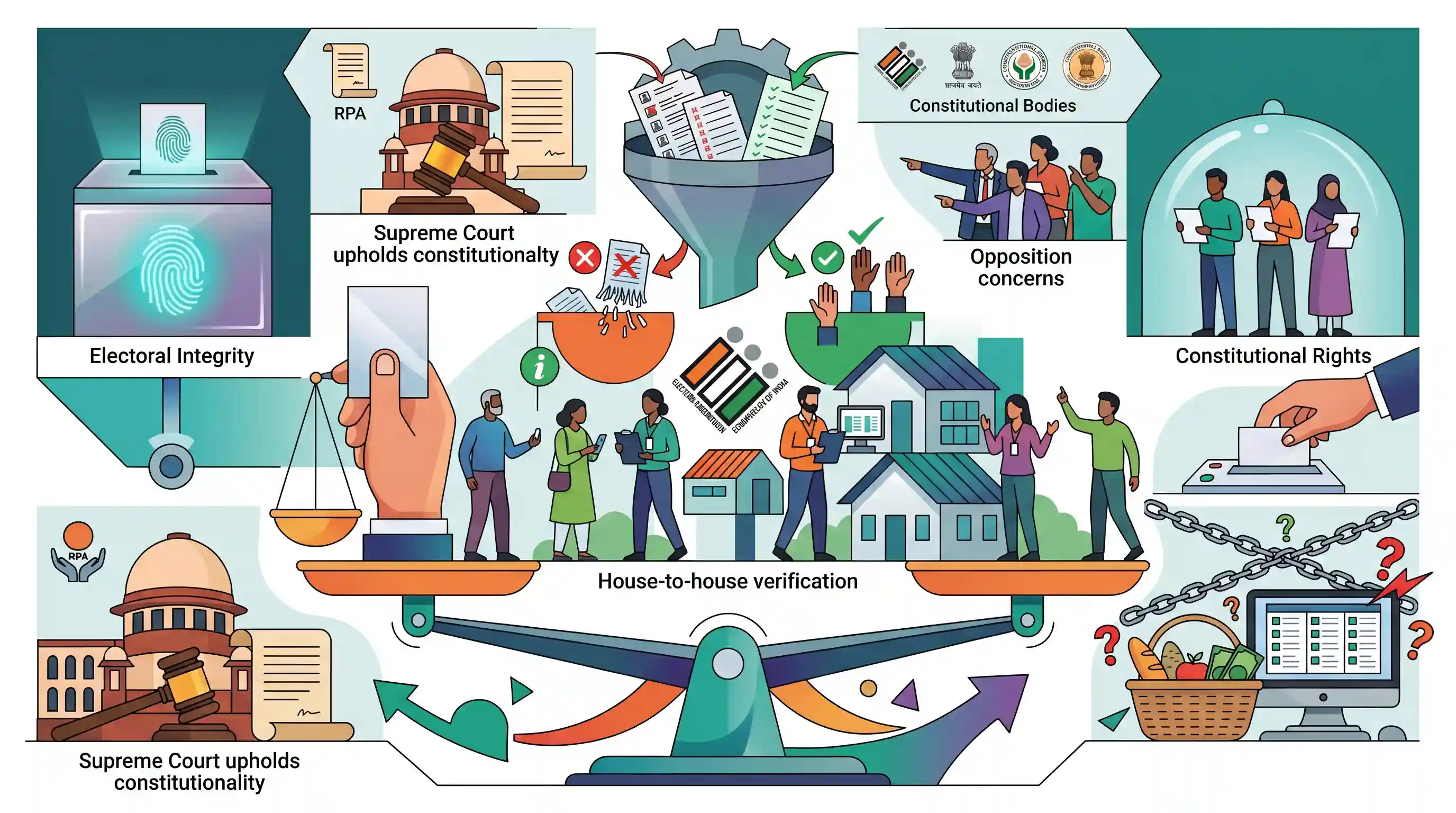
The purification of electoral rolls is essential for free and fair elections, a core constitutional mandate of the ECI. The article raises crucial polity and governance themes, including the statutory powers of the ECI under the RPA, debates over voter disenfranchisement impacting the Constitutional Right to Vote, and the ethical/legal implications of linking welfare delivery to electoral enumeration.
Summary
The Election Commission of India (ECI) is set to commence the third phase of its Special Intensive Revision (SIR) of electoral rolls in Delhi, Karnataka, Meghalaya, Maharashtra, and Jharkhand on June 30. Through house-to-house verification by Booth Level Officers, the exercise aims to purify the voter base. While the Supreme Court has upheld the constitutionality of SIR amidst Opposition concerns over mass voter deletions, new legal challenges have arisen, particularly regarding West Bengal's attempt to link social security benefits to the electoral verification process. The initiative highlights the critical balance between electoral integrity and the protection of citizens' constitutional right to vote.
Key Points
- The Election Commission of India (ECI) is launching the third phase of the Special Intensive Revision (SIR) of electoral rolls across five states (Delhi, Karnataka, Meghalaya, Maharashtra, and Jharkhand) starting June 30.
- The SIR involves Booth Level Officers (BLOs) conducting house-to-house verification to weed out duplicate or deceased voters and add new eligible voters, ahead of upcoming assembly elections.
- Previous phases of SIR led to a significant 10.2% decline in electoral roll numbers, sparking allegations from Opposition parties regarding targeted voter deletions.
- The Supreme Court upheld the constitutional validity of the SIR exercise in March, affirming the ECI's mandate to maintain accurate electoral rolls.
- A controversy has emerged in West Bengal over a state government notification that attempts to link the delivery of social security and welfare benefits to verification under the SIR, which has been legally challenged.
Important Terms
Special Intensive Revision (SIR)

A focused, time-bound house-to-house verification exercise conducted by the ECI to update and purify electoral rolls by adding new voters and removing deceased, shifted, or ineligible entries.
UPSC context
GS Paper II: Governance/Elections. Tests understanding of ECI's administrative procedures to ensure electoral purity and democratic integrity.
Booth Level Officer (BLO)
A local government or semi-government official (e.g., teacher) appointed by the ECI as the field-level custodian of electoral rolls, responsible for door-to-door verification and voter facilitation.
UPSC context
GS Paper II: Appointment to Constitutional posts. Vital for understanding the grass-roots administrative machinery of the Indian electoral system.
Representation of the People Act, 1950
The primary legislation governing the allocation of seats in legislatures and the preparation, revision, and publication of electoral rolls in India.
UPSC context
GS Paper II: Salient features of the RPA. Tests the distinction between roll preparation (1950) and election conduct (1951).
Election Commission of India (ECI)
A permanent, autonomous constitutional body under Article 324 responsible for the superintendence, direction, and control of all elections to Parliament and State Legislatures.
UPSC context
GS Paper II: Constitutional Bodies. Core focus on powers, functions, and responsibilities regarding free and fair elections.
Electoral Roll Purification
The administrative process of cleaning voter lists by removing duplicate, fraudulent, or non-existent entries to ensure the roll accurately reflects the genuine electorate.
UPSC context
GS Paper II: Electoral Reforms. Relevant for discussing challenges like voter exclusion, bogus voting, and technological interventions in elections.
Article 324
The constitutional provision that vests the superintendence, direction, and control of elections in the Election Commission, providing it with plenary powers for electoral management.
UPSC context
GS Paper II: Constitutional Provisions. Crucial for questions on the independence and authority of the Election Commission.
Prelims Trap
"The Special Intensive Revision (SIR) of electoral rolls is mandated and governed by the Representation of the People Act, 1951."
The preparation and revision of electoral rolls, including the SIR exercise, fall exclusively under the RPA 1950. The RPA 1951 governs the actual conduct of elections and post-election disputes.
Static Concepts Connected
What distinguishes the core scope of RPA 1950 from RPA 1951?
- RPA 1950: Deals with the allocation of seats, delimitation of constituencies, and preparation/revision of electoral rolls.
- RPA 1951: Deals with the conduct of elections, qualifications/disqualifications for membership, and corrupt electoral practices.
Who manages the electoral roll revision machinery at the district and grassroots levels?
- District Election Officer (DEO): Supervises election work within the district, subject to the superintendence of the Chief Electoral Officer.
- Electoral Registration Officer (ERO): Statutory authority responsible for the preparation and revision of the electoral roll for a specific constituency.
- Booth Level Officer (BLO): Local grassroots custodians (often teachers or Anganwadi workers) conducting door-to-door physical verification of voters.
Cross-Topic Patterns
Voter Data + Welfare Delivery + Privacy
The West Bengal controversy over linking social security to electoral verification mirrors Aadhaar-Voter ID linkage debates, intersecting directly with Right to Privacy (Puttaswamy) jurisprudence.
Article 324 Plenary Powers vs RPA limits
The Supreme Court upholding the SIR exercise reiterates the plenary power of the ECI under Article 324, allowing it to take necessary steps to ensure electoral integrity where statutes are silent.

Expect a 2026 prelims question testing the exact division of matters between RPA 1950 (electoral rolls) and RPA 1951 (conduct of polls).
Linked PYQs · 4
Linked PYQs · 4
- 2022MainsGS2
Discuss the role of the Election Commission of India in the light of the evolution of the Model Code of Conduct.
- 2022MainsGS2
Discuss the procedures to decide the disputes arising out of the election of a Member of the Parliament or State Legislature under The Representation of the People Act, 1951. What are the grounds on which the election of any returned candidate may be declared void ? What remedy is available to the aggrieved party against the decision ? Refer to the case laws.
- 2017PrelimsGS1
Right to vote and to be elected in India is a
- 2023MainsGS2
“Development and welfare schemes for the vulnerable, by its nature, are discriminatory in approach.” Do you agree? Give reasons for your answer.
