Delhi air quality improves to moderate category with AQI at 196
Source:The Hindu ↗
Why It Matters
Air pollution is a critical public health and environmental issue in India, particularly in Delhi-NCR. UPSC routinely asks questions regarding the calculation of the AQI, the pollutants involved, statutory bodies like the CPCB, and overarching frameworks like the National Clean Air Programme (NCAP). Understanding the metrics and regulatory monitoring helps aspirants evaluate governance responses to chronic pollution.
Summary
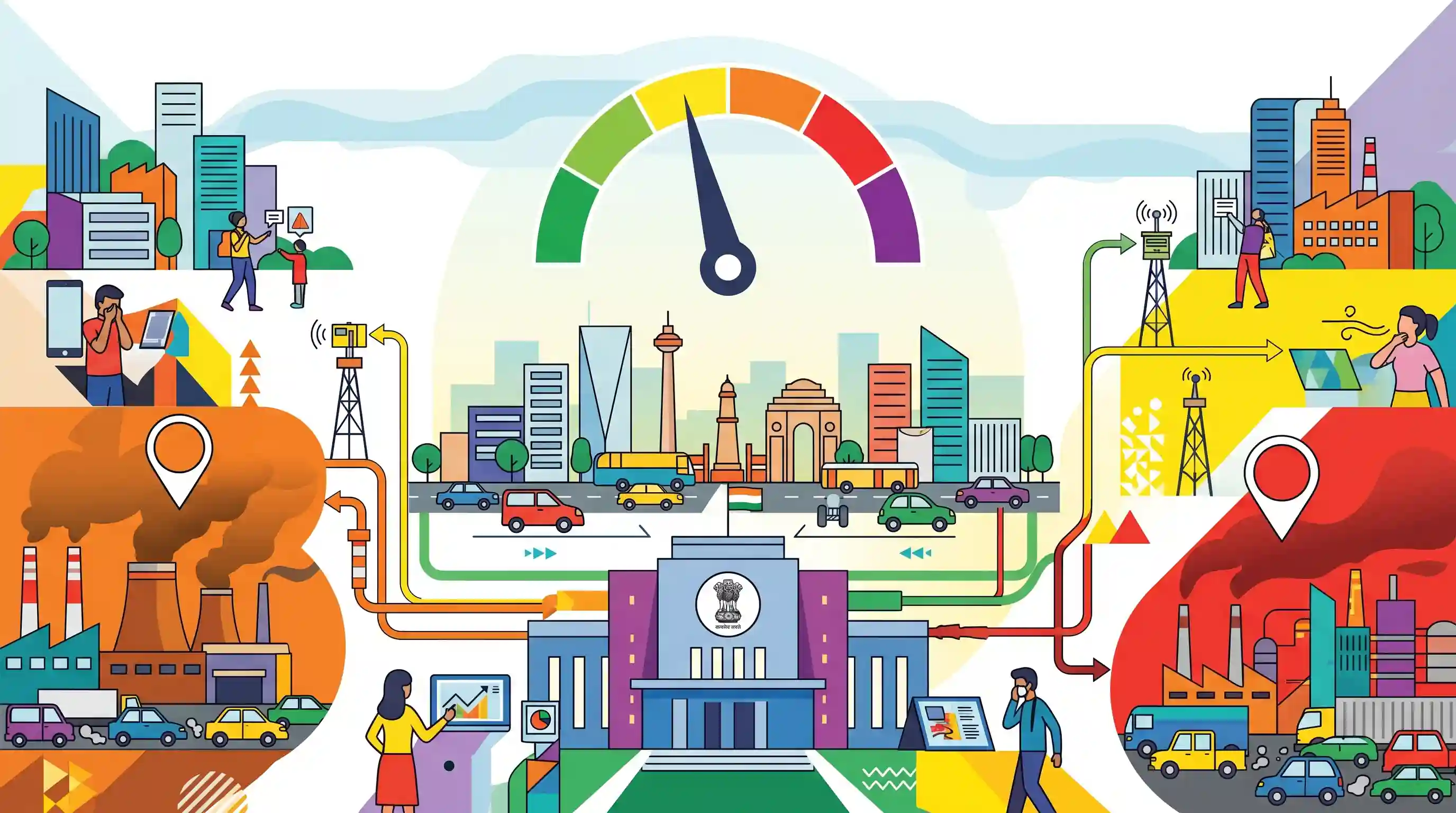
Delhi's air quality witnessed a slight improvement, with the overall Air Quality Index (AQI) dropping to 196, categorized as 'moderate' by the Central Pollution Control Board (CPCB). However, localized variations remained, with several monitoring stations in areas like Mundka and Wazirpur still recording 'poor' to 'very poor' air quality. The data underscores the ongoing challenge of managing urban air pollution and the importance of the CPCB's standardized AQI bands (0-500) for communicating environmental health risks.
Key Points
- Delhi's overall 24-hour average Air Quality Index (AQI) improved slightly to 196, placing it in the 'moderate' category according to the CPCB.
- Despite the overall improvement, several specific neighborhoods (like Mundka, Narela, and Wazirpur) continued to report AQI readings in the 'poor' or 'very poor' categories.
- The article highlights the official AQI classification system used in India, ranging from 'good' (0-50) to 'severe' (401-500), which dictates policy and health advisories.
- Continuous real-time monitoring by the CPCB is essential for evaluating the success of pollution control measures in the National Capital Region.
Important Terms
Air Quality Index (AQI)

A color-coded numerical scale (0-500) that simplifies complex air quality data for 8 pollutants into six categories to communicate health risks to the public.
UPSC context
GS Paper III (Environment). Tests knowledge of pollutants (PM2.5, NO2, etc.) and categories (Good to Severe) for urban pollution management.
Central Pollution Control Board (CPCB)
A statutory body established under the Water Act, 1974, serving as India's apex regulator for air and water pollution control under the MoEFCC.
UPSC context
GS Paper II (Governance) and GS III (Environment). Tests understanding of statutory frameworks and institutional roles in environmental protection.
Commission for Air Quality Management (CAQM)
A statutory authority established in 2021 to provide a consolidated and coordinated approach to managing air quality specifically in Delhi-NCR and adjoining states.
UPSC context
GS Paper II (Statutory Bodies). Tests awareness of recent legislative shifts in regional environmental governance and its overarching powers.
Graded Response Action Plan (GRAP)
A set of emergency measures triggered stage-wise based on AQI levels to prevent further deterioration of air quality in the National Capital Region.
UPSC context
GS Paper III (Environment). Tests knowledge of practical policy interventions for seasonal urban smog and inter-agency coordination.
Particulate Matter (PM2.5/PM10)
Microscopic inhalable particles (2.5 or 10 micrometers in diameter) that pose severe health risks by entering the respiratory system and bloodstream.
UPSC context
GS Paper III (Environment/Science). Tests understanding of specific pollutants, their sources, and public health implications in polluted urban centers.
Prelims Trap
"CPCB was established under the Air Act, 1981, and the National AQI measures 8 pollutants including Carbon Dioxide."
CPCB was actually established under the Water Act, 1974, not the Air Act. Additionally, AQI tracks Carbon Monoxide (CO), not Carbon Dioxide (CO2).
Static Concepts Connected
What distinguishes the National Air Quality Index (AQI) from NAAQS?
- AQI (8 Pollutants): Measures PM10, PM2.5, NO2, SO2, CO, O3, NH3, and Lead (Pb) to communicate daily air quality and immediate health risks via a 6-color code.
- NAAQS (12 Pollutants): Encompasses the 8 AQI pollutants plus Benzene, Benzopyrene, Arsenic, and Nickel to establish legally binding permissible ambient air quality limits.
How is emergency severe air pollution managed in the Delhi-NCR region?
- CAQM Authority: A statutory body established by an Act of Parliament that has overarching powers over pollution control boards of NCR states to tackle air pollution.
- Graded Response (GRAP): CAQM implements GRAP, an incremental emergency framework divided into 4 stages based on predictive and current AQI levels (from Poor to Severe+).
Cross-Topic Patterns
AQI + Agricultural Policy (Stubble Burning)
Delhi's seasonal AQI fluctuations are strongly tied to paddy residue burning in neighboring states, linking urban environmental degradation with MSP policies, groundwater conservation acts, and agricultural crop cycles.
Topography + Winter Inversions
Delhi's landlocked geography combined with winter temperature inversions and low wind speeds traps pollutants, linking urban pollution crises to fundamental physical geography and climatology concepts.

Expect a multi-statement question contrasting CPCB's statutory origin (Water Act) with CAQM, or identifying AQI vs NAAQS pollutants.
Linked PYQs · 4
Linked PYQs · 4
- 2022PrelimsGS1
In the context of WHO Air Quality Guidelines, consider the following statements: 1. The 24-hour mean of PM2.5 should not exceed 15 µg/m³ and annual mean of PM2.5 should not exceed 5 µg/m³. 2. In a year, the highest levels of ozone pollution occur during the periods of inclement weather. 3. PM10 can penetrate the lung barrier and enter the bloodstream. 4. Excessive ozone in the air can trigger asthma. Which of the statements given above are correct?
- 2020MainsGS3
What are the key features of the National Clean Air Programme (NCAP) initiated by the Government of India?
- 2016PrelimsGS1
In the cities of our country, which among the following atmospheric gases are normally considered in calculating the value of Air Quality Index? 1. Carbon dioxide 2. Carbon monoxide 3. Nitrogen dioxide 4. Sulfur dioxide 5. Methane Select the correct answer using the code given below.
- 2025PrelimsGS1
Artificial way of causing rainfall to reduce air pollution makes use of
