शीतकालीन स्मॉग की गतिशीलता और वायु गुणवत्ता सूचकांक निगरानी
स्रोत:द हिंदू ↗
क्यों मायने रखता है
दिल्ली का सर्दियों में लगातार बना रहने वाला वायु प्रदूषण एक आवर्ती संकट है जो पर्यावरणीय शासन, सार्वजनिक स्वास्थ्य और शहरी नियोजन से जुड़ा है। UPSC अभ्यर्थियों के लिए, AQI के पीछे की कार्यप्रणाली, CPCB का वैधानिक आधार और इसकी भूमिका, तथा मौसम संबंधी घटनाएं (जैसे तापमान विलोमन और कोहरा) जो कणिका सांद्रता (Particulate Concentration) को और बढ़ा देती हैं, को समझना प्रारंभिक (Prelims) और मुख्य (Mains) दोनों परीक्षाओं के लिए अत्यंत महत्वपूर्ण है।
सारांश
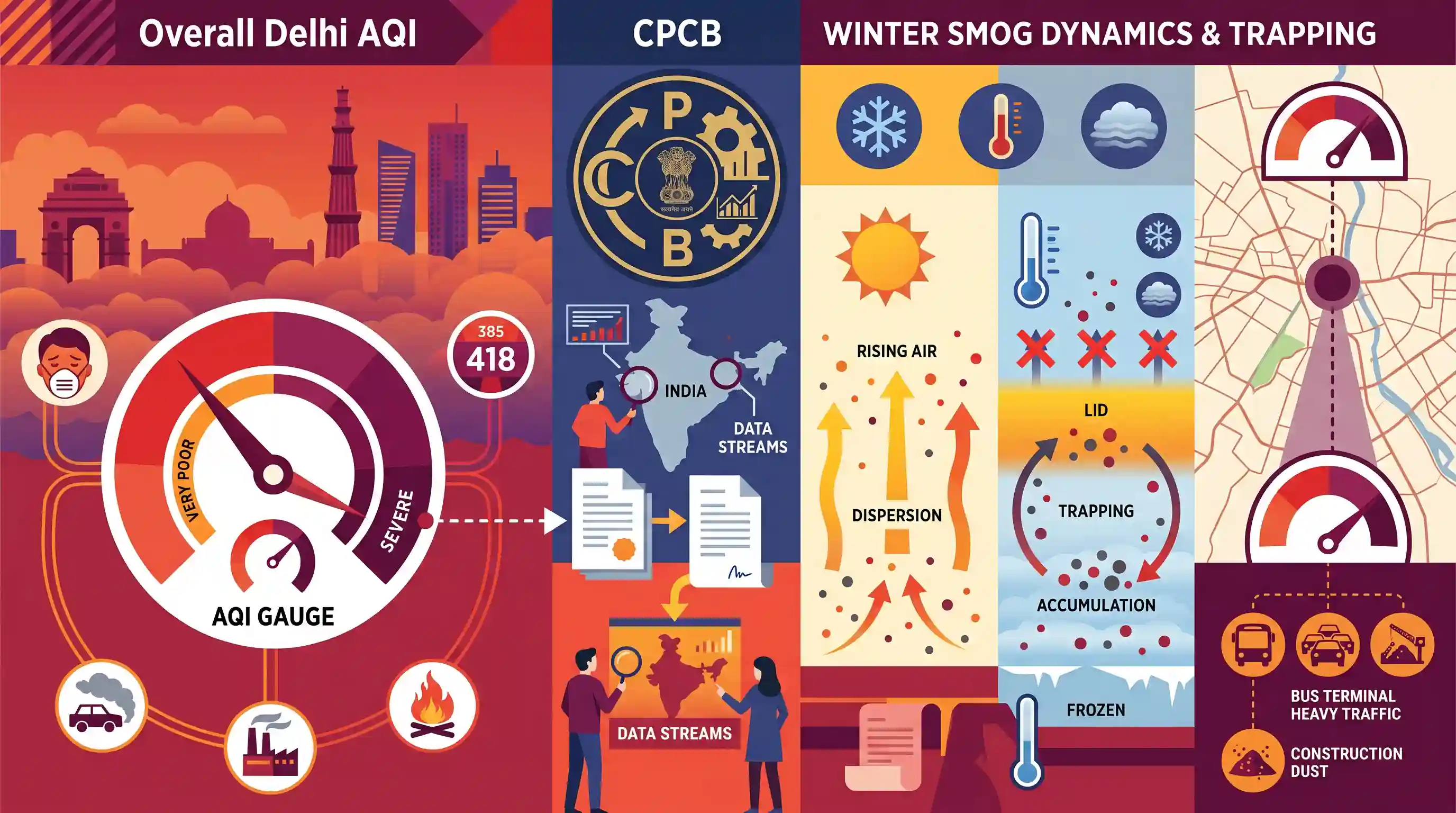
Delhi's air quality continued to be highly toxic, with the city's overall Air Quality Index (AQI) lingering in the 'very poor' category at 385. Specific areas like Anand Vihar crossed into the 'severe' category with an AQI of 418. The Central Pollution Control Board (CPCB) data indicates that such pollution levels are exacerbated by winter weather conditions, including lower temperatures and shallow fog, which trap particulate matter near the surface.
मुख्य बिंदु
- Delhi's air quality remained in the 'very poor' category, recording a 24-hour average Air Quality Index (AQI) of 385.
- आनंद विहार गंभीर रूप से प्रभावित रहा, जहाँ AQI 418 दर्ज किया गया, जो 'गंभीर' श्रेणी में आता है।
- केंद्रीय प्रदूषण नियंत्रण बोर्ड (CPCB) AQI को छह स्तरों में वर्गीकृत करता है, जो 'अच्छी' (0-50) से लेकर 'गंभीर' (401-500) तक है।
- The city also experienced a layer of shallow fog with a minimum temperature of 17.6°C, which can exacerbate the trapping of pollutants close to the ground.
महत्वपूर्ण शब्द
वायु गुणवत्ता सूचकांक (AQI)

A tool for communicating daily air quality, converting complex pollutant data into a single number and color. It tracks eight major pollutants: PM10, PM2.5, NO2, SO2, CO, O3, NH3, and Lead (Pb).
UPSC context
GS Paper 3 (Environment); tests understanding of pollution monitoring frameworks and health impacts.
केंद्रीय प्रदूषण नियंत्रण बोर्ड (CPCB)
A statutory body established in 1974 under the Water Act, later empowered by the Air Act (1981). It sets national air quality standards (NAAQS) and provides technical services to the Environment Ministry.
UPSC context
GS पेपर 2 (सांविधिक निकाय) और पेपर 3 (प्रदूषण); पर्यावरणीय शासन में संस्थागत भूमिकाओं का मूल्यांकन करता है।
ग्रेडेड रिस्पांस एक्शन प्लान (GRAP)
Emergency measures implemented in Delhi-NCR when air quality dips below specific thresholds. It involves four stages (Poor to Severe+) with increasing restrictions on construction, vehicles, and industrial activity.
UPSC context
GS पेपर 3 (आपदा प्रबंधन/पर्यावरण); शहरी प्रदूषण प्रबंधन और आपातकालीन नीतिगत ढांचे पर केंद्रित है।
Particulate Matter (PM2.5)
सूक्ष्म, श्वास के माध्यम से शरीर के भीतर जाने योग्य कण जिनका व्यास 2.5 माइक्रोमीटर या उससे कम होता है। ये विशेष रूप से खतरनाक होते हैं क्योंकि ये फेफड़ों में गहराई तक प्रवेश कर सकते हैं और रक्त प्रवाह में शामिल हो सकते हैं, जिससे गंभीर श्वसन और हृदय संबंधी समस्याएँ उत्पन्न होती हैं।
UPSC context
GS Paper 3 (Pollution and Health); tests scientific literacy regarding hazardous pollutants.
Commission for Air Quality Management (CAQM)
A statutory body established in 2021 specifically for the Delhi-NCR and adjoining states. It coordinates inter-state pollution control and oversees the implementation of the Graded Response Action Plan (GRAP).
UPSC context
GS पेपर 2 (शासन); पर्यावरणीय संकटों के लिए संघीय समन्वय और विशेष नियामक तंत्रों का विश्लेषण करता है।
प्रारंभिक ट्रैप
केंद्रीय प्रदूषण नियंत्रण बोर्ड (CPCB) का गठन वायु (प्रदूषण निवारण और नियंत्रण) अधिनियम, 1981 के तहत किया गया था।
CPCB की स्थापना जल (प्रदूषण निवारण और नियंत्रण) अधिनियम, 1974 के तहत की गई थी। बाद में वायु अधिनियम के तहत इसे केवल अतिरिक्त शक्तियां सौंपी गईं।
संबंधित अवधारणाएँ
सर्दियों के दौरान दिल्ली में प्रदूषकों को रोकने वाली मौसम संबंधी घटनाएं कौन सी हैं?
- Temperature Inversion: सतह के पास की ठंडी हवा ऊपर की एक गर्म परत द्वारा फंस जाती है, जिससे पर्टिकुलेट मैटर का ऊर्ध्वाधर मिश्रण और प्रसार रुक जाता है।
- Low Wind Speeds: Lower winter wind speeds prevent the horizontal dispersion of pollutants, allowing them to accumulate over the NCR region.
- स्थलाकृतिक बेसिन: The Himalayas to the north and the Vindhyas to the south create a landlocked basin that limits the escape of trapped air.
राष्ट्रीय वायु गुणवत्ता सूचकांक (AQI) की गणना करने के लिए किन 8 प्रदूषकों को मापा जाता है?
- Particulate Matter: PM10 और PM2.5, जो फेफड़ों और हृदय प्रणाली (cardiovascular system) में गहराई तक प्रवेश करते हैं।
- Toxic Gases: नाइट्रोजन डाइऑक्साइड (NO2), सल्फर डाइऑक्साइड (SO2), कार्बन मोनोऑक्साइड (CO), ओजोन (O3), और अमोनिया (NH3)। ध्यान दें कि कार्बन डाइऑक्साइड (CO2) को शामिल नहीं किया गया है।
- Heavy Metal: दैनिक AQI गणना में ट्रैक की जाने वाली लेड (Pb) एकमात्र भारी धातु है।
अंतर-विषय पैटर्न
Winter Smog + Stubble Burning
भौतिक भूगोल (temperature inversion) को कृषि पद्धतियों (खरीफ फसल की पराली जलाना) और अर्थव्यवस्था-संचालित कृषि यंत्रीकरण सब्सिडी (CRM scheme) के साथ जोड़ता है।
AQI Governance + CAQM Act 2021
Delhi's air quality management shifted from the ad-hoc EPCA to the statutory Commission for Air Quality Management (CAQM), which has sweeping overriding powers across NCR state boards.

WHO के नए कड़े PM2.5 वायु गुणवत्ता दिशा-निर्देशों और भारत के NAAQS तथा AQI मानकों के बीच तुलना करने वाले एक बहु-कथनीय (multi-statement) प्रश्न की अपेक्षा करें।
संबद्ध PYQ · 4
संबद्ध PYQ · 4
- 2022PrelimsGS1
In the context of WHO Air Quality Guidelines, consider the following statements: 1. The 24-hour mean of PM2.5 should not exceed 15 µg/m³ and annual mean of PM2.5 should not exceed 5 µg/m³. 2. In a year, the highest levels of ozone pollution occur during the periods of inclement weather. 3. PM10 can penetrate the lung barrier and enter the bloodstream. 4. Excessive ozone in the air can trigger asthma. Which of the statements given above are correct?
- 2016PrelimsGS1
In the cities of our country, which among the following atmospheric gases are normally considered in calculating the value of Air Quality Index? 1. Carbon dioxide 2. Carbon monoxide 3. Nitrogen dioxide 4. Sulfur dioxide 5. Methane Select the correct answer using the code given below.
- 2025PrelimsGS1
Artificial way of causing rainfall to reduce air pollution makes use of
- 2019PrelimsGS1
Consider the following statements : The Environment Protection Act, 1986 empowers the Government of India to 1. state the requirement of public participation in the process of environmental protection, and the procedure and manner in which it is sought 2. lay down the standards for emission or discharge of environmental pollutants from various sources Which of the statements given above is/are correct?
