Winter Smog Dynamics and Air Quality Index Monitoring
Source:The Hindu ↗
Why It Matters
Delhi's persistent winter air pollution is a recurring crisis that touches upon environmental governance, public health, and urban planning. For UPSC aspirants, understanding the methodology behind the AQI, the statutory backing and role of the CPCB, and the meteorological phenomena (like temperature inversion and fog) that worsen particulate concentration is crucial for both Prelims and Mains.
Summary
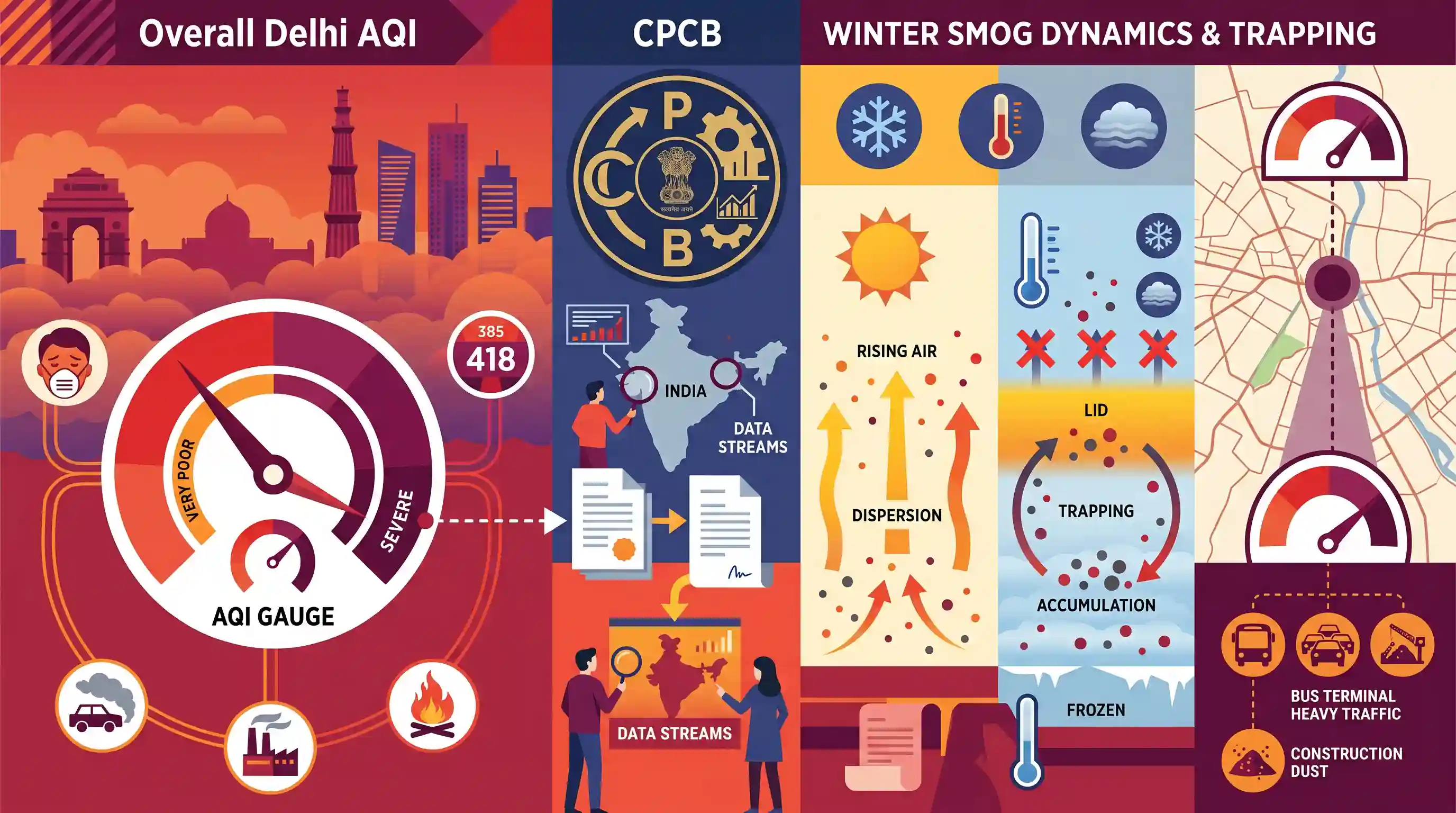
Delhi's air quality continued to be highly toxic, with the city's overall Air Quality Index (AQI) lingering in the 'very poor' category at 385. Specific areas like Anand Vihar crossed into the 'severe' category with an AQI of 418. The Central Pollution Control Board (CPCB) data indicates that such pollution levels are exacerbated by winter weather conditions, including lower temperatures and shallow fog, which trap particulate matter near the surface.
Key Points
- Delhi's air quality remained in the 'very poor' category, recording a 24-hour average Air Quality Index (AQI) of 385.
- Anand Vihar was severely affected, registering an AQI of 418, which falls into the 'severe' category.
- The Central Pollution Control Board (CPCB) categorizes AQI into six levels, ranging from 'good' (0-50) to 'severe' (401-500).
- The city also experienced a layer of shallow fog with a minimum temperature of 17.6°C, which can exacerbate the trapping of pollutants close to the ground.
Important Terms
Air Quality Index (AQI)

A tool for communicating daily air quality, converting complex pollutant data into a single number and color. It tracks eight major pollutants: PM10, PM2.5, NO2, SO2, CO, O3, NH3, and Lead (Pb).
UPSC context
GS Paper 3 (Environment); tests understanding of pollution monitoring frameworks and health impacts.
Central Pollution Control Board (CPCB)
A statutory body established in 1974 under the Water Act, later empowered by the Air Act (1981). It sets national air quality standards (NAAQS) and provides technical services to the Environment Ministry.
UPSC context
GS Paper 2 (Statutory Bodies) and Paper 3 (Pollution); evaluates institutional roles in environmental governance.
Graded Response Action Plan (GRAP)
Emergency measures implemented in Delhi-NCR when air quality dips below specific thresholds. It involves four stages (Poor to Severe+) with increasing restrictions on construction, vehicles, and industrial activity.
UPSC context
GS Paper 3 (Disaster Management/Environment); focuses on urban pollution management and emergency policy frameworks.
Particulate Matter (PM2.5)
Fine, inhalable particles with diameters 2.5 micrometers or smaller. They are particularly dangerous because they can penetrate deep into the lungs and enter the bloodstream, causing severe respiratory and cardiovascular issues.
UPSC context
GS Paper 3 (Pollution and Health); tests scientific literacy regarding hazardous pollutants.
Commission for Air Quality Management (CAQM)
A statutory body established in 2021 specifically for the Delhi-NCR and adjoining states. It coordinates inter-state pollution control and oversees the implementation of the Graded Response Action Plan (GRAP).
UPSC context
GS Paper 2 (Governance); examines federal coordination and specialized regulatory mechanisms for environmental crises.
Prelims Trap
"The Central Pollution Control Board (CPCB) was constituted under the Air (Prevention and Control of Pollution) Act, 1981."
CPCB was established under the Water (Prevention and Control of Pollution) Act, 1974. It was merely entrusted with additional powers under the Air Act later.
Static Concepts Connected
What meteorological phenomena trap pollutants over Delhi during winter?
- Temperature Inversion: Cold air near the surface is trapped by a warmer layer above, preventing the vertical mixing and dispersion of particulate matter.
- Low Wind Speeds: Lower winter wind speeds prevent the horizontal dispersion of pollutants, allowing them to accumulate over the NCR region.
- Topographical Basin: The Himalayas to the north and the Vindhyas to the south create a landlocked basin that limits the escape of trapped air.
Which 8 pollutants are measured to calculate the National Air Quality Index (AQI)?
- Particulate Matter: PM10 and PM2.5, which penetrate deep into the lungs and cardiovascular system.
- Toxic Gases: Nitrogen Dioxide (NO2), Sulphur Dioxide (SO2), Carbon Monoxide (CO), Ozone (O3), and Ammonia (NH3). Note that Carbon Dioxide (CO2) is excluded.
- Heavy Metal: Lead (Pb) is the only heavy metal tracked in the daily AQI calculation.
Cross-Topic Patterns
Winter Smog + Stubble Burning
Links physical geography (temperature inversion) with agricultural practices (kharif harvest stubble burning) and economy-driven farm mechanization subsidies (CRM scheme).
AQI Governance + CAQM Act 2021
Delhi's air quality management shifted from the ad-hoc EPCA to the statutory Commission for Air Quality Management (CAQM), which has sweeping overriding powers across NCR state boards.

Expect a multi-statement question contrasting WHO's stringent new PM2.5 air quality guidelines with India's NAAQS and AQI parameters.
Linked PYQs · 4
Linked PYQs · 4
- 2022PrelimsGS1
In the context of WHO Air Quality Guidelines, consider the following statements: 1. The 24-hour mean of PM2.5 should not exceed 15 µg/m³ and annual mean of PM2.5 should not exceed 5 µg/m³. 2. In a year, the highest levels of ozone pollution occur during the periods of inclement weather. 3. PM10 can penetrate the lung barrier and enter the bloodstream. 4. Excessive ozone in the air can trigger asthma. Which of the statements given above are correct?
- 2016PrelimsGS1
In the cities of our country, which among the following atmospheric gases are normally considered in calculating the value of Air Quality Index? 1. Carbon dioxide 2. Carbon monoxide 3. Nitrogen dioxide 4. Sulfur dioxide 5. Methane Select the correct answer using the code given below.
- 2025PrelimsGS1
Artificial way of causing rainfall to reduce air pollution makes use of
- 2019PrelimsGS1
Consider the following statements : The Environment Protection Act, 1986 empowers the Government of India to 1. state the requirement of public participation in the process of environmental protection, and the procedure and manner in which it is sought 2. lay down the standards for emission or discharge of environmental pollutants from various sources Which of the statements given above is/are correct?
