Delhi Air Quality Plummets to Very Poor Category During Diwali
Source:Indian Express ↗
Why It Matters
Delhi's annual winter air crisis is a recurring case study for GS3 (Environment) and GS2 (Governance/Judiciary). It highlights institutional coordination challenges (CAQM, CPCB, State Governments), the practical implementation of anti-pollution policies (GRAP), and the enforcement limitations of judicial orders (Supreme Court firecracker bans).
Summary
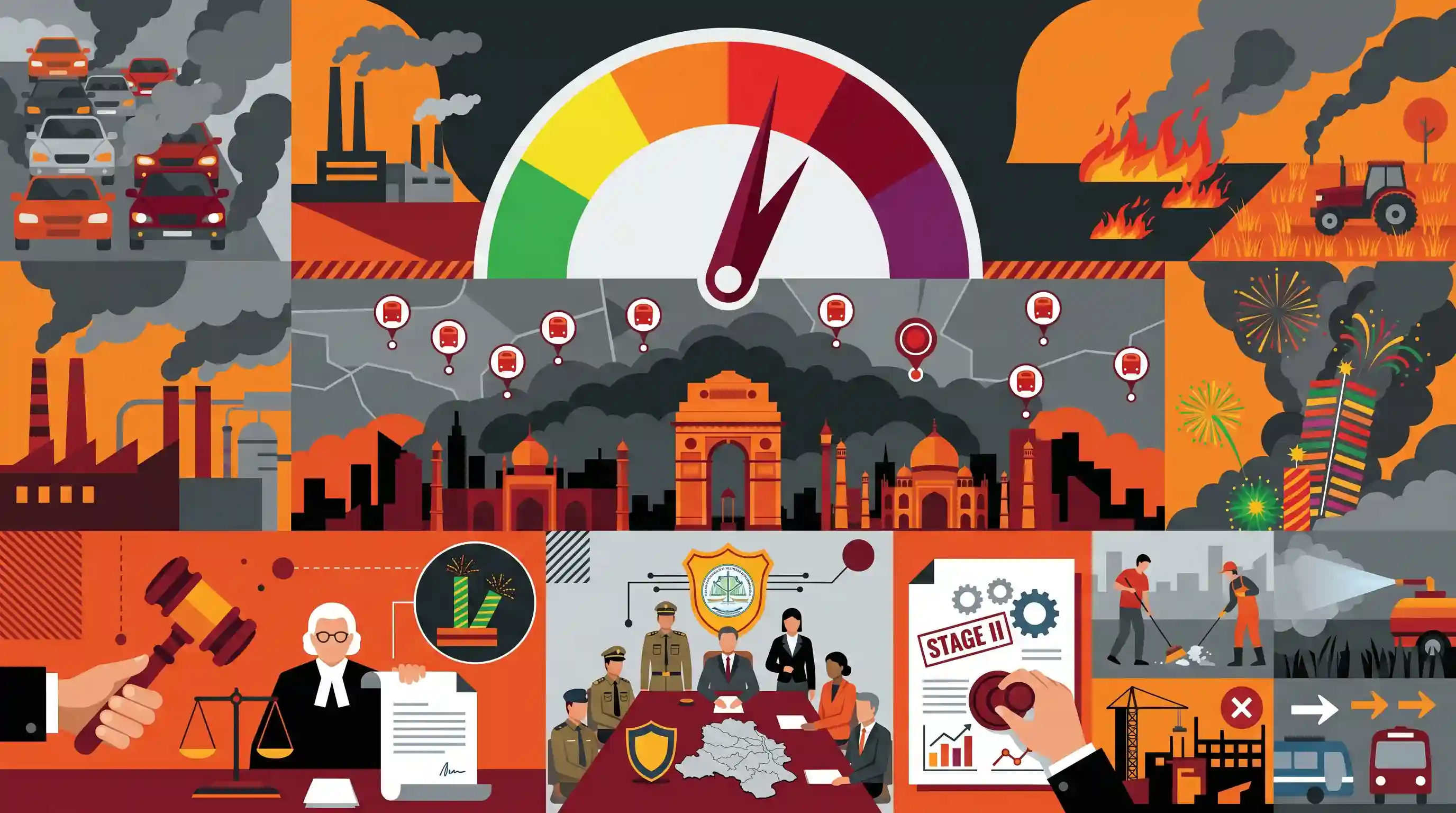
Delhi experienced severe air quality degradation on Diwali evening, with the city's overall Air Quality Index (AQI) falling into the 'very poor' category and 34 of 38 stations recording 'red zone' levels. Anand Vihar recorded the worst air quality, touching the 'severe' mark. The deterioration is attributed to a combination of vehicular emissions, industrial pollution, seasonal stubble burning, and the bursting of firecrackers, despite the Supreme Court's guidelines permitting only green firecrackers. In response to the escalating crisis, the Commission for Air Quality Management (CAQM) enacted Stage II of the Graded Response Action Plan (GRAP) across the Delhi-NCR region to implement emergency anti-pollution measures.
Key Points
- Delhi's Air Quality Index (AQI) worsened to the 'very poor' category on Diwali, with most monitoring stations recording 'red zone' levels.
- Anand Vihar emerged as a critical hotspot, recording an AQI in the 'severe' category (above 400).
- Major contributing factors to the poor air quality included vehicular transport (15.6%), industrial emissions (23.3%), and seasonal stubble burning.
- The Commission for Air Quality Management (CAQM) implemented Stage II of the Graded Response Action Plan (GRAP) to mitigate the escalating pollution levels in the NCR.
- Despite Supreme Court guidelines restricting conventional fireworks and permitting only 'green firecrackers' for specific durations, localized violations contributed to the smog.
Important Terms
Commission for Air Quality Management (CAQM)

A statutory body established in 2021 to coordinate, research, and resolve air quality issues in Delhi-NCR and adjoining states with powers to issue binding directions.
UPSC context
GS Papers II & III; key for environmental governance, statutory bodies, and interstate regulatory coordination.
Graded Response Action Plan (GRAP)
An emergency framework in Delhi-NCR that triggers specific anti-pollution measures across four stages (Poor to Severe+) based on prevailing Air Quality Index (AQI) levels.
UPSC context
GS Paper III (Environment); essential for understanding administrative responses to seasonal urban pollution crises.
Air Quality Index (AQI)
A metric used to communicate daily air quality levels to the public, categorizing pollution from 'Good' to 'Severe' based on eight major pollutants.
UPSC context
GS Paper III (Environment); critical for monitoring environmental health and evaluating pollution control standards.
Green Firecrackers
Eco-friendly fireworks developed by CSIR-NEERI that reduce particulate emissions by ~30% and exclude toxic chemicals like barium nitrate, verified via QR codes.
UPSC context
GS Paper III (Environment/S&T); highlights technological interventions and judicial mandates for sustainable festive celebrations.
Central Pollution Control Board (CPCB)
The statutory organization under the Ministry of Environment responsible for setting pollution standards, monitoring air/water quality, and providing technical services nationwide.
UPSC context
GS Papers II & III; fundamental body for environmental regulation and implementation of federal pollution laws.
Stubble Burning
The practice of burning crop residue to clear fields for the next season, a major contributor to winter smog and particulate matter in North India.
UPSC context
GS Paper III (Agriculture/Environment); significant for topics on sustainable farming, air pollution, and interstate environmental challenges.
Prelims Trap
The National Air Quality Index includes Carbon Dioxide (CO2) and Methane (CH4) among its 8 monitored pollutants.
CO2 and Methane are greenhouse gases, not criteria air pollutants. AQI measures Carbon Monoxide (CO), alongside PM2.5, PM10, SO2, NO2, Ozone (O3), Ammonia, and Lead.
Static Concepts Connected
Which 8 pollutants are monitored under the National Air Quality Index (AQI)?
- Particulate Matter: PM10 and PM2.5 are the primary drivers of the air quality index.
- Reactive Gases: Sulphur Dioxide (SO2), Nitrogen Dioxide (NO2), Carbon Monoxide (CO), and ground-level Ozone (O3).
- Other Pollutants: Ammonia (NH3) and Lead (Pb). Note that Carbon Dioxide (CO2) is explicitly excluded from the AQI.
What are the core powers and jurisdiction of the CAQM?
- Statutory Backing: Established by the CAQM Act 2021, replacing the Supreme Court-mandated EPCA for the NCR region.
- Overriding Authority: Its orders prevail over State Pollution Control Boards of Delhi, Punjab, Haryana, UP, and Rajasthan regarding NCR air quality.
- Penal Powers: Empowered to levy environmental compensation, shut down polluting industries, and unilaterally enforce GRAP stages.
Cross-Topic Patterns
Stubble burning + Agri-economics
Crop residue burning stems directly from MSP-backed paddy procurement and delayed harvesting caused by groundwater preservation laws, linking environmental degradation to agricultural policies.
Green crackers + CSIR-NEERI tech
Prelims frequently tests environmental tech. Green crackers (SWAS, SAFAL, STAR) developed by CSIR-NEERI use water-release mechanisms to suppress dust and eliminate the toxic salt Barium Nitrate.

Expect a question testing statutory powers of CAQM over State Boards, paired with the specific 8 pollutants comprising the National AQI.
Linked PYQs · 5
Linked PYQs · 5
- 2016PrelimsGS1
In the cities of our country, which among the following atmospheric gases are normally considered in calculating the value of Air Quality Index? 1. Carbon dioxide 2. Carbon monoxide 3. Nitrogen dioxide 4. Sulfur dioxide 5. Methane Select the correct answer using the code given below.
- 2022PrelimsGS1
In the context of WHO Air Quality Guidelines, consider the following statements: 1. The 24-hour mean of PM2.5 should not exceed 15 µg/m³ and annual mean of PM2.5 should not exceed 5 µg/m³. 2. In a year, the highest levels of ozone pollution occur during the periods of inclement weather. 3. PM10 can penetrate the lung barrier and enter the bloodstream. 4. Excessive ozone in the air can trigger asthma. Which of the statements given above are correct?
- 2021MainsGS3
Describe the key points of the revised Global Air Quality Guidelines (AQGs) recently released by the World Health Organisation (WHO). How are these different from its last update in 2005? What changes in India's National Clean Air Programme are required to achieve these revised standards?
- 2025PrelimsGS1
Artificial way of causing rainfall to reduce air pollution makes use of
- 2022MainsGS2
“The most significant achievement of modern law in India is the constitutionalization of environmental problems by the Supreme Court.” Discuss this statement with the help of relevant case laws.
