Delhi Air Quality Improves Marginal Transition to Poor Category
Source:The Hindu ↗
Why It Matters
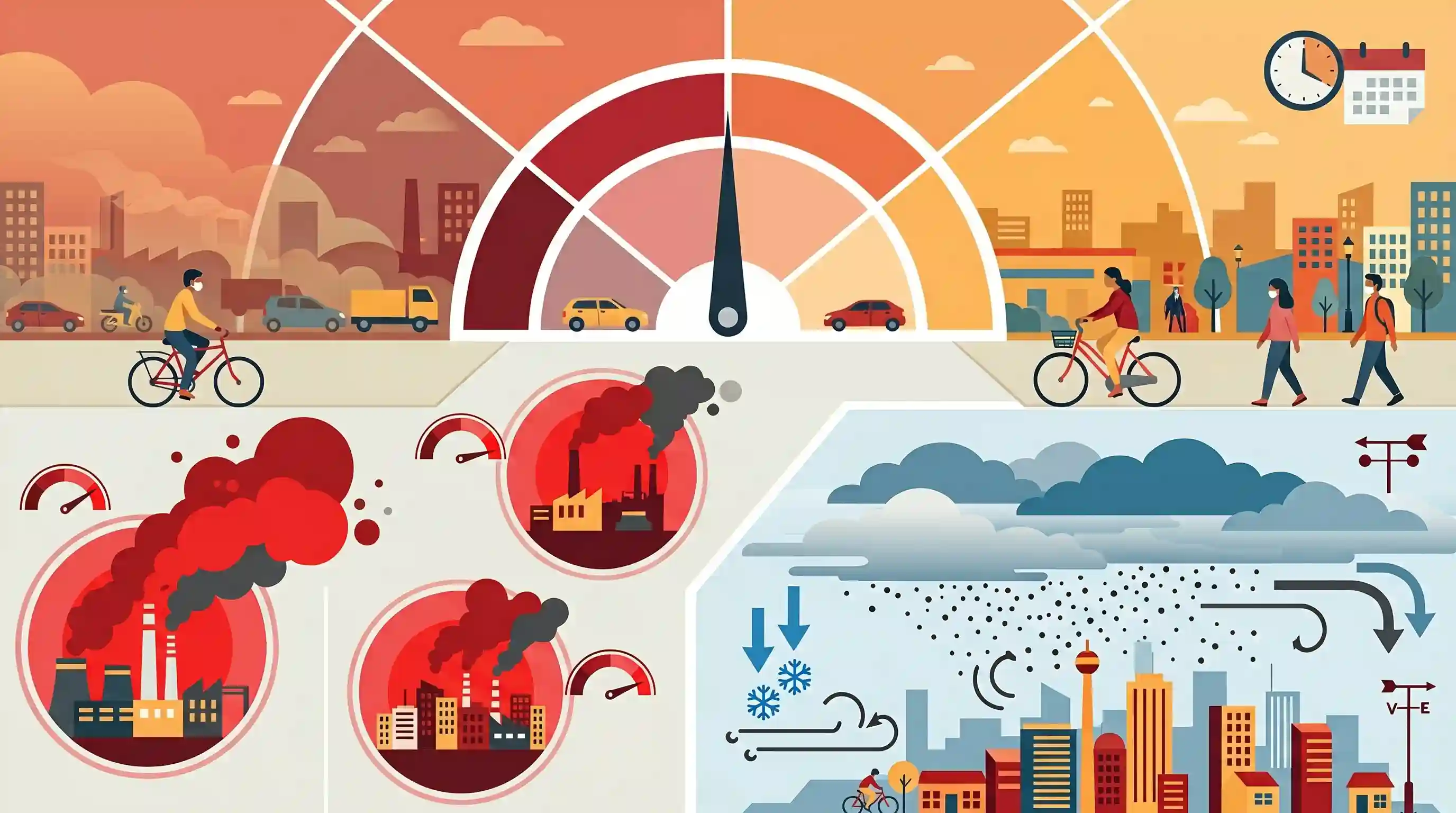
Winter air pollution in Delhi is a recurring environmental crisis that regularly appears in both Prelims and Mains. Understanding how the AQI is calculated, the pollutants it measures (PM2.5, PM10, etc.), the role of the CPCB, and how geographical and meteorological factors like temperature inversion and humidity trap pollutants is fundamental for the Environment and Ecology syllabus.
Summary
Delhi's air quality witnessed a marginal improvement on October 31, moving from the 'very poor' to the 'poor' category with an overall Air Quality Index (AQI) of 268. According to data from the Central Pollution Control Board's (CPCB) Sameer app, while the city average improved, several hotspots like Wazirpur and Bawana remained heavily polluted 'red zones' with AQI levels exceeding 300. The prevailing weather conditions, including high humidity and fog, remain critical factors in the accumulation and poor dispersion of winter particulate pollution in the national capital.
Key Points
- Delhi's overall Air Quality Index (AQI) recorded a slight improvement, transitioning from 'very poor' (373) to 'poor' (268).
- The data was accessed via the Sameer app, a platform developed by the Central Pollution Control Board (CPCB) to provide hourly AQI updates.
- Despite the overall drop in the index, specific industrial and high-traffic areas like Wazirpur (355) and Bawana (349) remained in the 'red zone'.
- The CPCB classifies AQI between 0-50 as good, 51-100 as satisfactory, 101-200 as moderate, 201-300 as poor, 301-400 as very poor, and 401-500 as severe.
- Meteorological factors such as a minimum temperature of 21.6°C, high relative humidity of 98%, and foggy conditions continue to influence pollutant dispersion in the region.
Important Terms
Air Quality Index (AQI)

A numerical scale (0-500) simplified into 'One Number-One Color-One Description' to communicate daily air quality. It monitors eight pollutants: PM10, PM2.5, NO2, SO2, CO, O3, NH3, and Pb.
UPSC context
GS3: Environmental Pollution. Tests knowledge of pollution metrics, the National Clean Air Programme (NCAP), and health impact standards.
Central Pollution Control Board (CPCB)
A statutory body established in 1974 under the Water Act and later the Air Act (1981). It functions as India's apex technical authority for pollution monitoring and environmental standard-setting.
UPSC context
GS2/GS3: Statutory Bodies. Relevant for understanding institutional frameworks and the enforcement of environmental laws in India.
Graded Response Action Plan (GRAP)
An emergency framework for Delhi-NCR that mandates stage-wise actions (Stage I-IV) as AQI levels deteriorate. It was formulated following Supreme Court directives to prevent pollution from reaching hazardous levels.
UPSC context
GS3: Environmental Management. Tests understanding of crisis response, judicial activism (M.C. Mehta case), and regional pollution mitigation.
Thermal Inversion
A meteorological condition where a warm air layer traps cooler air near the surface, reversing the normal lapse rate. This 'capping' effect prevents pollutants from dispersing vertically, worsening winter smog.
UPSC context
GS1/GS3: Geography/Environment. Explains why North India experiences severe pollution accumulation during winter despite static emission levels.
Particulate Matter (PM)
Microscopic solid or liquid droplets in the air categorized by size (e.g., PM2.5, PM10). These particles are small enough to enter the lungs and bloodstream, posing major health risks.
UPSC context
GS3: Environment/Science. Key metric for studying the health impacts of urban air pollution and industry standards.
Prelims Trap
"Carbon dioxide (CO2) is one of the eight core pollutants measured to calculate the National Air Quality Index."
UPSC frequently swaps Carbon Monoxide (CO) with Carbon Dioxide (CO2). CO2 and greenhouse gases are NOT part of the 8 core AQI pollutants.
Static Concepts Connected
What is the statutory framework governing the CPCB?
- Formation: The CPCB is a statutory organisation constituted in September 1974 under the Water (Prevention and Control of Pollution) Act, 1974.
- Air Act Powers: It was later entrusted with additional powers and functions under the Air (Prevention and Control of Pollution) Act, 1981.
- Nodal Ministry: It provides technical services to the Ministry of Environment, Forest and Climate Change (MoEFCC).
How does 'Temperature Inversion' worsen winter air pollution?
- Mechanism: A reversal of normal tropospheric behavior where a layer of warm air sits above cooler surface air.
- Pollution Trap: This inversion layer acts as a 'lid', preventing vertical mixing and trapping particulate matter and smog close to the ground.
- Winter Aggravation: Winter conditions like long nights, clear skies, and calm winds strongly favor the development of surface temperature inversions in North India.
Cross-Topic Patterns
CAQM and GRAP implementation
Severe AQI directly triggers statutory GRAP measures under the Commission for Air Quality Management (CAQM), an entity frequently contrasted with CPCB mandates in Prelims.
Vehicular emissions and Ethanol Blending
Urban PM2.5 and NOx spikes drive systemic policy shifts, linking seasonal air quality drops to BS-VI emission standards, EV subsidies (FAME), and India's E20 biofuel target.

Expect a 2026 multi-statement question contrasting India's 8-pollutant AQI against WHO Air Quality Guidelines and CAQM/CPCB mandates.
Linked PYQs · 4
Linked PYQs · 4
- 2016PrelimsGS1
In the cities of our country, which among the following atmospheric gases are normally considered in calculating the value of Air Quality Index? 1. Carbon dioxide 2. Carbon monoxide 3. Nitrogen dioxide 4. Sulfur dioxide 5. Methane Select the correct answer using the code given below.
- 2022PrelimsGS1
In the context of WHO Air Quality Guidelines, consider the following statements: 1. The 24-hour mean of PM2.5 should not exceed 15 µg/m³ and annual mean of PM2.5 should not exceed 5 µg/m³. 2. In a year, the highest levels of ozone pollution occur during the periods of inclement weather. 3. PM10 can penetrate the lung barrier and enter the bloodstream. 4. Excessive ozone in the air can trigger asthma. Which of the statements given above are correct?
- 2021MainsGS3
Describe the key points of the revised Global Air Quality Guidelines (AQGs) recently released by the World Health Organisation (WHO). How are these different from its last update in 2005? What changes in India's National Clean Air Programme are required to achieve these revised standards?
- 2025PrelimsGS1
Artificial way of causing rainfall to reduce air pollution makes use of
