Delhi Air Quality Remains in Poor Category for Consecutive Days
Source:The Hindu ↗
Why It Matters
Delhi's recurring winter air pollution crisis is a quintessential example of urban environmental degradation. It is highly relevant for UPSC GS3 (Environment) and GS2 (Governance), requiring aspirants to understand the technical parameters (AQI), the role of statutory bodies (CPCB, CAQM), policy interventions like the National Clean Air Programme (NCAP) or GRAP, and potential technological solutions.
Summary
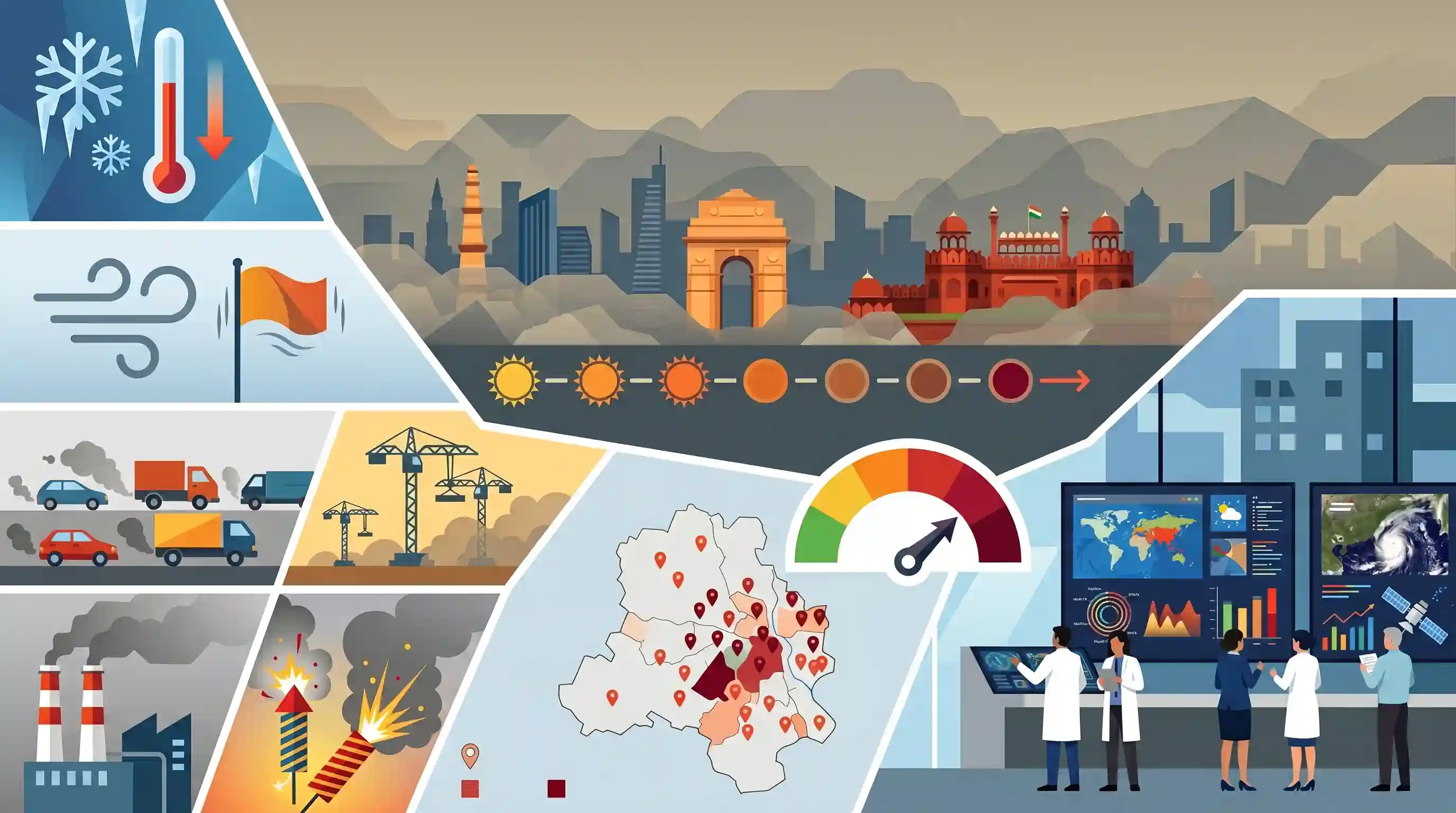
Delhi's air quality has lingered in the 'poor' category for six consecutive days, with an average AQI of 284, while 12 out of 38 monitoring stations reported 'very poor' conditions. Factors compounding the smog include seasonal drops in temperature, sluggish wind speeds, and localized emissions including firecracker ban violations. Regulatory bodies like the Central Pollution Control Board (CPCB) and India Meteorological Department (IMD) continue monitoring the situation as the capital faces its annual winter pollution crisis.
Key Points
- Delhi's Air Quality Index (AQI) remained in the 'poor' category for a sixth consecutive day, registering an average of 284.
- Several localized monitoring stations, including Anand Vihar and Wazirpur, recorded 'very poor' to 'severe' AQI levels.
- The persistent pollution is driven by a combination of dropping winter temperatures, stagnant winds, and violations of the firecracker ban.
- Institutions like the CPCB track the data, underscoring the seasonal challenge of urban air pollution governance in the National Capital Region.
Important Terms
Air Quality Index (AQI)

A color-coded scale (0–500) providing "One Number-One Colour-One Description" to communicate air quality. It monitors eight pollutants: PM10, PM2.5, NO2, SO2, CO, O3, NH3, and Pb.
UPSC context
GS Paper 3 (Environment). Essential for understanding pollution monitoring metrics and their direct public health implications.
Graded Response Action Plan (GRAP)
An emergency framework for Delhi-NCR that mandates specific pollution-control actions across four stages, triggered by AQI thresholds and implemented by the Commission for Air Quality Management (CAQM).
UPSC context
GS Paper 3 (Environment). Key for urban pollution governance and disaster management in the National Capital Region.
Central Pollution Control Board (CPCB)
A statutory body established under the Water Act (1974) and empowered by the Air Act (1981) to improve air quality and provide technical services for pollution control nationwide.
UPSC context
GS Paper 2 & 3. Tests knowledge of statutory regulatory frameworks and institutional roles in environmental protection.
National Clean Air Programme (NCAP)
A time-bound national strategy launched in 2019 aiming for a 40% reduction in particulate matter (PM10) concentrations by 2026 across identified "non-attainment" Indian cities.
UPSC context
GS Paper 3 (Environment). Vital for understanding national targets, policy gaps, and long-term environmental strategies.
India Meteorological Department (IMD)
The principal government agency for weather forecasting and meteorological observations. It provides critical data on wind speed and temperature that influence seasonal smog and pollutant dispersal.
UPSC context
GS Paper 1 & 3. Relevant for physical geography, climate change, and multi-agency coordination in early warning.
Prelims Trap
The National Air Quality Index (AQI) includes Carbon Dioxide (CO2) and Methane (CH4) in its eight-pollutant calculation.
AQI measures Carbon Monoxide (CO), not CO2 or Methane. CO2 is a greenhouse gas but not part of the 8 criteria pollutants (PM10, PM2.5, NO2, SO2, CO, O3, NH3, Pb) for AQI.
Static Concepts Connected
What is the statutory framework governing the Central Pollution Control Board (CPCB)?
- Statutory Genesis: CPCB was constituted as a statutory organization under the Water (Prevention and Control of Pollution) Act, 1974, not the Environment Protection Act.
- Additional Powers: It was subsequently entrusted with powers and functions under the Air (Prevention and Control of Pollution) Act, 1981.
What are the core mechanisms of the Graded Response Action Plan (GRAP)?
- Emergency Framework: It is a dynamic, emergency response framework implemented progressively based on real-time and forecasted AQI severity.
- Enforcement Authority: It is enforced by the Commission for Air Quality Management (CAQM), a statutory body that replaced the Supreme Court-mandated EPCA.
- Stage-wise Curbs: Actions range from heavy-vehicle entry bans to shutting down construction activities across four stages (Poor to Severe+).
Cross-Topic Patterns
Temperature Inversion & Winter Smog
Stagnant winds and subsidence of cold air trap pollutants near the surface, linking core physical geography (climatology) with urban environmental degradation.
Paddy cultivation & MSP distortion
Winter stubble burning is inherently linked to water-intensive paddy-wheat crop cycles, which are artificially sustained by MSP regimes and delayed-sowing laws protecting groundwater.

Expect a multi-statement question combining CAQM's statutory powers, GRAP stages, and the exact 8 pollutants measured under the AQI.
Linked PYQs · 3
Linked PYQs · 3
- 2020MainsGS3
What are the key features of the National Clean Air Programme (NCAP) initiated by the Government of India?
- 2021MainsGS3
Describe the key points of the revised Global Air Quality Guidelines (AQGs) recently released by the World Health Organisation (WHO). How are these different from its last update in 2005? What changes in India's National Clean Air Programme are required to achieve these revised standards?
- 2025PrelimsGS1
Artificial way of causing rainfall to reduce air pollution makes use of
