Delhi Urban Air Quality Management and Firecracker Bans
Source:The Hindu ↗
Why It Matters
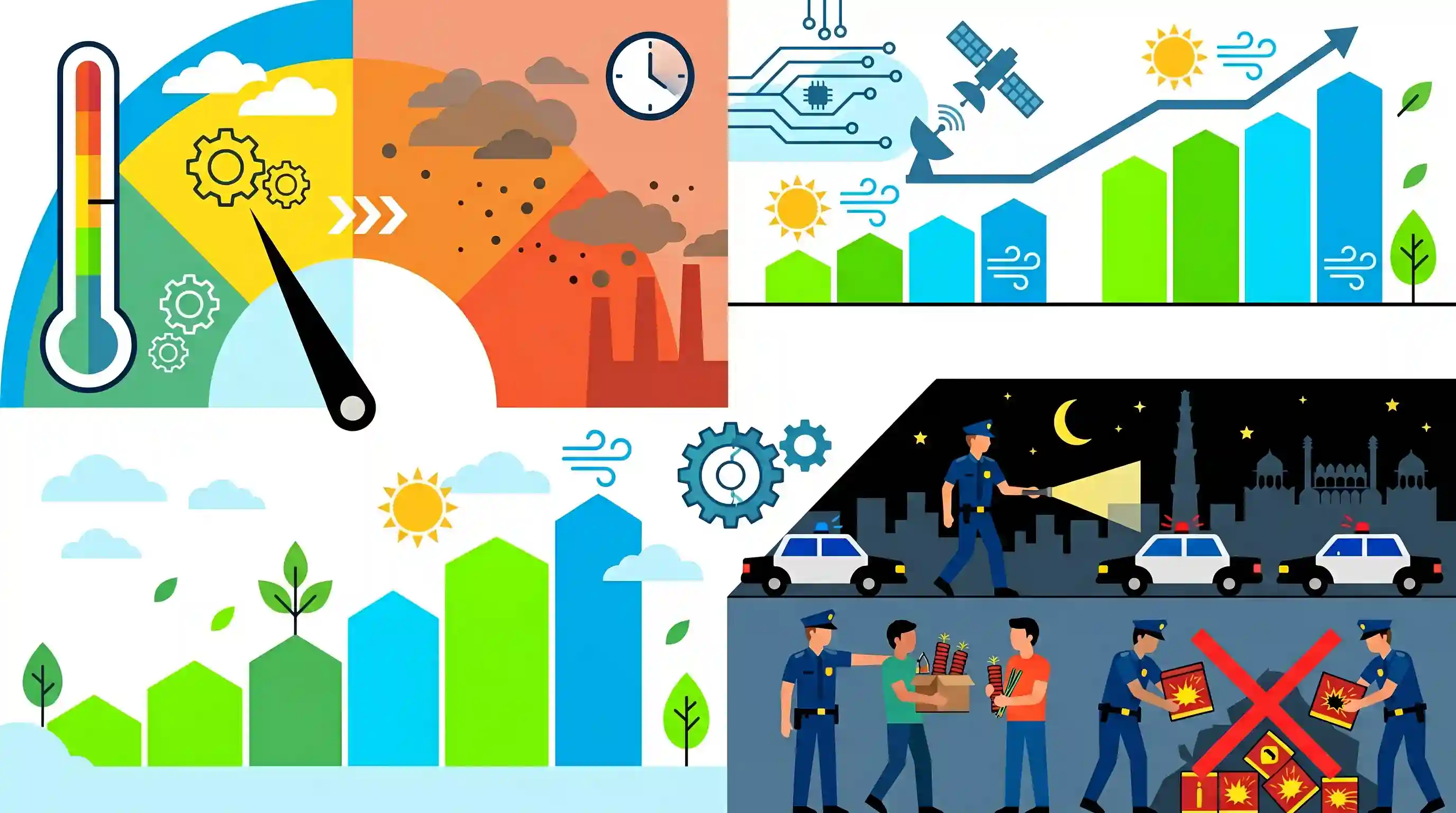
Highlights the practical metrics (AQI, clean air days) used to assess urban air quality, and emphasizes the critical intersection of environmental policy and strict law enforcement (e.g., firecracker bans) required to manage seasonal pollution spikes in metropolitan areas like Delhi.
Summary
Delhi's air quality temporarily improved to the 'moderate' category, though early warning systems predict a drop to 'poor' by midweek. Environmental authorities highlighted a long-term positive trend, noting that Delhi recorded 199 'clean air days' in 2025—up from 110 in 2016—attributing this to a technology-backed policy approach. Simultaneously, to prevent pollution spikes during the upcoming festive season, Delhi Police have heightened enforcement of the complete ban on firecrackers in the NCR through increased night patrolling and active seizures.
Key Points
- Delhi's 24-hour average Air Quality Index (AQI) briefly improved to 167 (moderate category), though a deterioration to 'poor' is expected by mid-week.
- The number of 'clean air days' in Delhi has increased significantly, reaching 199 in 2025 compared to 110 in 2016.
- The improvement is credited to an integrated, technology-backed strategy led by both the Central and State governments.
- A comprehensive ban on the sale, manufacture, and storage of firecrackers remains active across Delhi-NCR ahead of the festive season.
- Delhi Police have intensified enforcement efforts, utilizing night patrols and seizing illegal firecrackers in areas like Seelampur and Gokalpuri.
Important Terms
Central Pollution Control Board (CPCB)

A statutory organization established in 1974 under the Water Act, later empowered by the Air Act (1981). It serves as India's apex authority for pollution control and environmental standards.
UPSC context
GS Paper 2 (Governance) & GS Paper 3 (Environment). Tests knowledge of environmental regulatory frameworks and statutory bodies.
Air Quality Early Warning System (AQEWS)
A decision support system developed by IITM Pune that predicts extreme pollution events 3-10 days in advance, allowing for proactive implementation of the Graded Response Action Plan (GRAP).
UPSC context
GS Paper 3 (Environmental Pollution). Focuses on technology-backed policy interventions and scientific management of urban air quality.
Delhi Police (Environmental Enforcement)
The enforcement agency in the NCR responsible for implementing environmental bans, such as the complete prohibition of non-green firecrackers and conducting night patrols to prevent pollution spikes.
UPSC context
GS Paper 2 (Executive/Governance). Tests the role of law enforcement in implementing judicial mandates and public health policies.
Air Quality Index (AQI)
A composite metric used to communicate air quality status. In Delhi, 'clean air days' refer to days categorized as 'Good,' 'Satisfactory,' or 'Moderate' (AQI < 200).
UPSC context
GS Paper 3 (Pollution). Essential for understanding environmental monitoring and standardizing health risk communication.
Commission for Air Quality Management (CAQM)
A statutory body created in 2021 to streamline air quality management in the NCR. It replaced the EPCA and coordinates between Delhi, Haryana, Punjab, Rajasthan, and UP.
UPSC context
GS Paper 2 & 3. Tests coordination between central and state governments in resolving inter-state environmental issues.
Prelims Trap
Carbon Dioxide and Methane are key pollutants tracked to calculate the National Air Quality Index (AQI).
The National AQI tracks 8 specific criteria pollutants (PM2.5, PM10, NO2, SO2, CO, O3, NH3, Pb). It explicitly excludes major greenhouse gases like Carbon Dioxide and Methane.
Static Concepts Connected
What pollutants are tracked under India's National Air Quality Index (AQI)?
- Particulate Matter: PM10 and PM2.5 are the primary particulate markers tracked for respiratory impact.
- Gases: Nitrogen Dioxide (NO2), Sulfur Dioxide (SO2), Carbon Monoxide (CO), Ozone (O3), and Ammonia (NH3).
- Heavy Metals: Lead (Pb) is the only heavy metal included in the 8-pollutant AQI basket.
What is the statutory mandate and authority of the CAQM?
- Statutory Body: Established via the CAQM Act 2021, replacing the Supreme Court-mandated EPCA to manage NCR air quality.
- Jurisdiction: It covers Delhi, Punjab, Haryana, Rajasthan, and UP, specifically focusing on cross-border pollution sources.
- Overriding Powers: Its orders and directives prevail over those of State Pollution Control Boards in case of conflicts.
Cross-Topic Patterns
Airshed management vs. Federalism
Pollution ignores state borders. The CAQM's overriding powers over State Pollution Control Boards highlight the shift towards 'airshed' governance, frequently testing cooperative federalism in the NCR region.
Article 21 vs. Article 19(1)(g)
Blanket firecracker bans invoke Article 21 (right to clean air) overriding Article 19(1)(g) (manufacturers' livelihood), a constitutional friction that prompted the Supreme Court to push for NEERI's Green Crackers.

Expect a multi-statement Prelims question in 2026 contrasting AQI pollutants (no CO2) with NCAP targets and the CAQM's statutory powers.
Linked PYQs · 4
Linked PYQs · 4
- 2020MainsGS3
What are the key features of the National Clean Air Programme (NCAP) initiated by the Government of India?
- 2021MainsGS3
Describe the key points of the revised Global Air Quality Guidelines (AQGs) recently released by the World Health Organisation (WHO). How are these different from its last update in 2005? What changes in India's National Clean Air Programme are required to achieve these revised standards?
- 2022MainsGS3
Discuss in detail the photochemical smog emphasizing its formation, effects and mitigation. Explain the 1999 Gothenburg Protocol.
- 2025PrelimsGS1
Artificial way of causing rainfall to reduce air pollution makes use of
