स्कूल बंद करने और मध्याह्न भोजन योजनाओं की न्यायिक समीक्षा
स्रोत:द हिंदू ↗
क्यों मायने रखता है
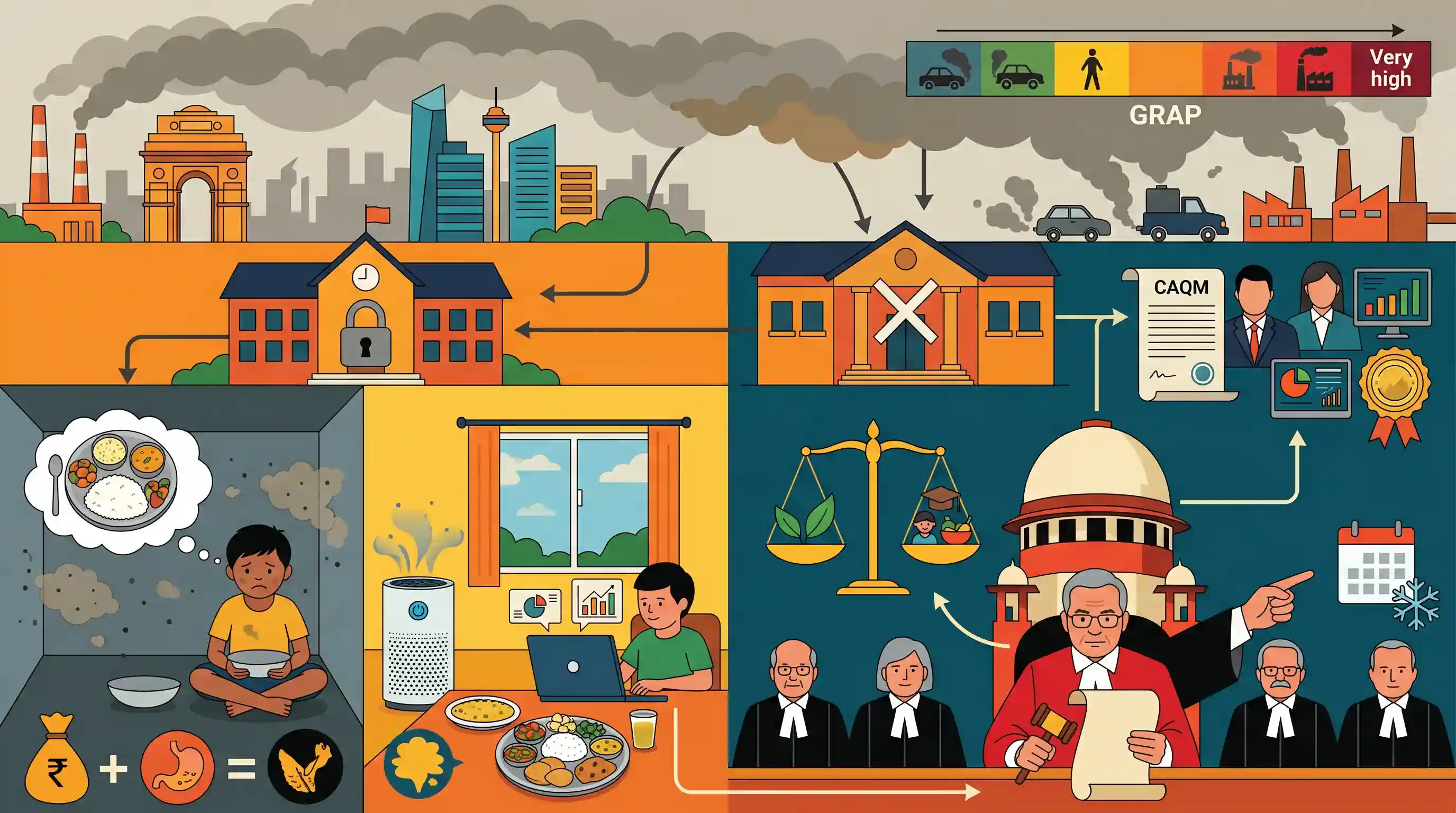
This issue perfectly illustrates the 'policy contradictions' often seen in governance, where an environmental mandate (closing schools to reduce exposure and vehicular emissions) inadvertently triggers a social justice crisis (depriving poor children of essential nutrition and education). It is highly relevant for GS-2 (Social Justice/Vulnerable Sections) and GS-3 (Environment).
सारांश
The Supreme Court of India reviewed a plea against the closure of primary schools in Delhi due to severe air pollution under the Graded Response Action Plan (GRAP). Petitioners argued that such closures disproportionately harm economically vulnerable children by depriving them of crucial nutrition from the Mid-Day Meal scheme, while failing to shield them from pollution at home. While acknowledging the socio-economic inequalities exacerbated by hybrid education models, Chief Justice of India Sanjiv Khanna declined to order an immediate reopening, citing the upcoming winter break. The Court deferred the final decision to the Commission for Air Quality Management (CAQM), highlighting the complex intersection between environmental mitigation policies and social welfare.
मुख्य बिंदु
- Petitioners challenged the closure of primary schools in Delhi under anti-pollution measures (GRAP), arguing it deprives poor children of their daily nutritional support via the Mid-Day Meal Scheme.
- The petitioners highlighted that school closures do not protect economically vulnerable children from pollution, as their homes typically lack air purifiers and are often located in highly polluted areas.
- Chief Justice of India Sanjiv Khanna noted that hybrid learning models inherently discriminate against poorer students who lack the digital infrastructure available to wealthier students.
- The Supreme Court refrained from passing immediate orders to reopen schools, citing the approaching winter break and deferring the policy decision to the domain expertise of the Commission for Air Quality Management (CAQM).
महत्वपूर्ण शब्द
PM POSHAN (Mid-Day Meal Scheme)

A centrally sponsored scheme (renamed PM POSHAN) providing one hot-cooked meal daily to students in government schools to improve nutritional status, school enrollment, and social socialization.
UPSC context
GS Paper 2 (Social Justice) & GS 3 (Malnutrition); tests welfare schemes for vulnerable sections and nutrition security.
Graded Response Action Plan (GRAP)
An emergency framework for Delhi-NCR that mandates stage-wise anti-pollution measures (Stages I-IV) based on the severity of the Air Quality Index (AQI) and weather forecasts.
UPSC context
GS Paper 3 (Environment); tests urban pollution mitigation strategies and administrative responses to environmental crises.
वायु गुणवत्ता प्रबंधन आयोग (CAQM)
A statutory body established in 2021 to coordinate and enforce air pollution control measures across the National Capital Region and adjoining states like Punjab and Haryana.
UPSC context
GS Paper 3 (Environmental Governance); tests statutory bodies and inter-state coordination in addressing regional environmental challenges.
Judicial Activism
The proactive role of the judiciary in interpreting constitutional provisions (like Article 21) to protect fundamental rights and enforce executive accountability in public interest matters.
UPSC context
GS Paper 2 (Polity); tests the separation of powers, Public Interest Litigation (PIL), and the judiciary's role in social justice.
प्रारंभिक ट्रैप
"The Commission for Air Quality Management (CAQM) is a Supreme Court-appointed committee."
CAQM is a statutory body created by an Act of Parliament in 2021. It replaced the EPCA, which was the actual Supreme Court-appointed authority.
संबंधित अवधारणाएँ
What are the statutory provisions governing the Mid-Day Meal (PM POSHAN) scheme?
- Statutory backing: Mandated under the National Food Security Act (NFSA), 2013, ensuring a legal right to nutrition for eligible children.
- Coverage: Targets children in classes I-VIII studying in government, government-aided schools, and special training centers.
- Food Security Allowance: If meals are not provided due to disruptions (like school closures), states are legally obligated to pay a Food Security Allowance to beneficiaries.
What are the powers and mandate of the CAQM?
- Statutory Status: Established by the CAQM Act, 2021, replacing the SC-appointed Environment Pollution (Prevention and Control) Authority (EPCA).
- अधिभावी शक्तियां: In cases of conflict, CAQM’s orders and directives prevail over those of state governments and State Pollution Control Boards in the NCR.
- Penal Provisions: Possesses powers to impose fines and order closures of polluting industries, though farmers are exempt from criminal penalties for stubble burning.
अंतर-विषय पैटर्न
पर्यावरणीय उपाय बनाम सामाजिक कल्याण
Shows how blunt environmental tools like GRAP inadvertently disrupt institutional welfare (PM POSHAN), highlighting the complex trade-offs in urban policy interventions and the socio-economic costs of pollution.
Shifting Judicial Environmentalism
The SC’s deferral to CAQM illustrates a shift from the judicial activism of the 1990s (MC Mehta cases) to reliance on specialized statutory commissions for operational environmental governance.

CAQM’s overriding statutory powers + PM POSHAN’s Food Security Allowance rules are ripe for a paired multi-statement Prelims question.
संबद्ध PYQ · 4
संबद्ध PYQ · 4
- 2024MainsGS2
Poverty and malnutrition create a vicious cycle, adversely affecting human capital formation. What steps can be taken to break the cycle ?
- 2022MainsGS2
“The most significant achievement of modern law in India is the constitutionalization of environmental problems by the Supreme Court.” Discuss this statement with the help of relevant case laws.
- 2021MainsGS3
Describe the key points of the revised Global Air Quality Guidelines (AQGs) recently released by the World Health Organisation (WHO). How are these different from its last update in 2005? What changes in India's National Clean Air Programme are required to achieve these revised standards?
- 2018MainsGS2
“Policy contradictions among various competing sectors and stakeholders have resulted in inadequate 'protection and prevention of degradation' to environment.” Comment with relevant illustrations.
