Opposition demands parliamentary discussion on Delhi air pollution
Source:Indian Express ↗
Why It Matters
The recurrent air pollution crisis in North India, especially Delhi, is a critical environmental and public health issue. UPSC frequently tests the causes of pollution, government mitigation strategies (like NCAP), and the health implications of poor air quality (e.g., WHO guidelines) in both Prelims and GS3.
Summary
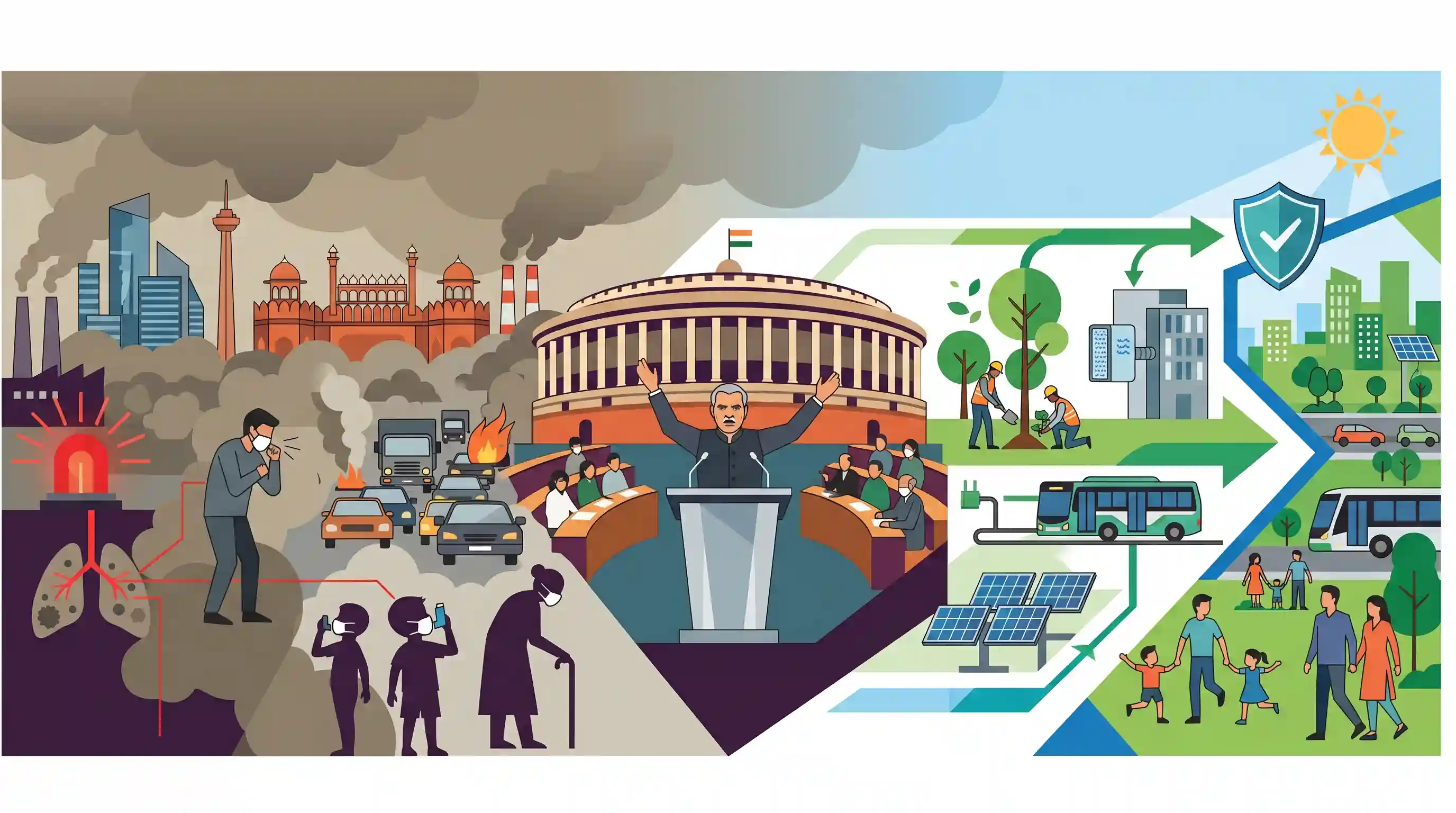
Leader of Opposition Rahul Gandhi demanded a discussion in Parliament on the severe air pollution crisis in Delhi, describing the toxic smog as a 'national health emergency'. Emphasizing the severe health risks posed to citizens, especially vulnerable groups like children and the elderly, he urged the government to take immediate and comprehensive action. The demand highlights the intersection of environmental degradation and public health, pointing to the urgent need for effective implementation of mitigation measures like the National Clean Air Programme.
Key Points
- Leader of Opposition Rahul Gandhi termed the severe air pollution in Delhi a 'national health emergency'.
- He demanded a dedicated discussion in Parliament to address the toxic smog and its severe health impacts.
- The crisis highlights the vulnerabilities of residents, particularly children and the elderly, to hazardous PM2.5 levels.
- The persistent pollution underscores the limitations of current environmental mitigation strategies and the need for urgent policy interventions.
Important Terms
National Clean Air Programme (NCAP)

India’s first national framework launched in 2019 to reduce particulate matter (PM2.5 and PM10) concentrations by 20-40% in 131 cities by 2026.
UPSC context
GS Paper III (Environment); relevant for prelims (targets) and mains (policy effectiveness in pollution mitigation).
Graded Response Action Plan (GRAP)
A set of emergency measures implemented in Delhi-NCR based on AQI thresholds, ranging from Stage I (Poor) to Stage IV (Severe+).
UPSC context
GS Paper III; tests knowledge of institutional mechanisms and judicial interventions in pollution control.
Commission for Air Quality Management (CAQM)
A statutory body established in 2021 to coordinate and oversee air pollution management in the National Capital Region (NCR) and adjoining areas.
UPSC context
GS Paper III; significant for understanding governance and regulatory frameworks for North India's air quality.
Leader of Opposition (LoP)
A statutory role representing the head of the largest opposition party in Parliament, holding the rank of Cabinet Minister and ensuring government accountability.
UPSC context
GS Paper II (Polity); vital for questions on parliamentary democracy, checks and balances, and statutory committees.
Air Quality Index (AQI)
A color-coded numerical scale (0-500) that measures eight major air pollutants to communicate quality levels and associated health risks to the public.
UPSC context
GS Paper III; frequently tested in prelims regarding specific pollutants and measurement standards.
Non-attainment Cities
Cities that fail to meet National Ambient Air Quality Standards (NAAQS) for five consecutive years, targeted under the National Clean Air Programme.
UPSC context
GS Paper III; crucial for understanding the geographical and policy focus of India’s environmental strategies.
National Ambient Air Quality Standards (NAAQS)
Regulatory standards for ambient air quality set by the CPCB, measuring concentrations of 12 pollutants to protect public health and the environment.
UPSC context
GS Paper III; the technical benchmark for all national and state-level air pollution control initiatives.
Prelims Trap
"An Adjournment Motion to discuss a national emergency can be moved in either House of Parliament."
An adjournment motion involves an element of censure against the government. Therefore, it is permitted only in the Lok Sabha, not the Rajya Sabha.
Static Concepts Connected
What are the key features of an Adjournment Motion?
- Primary Purpose: It is used exclusively to draw Parliament's attention to a definite matter of urgent public importance.
- Member Support: It requires the support of at least 50 members to be admitted for discussion.
- House Restriction: It is allowed only in the Lok Sabha, as it implicitly censures the ruling government.
What is the National Clean Air Programme (NCAP) and its revised target?
- Scope: Launched by MoEFCC to combat air pollution in 131 non-attainment cities that failed to meet National Ambient Air Quality Standards.
- Revised Target: The revised target aims for a 40% reduction in PM2.5 and PM10 concentrations by 2026.
- Base Year: The reduction targets are calculated using 2017 as the baseline year.
Cross-Topic Patterns
Parliamentary devices for environmental crises
UPSC often links core polity (motions, debates) with contemporary crises. Expect questions combining Lok Sabha rules (like Adjournment Motions) with statutory environmental bodies like CAQM.
WHO standards vs India's NCAP targets
Prelims frequently tests the technical gap between India's National Ambient Air Quality Standards (NAAQS) and the much stricter, recently revised WHO Global Air Quality Guidelines.

Expect a multi-statement Prelims question merging NCAP's 2026 targets with CAQM's statutory powers and WHO air quality guidelines.
Linked PYQs · 4
Linked PYQs · 4
- 2021MainsGS3
Describe the key points of the revised Global Air Quality Guidelines (AQGs) recently released by the World Health Organisation (WHO). How are these different from its last update in 2005? What changes in India's National Clean Air Programme are required to achieve these revised standards?
- 2020MainsGS3
What are the key features of the National Clean Air Programme (NCAP) initiated by the Government of India?
- 2025PrelimsGS1
Artificial way of causing rainfall to reduce air pollution makes use of
- 2022PrelimsGS1
In the context of WHO Air Quality Guidelines, consider the following statements: 1. The 24-hour mean of PM2.5 should not exceed 15 µg/m³ and annual mean of PM2.5 should not exceed 5 µg/m³. 2. In a year, the highest levels of ozone pollution occur during the periods of inclement weather. 3. PM10 can penetrate the lung barrier and enter the bloodstream. 4. Excessive ozone in the air can trigger asthma. Which of the statements given above are correct?
