Delhi pollution protests raise public health and governance concerns
Source:The Hindu ↗
Why It Matters
The article is important as it intersects two major UPSC themes: the recurring, severe environmental crisis of urban air pollution (GS3) and the constitutional balance between citizens' fundamental right to peaceful assembly and the state's imposition of reasonable restrictions for public order (GS2).
Summary
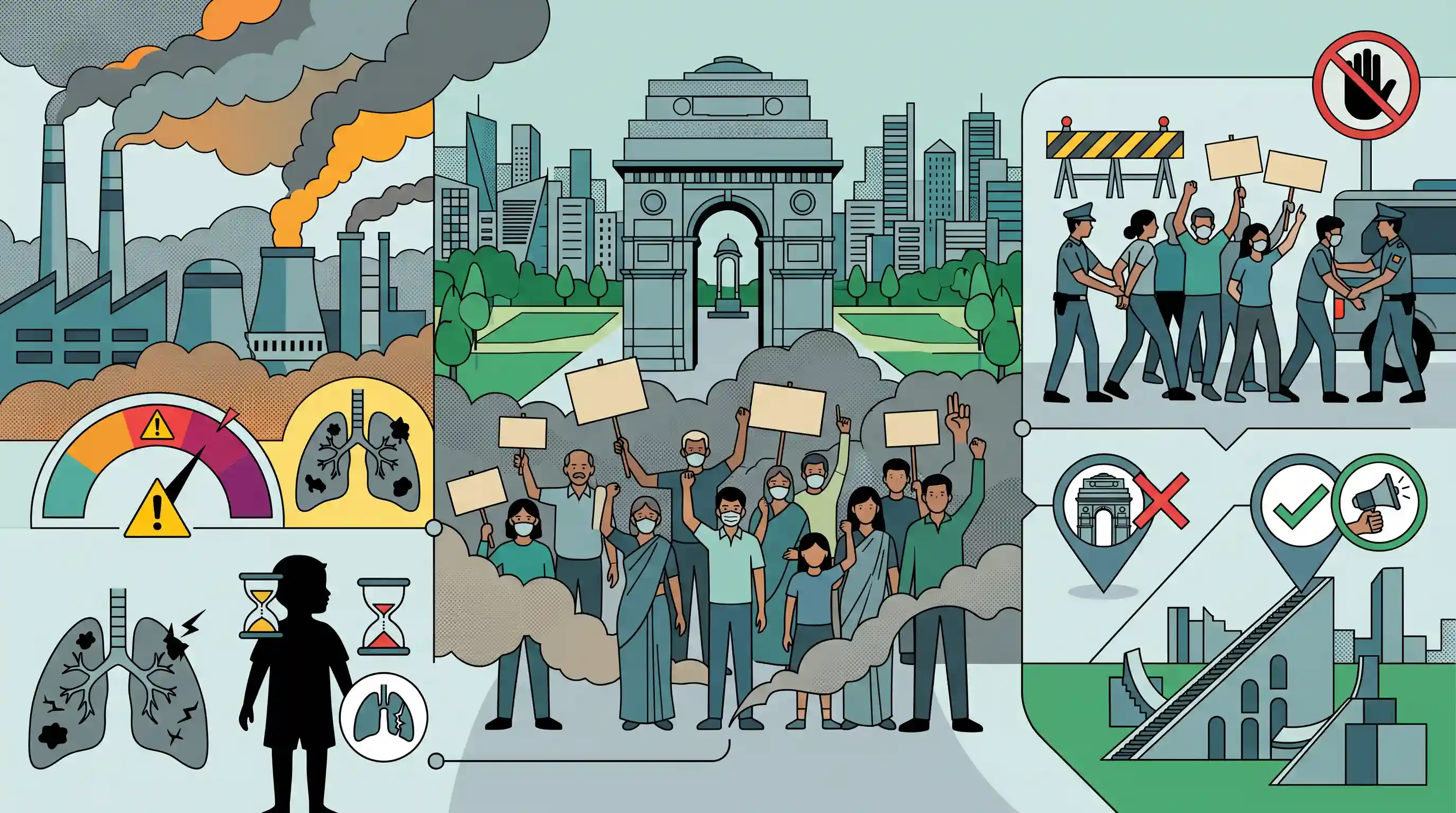
Protests erupted at India Gate in New Delhi over the city's severe air quality, which recently crossed an Air Quality Index (AQI) of 400. Parents and environmental activists gathered to demand immediate government action, emphasizing grave health consequences for children, including permanently damaged lungs and reduced life expectancy. The Delhi Police detained several protesters for assembling without permission, clarifying that Jantar Mantar is the only designated protest site in the capital and the detentions were preventive measures to maintain law and order.
Key Points
- Delhi's air quality plunged into the 'severe' category (AQI > 400), triggering public protests at India Gate.
- Protesters, including parents and environmentalists, highlighted severe health impacts such as permanent lung damage and a reduction in life expectancy by nearly 10 years.
- Delhi Police detained several participants for assembling without prior permission.
- Police authorities cited public order, clarifying that Jantar Mantar is the sole officially designated protest site in New Delhi and detentions were preventive.
Important Terms
Air Quality Index (AQI)

A numerical tool used by the government to communicate daily air quality, monitoring eight major pollutants (PM10, PM2.5, NO2, SO2, CO, O3, NH3, Pb) through six color-coded categories from 'Good' to 'Severe'.
UPSC context
GS Paper III (Environment); essential for understanding pollution thresholds and public health impacts.
Graded Response Action Plan (GRAP)
An emergency framework for Delhi-NCR that mandates stage-wise actions (Stage I to IV) based on AQI levels to curb air pollution, implemented by the Commission for Air Quality Management (CAQM).
UPSC context
GS Paper III (Environment/Disaster Management); tests knowledge of governance responses to environmental crises.
Right to Peaceful Assembly
A fundamental right under Article 19(1)(b) of the Indian Constitution allowing citizens to gather without arms, though it is subject to 'reasonable restrictions' for public order and national sovereignty.
UPSC context
GS Paper II (Polity); central to the balance between civil liberties and the state's power to maintain order.
Section 163, Bharatiya Nagarik Suraksha Sanhita (BNSS)
Provisions under the BNSS (replacing Section 144 CrPC) that empower magistrates to prohibit assemblies of four or more people to prevent urgent nuisance or apprehended danger to public safety.
UPSC context
GS Paper II (Governance/Polity); concerns the legal mechanisms for maintaining public order vs. fundamental rights.
Preventive Detention
The detention of a person without trial or conviction to prevent them from committing a future offense, governed by Article 22 of the Constitution which provides specific procedural safeguards.
UPSC context
GS Paper II (Polity/Fundamental Rights); critical for understanding state security powers and judicial safeguards.
Commission for Air Quality Management (CAQM)
A statutory body established to coordinate air quality management in the National Capital Region and adjoining areas, replacing the earlier EPCA to oversee the implementation of pollution-control measures like GRAP.
UPSC context
GS Paper II & III (Governance/Environment); identifies the institutional framework for environmental regulation in India.
Prelims Trap
CO2 and Methane are included in the eight pollutants measured to calculate the National Air Quality Index.
Aspirants confuse greenhouse gases with criteria air pollutants. The National AQI measures 8 pollutants (PM10, PM2.5, NO2, SO2, CO, O3, NH3, Pb), but explicitly excludes CO2 and Methane.
Static Concepts Connected
What are the constitutional boundaries on the Right to Freedom of Assembly?
- Constitutional Basis: Article 19(1)(b) of the Constitution guarantees citizens the fundamental right to assemble peacefully and without arms.
- Reasonable Restrictions: Under Article 19(3), the State can impose restrictions only in the interest of India's sovereignty and integrity, or 'public order'.
- Judicial Precedent: In the Shaheen Bagh case, the Supreme Court ruled that protests cannot indefinitely occupy public spaces, balancing assembly rights with the general public's right to free movement.
What is the Graded Response Action Plan (GRAP) for Delhi-NCR?
- Statutory Execution: GRAP is an emergency response mechanism implemented by the statutory Commission for Air Quality Management (CAQM), which holds overriding jurisdiction across Delhi and NCR states.
- Stage-based Triggers: It operates in four progressive stages based on AQI levels: Stage I (Poor), Stage II (Very Poor), Stage III (Severe), and Stage IV (Severe+).
- Stage IV Measures: Triggered when AQI exceeds 450, this stage mandates extreme interventions such as halting construction activities, restricting BS-IV diesel vehicles, and limiting truck entry into Delhi.
Cross-Topic Patterns
Right to Protest vs. Free Movement
The administrative restriction of protests to designated sites like Jantar Mantar frequently brings Article 19(1)(b) (assembly) into direct conflict with Article 19(1)(d) (free movement) in Supreme Court rulings.
CAQM replacing EPCA for NCR pollution
UPSC frequently tests institutional evolution. The statutory CAQM replaced the SC-mandated Environment Pollution Authority (EPCA), gaining overriding powers over State Pollution Control Boards for air quality management.

Expect a 2026 prelims question combining CAQM's overriding statutory powers over State Boards with the 8 specific National AQI pollutants.
Linked PYQs · 4
Linked PYQs · 4
- 2021MainsGS3
Describe the key points of the revised Global Air Quality Guidelines (AQGs) recently released by the World Health Organisation (WHO). How are these different from its last update in 2005? What changes in India's National Clean Air Programme are required to achieve these revised standards?
- 2020MainsGS3
What are the key features of the National Clean Air Programme (NCAP) initiated by the Government of India?
- 2022MainsGS2
“Right of movement and residence throughout the territory of India are freely available to the Indian citizens, but these rights are not absolute.” Comment.
- 2014MainsGS2
What do you understand by the concept "freedom of speech and expression"? Does it cover hate speech also ? Why do the films in India stand on a slightly different plane from other forms of expression ? Discuss.
