GRAP Stage 3 implementation for severe air pollution mitigation in NCR
Source:The Hindu ↗
Why It Matters
Air pollution in the NCR is a critical and recurring environmental crisis that directly affects public health and economic productivity. UPSC candidates must grasp the statutory frameworks (like CAQM and CPCB) and regulatory mechanisms (such as GRAP and Bharat Stage emission standards) implemented to curb urban pollution, as this frequently features in GS-III (Environment) and GS-I (Urban Issues).
Summary
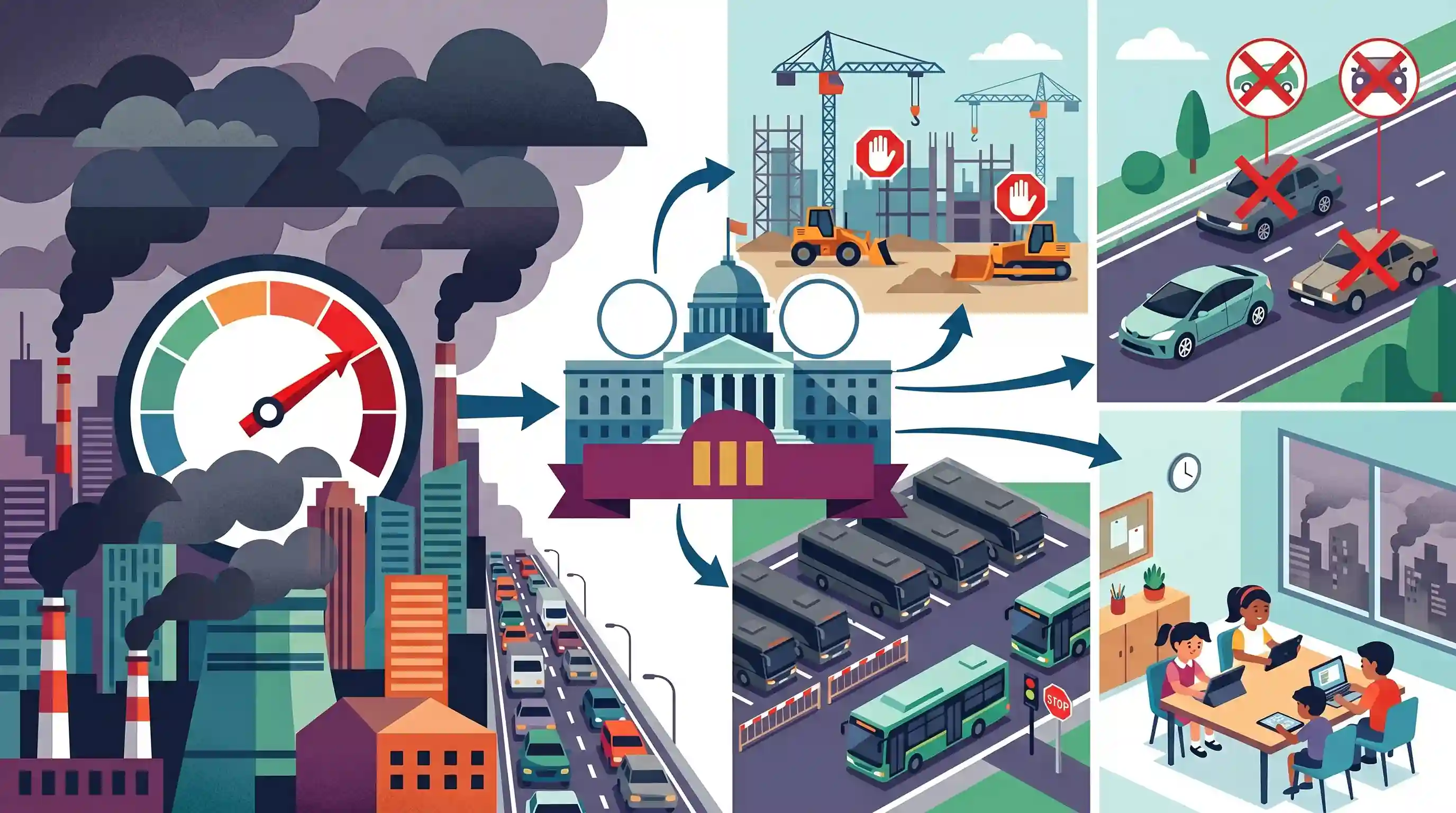
Following a sharp drop in air quality to the 'severe' category (AQI 401-450), the Commission for Air Quality Management (CAQM) has invoked Stage 3 of the Graded Response Action Plan (GRAP) in Delhi and the National Capital Region (NCR). The Central Pollution Control Board (CPCB) reported an AQI of 397, with several stations breaching the 400 mark. The resultant emergency measures include a blanket ban on non-essential construction and demolition activities, restrictions on older, heavily polluting vehicles (BS-III petrol and BS-IV diesel), a bar on most inter-state diesel buses entering Delhi, and the shift to hybrid learning for primary school children to mitigate their exposure to toxic air.
Key Points
- The Commission for Air Quality Management (CAQM) activated Stage 3 of the Graded Response Action Plan (GRAP) as Delhi's air quality worsened to the 'severe' category.
- Under Stage 3, a strict ban is imposed on construction and demolition activities across the National Capital Region.
- Plying of older, more polluting vehicles—specifically BS-III petrol and BS-IV diesel light motor vehicles—is banned in key NCR districts including Delhi, Gurugram, and Ghaziabad.
- Inter-state buses entering Delhi are restricted unless they operate on electricity, CNG, or adhere to BS-VI diesel norms.
- To protect vulnerable populations, physical classes for students up to grade 5 have been shifted to a hybrid mode.
Important Terms
Graded Response Action Plan (GRAP)

A set of emergency response measures implemented in Delhi-NCR based on Air Quality Index (AQI) levels. It follows a four-stage hierarchy to prevent further deterioration of air quality.
UPSC context
GS Paper III (Environment); vital for questions on urban pollution management and emergency regulatory frameworks.
Commission for Air Quality Management (CAQM)
A statutory body established in 2021 to coordinate, research, and address air quality issues in Delhi-NCR and adjoining states (Punjab, Haryana, Rajasthan, and UP). Its rulings override other bodies.
UPSC context
GS Paper II (Statutory Bodies) and GS III (Environment); relevant for institutional responses to environmental crises.
Bharat Stage Emission Standards (BSES)
Emission standards based on European regulations that limit air pollutants from motor vehicles. BS-VI, the most stringent standard, was implemented nationwide in 2020, skipping BS-V to accelerate pollution reduction.
UPSC context
GS Paper III (Environment & Technology); essential for understanding vehicular pollution norms and technological transitions.
Central Pollution Control Board (CPCB)
India's apex statutory body for pollution control, established under the Water Act 1974 and empowered by the Air Act 1981. It provides technical services to the Environment Ministry.
UPSC context
GS Paper II (Governance) and GS III (Environment); frequently tested in Prelims regarding statutory origins and functions.
National Air Quality Index (AQI)
A technical tool that communicates air quality status to the public using a single number and color. It monitors eight pollutants: PM10, PM2.5, NO2, SO2, CO, O3, NH3, and Lead.
UPSC context
GS Paper III (Environment); critical for Prelims (pollutants covered) and Mains (pollution monitoring metrics).
Prelims Trap
"The National Air Quality Index (AQI) calculates pollution levels by measuring the concentration of Carbon Dioxide (CO2)."
The National AQI measures 8 specific pollutants (PM10, PM2.5, NO2, SO2, CO, O3, NH3, Pb). It excludes greenhouse gases like CO2, focusing strictly on health pollutants.
Static Concepts Connected
How do the mandates of CAQM, CPCB, and NGT differ in environmental governance?
- CAQM (Executive/Regulatory): A statutory body created via a 2021 Act specifically to manage, coordinate, and regulate air quality solely in the NCR and adjoining areas.
- CPCB (Technical/Advisory): The apex statutory technical and advisory body under the Water (1974) and Air (1981) Acts, operating at a pan-India level.
- NGT (Judicial): A specialized statutory judicial body designed for adjudicating environmental disputes and providing compensation, rather than setting emission standards.
What are the key technical differences between BS-IV and BS-VI vehicle emission norms?
- Sulphur Content: BS-VI drastically reduces the permissible sulphur content in fuels from 50 ppm (BS-IV) down to just 10 ppm.
- Nitrogen Oxide (NOx): BS-VI norms mandate a reduction in NOx emissions by 25% for petrol engines and 68% for diesel engines compared to BS-IV.
- On-Board Diagnostics: BS-VI makes On-Board Diagnostics (OBD) mandatory for all vehicles to monitor the performance of emission control systems in real-time.
Cross-Topic Patterns
Meteorology and Winter Inversions
GRAP interventions are tied to meteorological forecasts. Winter temperature inversions and low wind speeds trap pollutants, exacerbating Delhi's landlocked geographical disadvantage and necessitating emergency administrative measures.
Urban AQI vs. Agricultural Stubble Burning
CAQM's jurisdiction bridges urban transport limits with rural agricultural practices. Its mandate covers stubble burning in Punjab and Haryana, linking urban AQI directly to Kharif harvesting cycles.

Expect a 2026 Prelims multi-statement question contrasting the statutory jurisdiction and penal powers of CAQM against the CPCB.
Linked PYQs · 2
Linked PYQs · 2
- 2021MainsGS3
Describe the key points of the revised Global Air Quality Guidelines (AQGs) recently released by the World Health Organisation (WHO). How are these different from its last update in 2005? What changes in India's National Clean Air Programme are required to achieve these revised standards?
- 2018PrelimsGS1
How is the National Green Tribunal (NGT) different from the Central Pollution Control Board (CPCB)? 1. The NGT has been established by an Act whereas the CPCB has been created by an executive order of the Government. 2. The NGT provides environmental justice and helps reduce the burden of litigation in the higher courts whereas the CPCB promotes cleanliness of streams and wells, and aims to improve the quality of air in the country. Which of the statements given above is/are correct?
