Delhi winter temperature inversion and severe air pollution crisis
Source:The Hindu ↗
Why It Matters
Urban air pollution, specifically winter smog in North India, is a recurring environmental and public health crisis. It underscores the need to understand geographical factors like temperature inversion and regulatory frameworks like the National Clean Air Programme (NCAP) and CPCB guidelines.
Summary
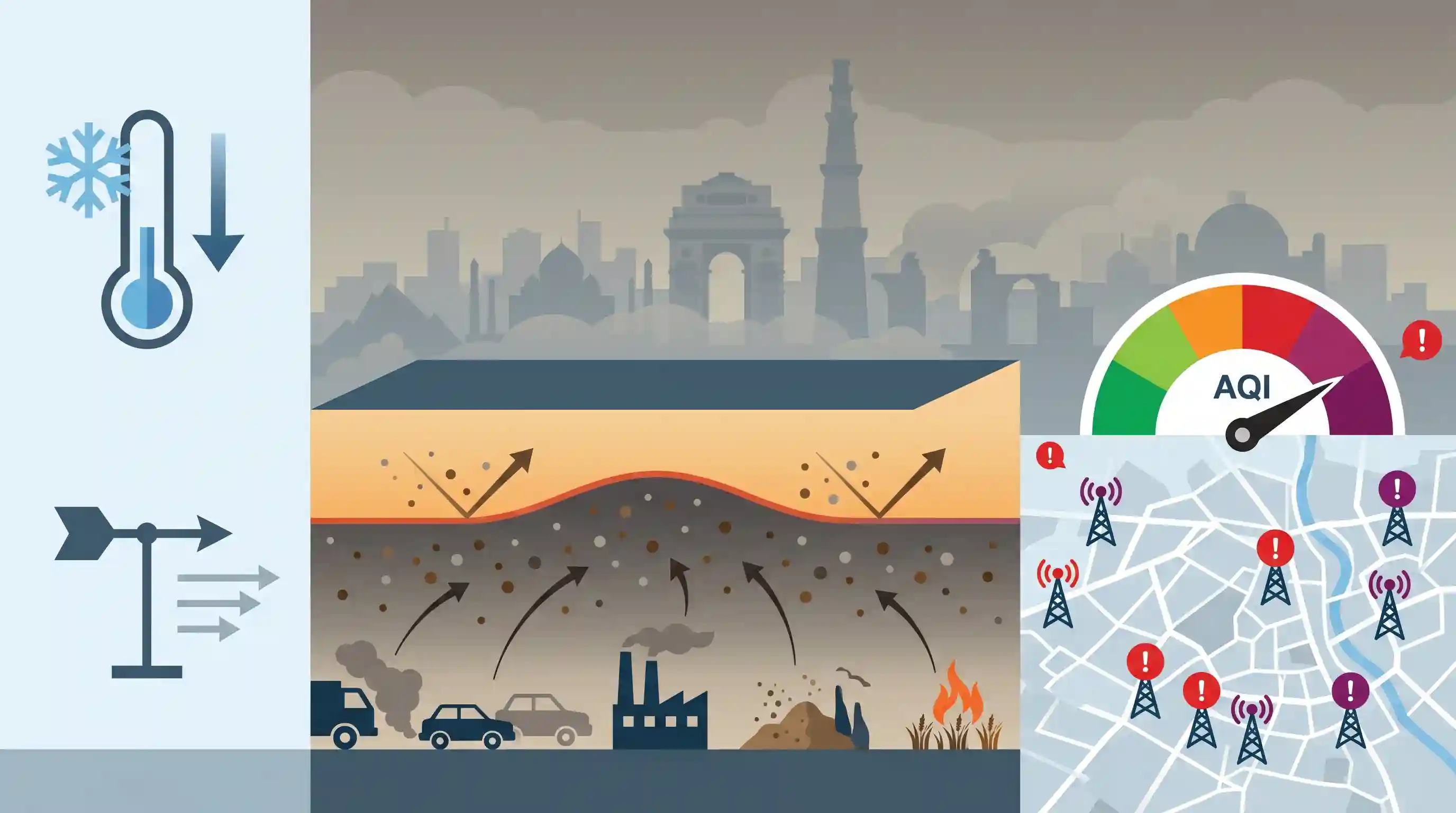
Delhi continues to grapple with severe winter air pollution as falling temperatures and calm winds trap particulate matter close to the surface. With the minimum temperature dropping to 8.1 degrees Celsius, the city's overall Air Quality Index (AQI) plunged to 384, placing it in the 'very poor' category. Data from the Central Pollution Control Board's (CPCB) Sameer app showed nearly half of the city's monitoring stations slipping into the 'severe' zone. The recurring winter smog highlights the persistent environmental and public health challenges in the National Capital Region.
Key Points
- Delhi's air quality remained in the 'very poor' category with an overall Air Quality Index (AQI) of 384.
- A cold morning with a minimum temperature of 8.1°C exacerbated the pollution, trapping pollutants closer to the ground.
- Out of 39 monitoring stations, 18 recorded 'severe' air quality (AQI above 400), while 20 recorded 'very poor' air quality.
- The Central Pollution Control Board (CPCB) tracks real-time air quality data via its 'Sameer' application, classifying AQI up to 500.
Important Terms
Central Pollution Control Board (CPCB)

A statutory body established in 1974 under the Water Act, providing technical services to the Environment Ministry and coordinating pollution control efforts nationwide.
UPSC context
GS Papers 2 & 3: Key for governance, environmental regulation, and statutory bodies' functions.
Air Quality Index (AQI)
A simplified 'one number, one color' tool launched in 2014 to communicate air quality status across six categories, monitoring eight key pollutants.
UPSC context
GS Paper 3: Environment; frequently tested on monitored pollutants and health impact categories.
Temperature Inversion
A meteorological phenomenon where air temperature increases with altitude, trapping a layer of cold air and pollutants close to the ground.
UPSC context
GS Paper 1: Geography; GS Paper 3: Environment. Explains winter smog peaks in Northern India.
Particulate Matter (PM)
Fine (PM2.5) and coarse (PM10) airborne particles that can bypass biological filters, enter the lungs, or penetrate the bloodstream, causing severe health issues.
UPSC context
GS Paper 3: Health and Environment; essential for understanding the primary drivers of urban pollution.
National Capital Region (NCR)
An inter-state planning region centered on Delhi, created by a 1985 Act to coordinate development across Delhi, Haryana, Uttar Pradesh, and Rajasthan.
UPSC context
GS Paper 2: Polity/Governance; GS Paper 3: Regional planning and inter-state environmental management.
Prelims Trap
CPCB is a statutory body established under the Air (Prevention and Control of Pollution) Act, 1981.
CPCB was actually constituted under the Water (Prevention and Control of Pollution) Act, 1974. It was later given powers under the Air Act.
Static Concepts Connected
How does Temperature Inversion trap winter pollution?
- Normal conditions: Normally, air cools with altitude, allowing warm surface air and pollutants to rise and disperse vertically.
- Winter inversion: In winter, a cold air layer forms at the surface, trapped by a warmer air mass above it, preventing vertical mixing.
- Smog formation: This 'lid' effect traps PM2.5, vehicle emissions, and dust close to the ground, causing severe and prolonged winter smog.
What are the parameters of the National Air Quality Index (AQI)?
- The 8 pollutants: It tracks exactly eight pollutants: PM10, PM2.5, NO2, SO2, CO, Ozone (O3), Ammonia (NH3), and Lead (Pb).
- Common exclusions: Carbon dioxide (CO2) and methane are major greenhouse gases but are explicitly NOT included in the AQI calculation.
Cross-Topic Patterns
Airshed Management via CAQM
The shift from CPCB to CAQM in Delhi-NCR highlights a modern environmental governance approach, focusing on contiguous regional airsheds rather than rigid state administrative boundaries.
Agri-economics driving winter smog
The paddy-wheat cycle, driven by MSP and groundwater conservation laws that delay sowing, leaves a brief harvest window that forces farmers into rapid stubble burning.

Expect a 2026 multi-statement question linking CPCB's origin (Water Act), exact AQI parameters (excluding CO2), and temperature inversion.
Linked PYQs · 5
Linked PYQs · 5
- 2022PrelimsGS1
In the context of WHO Air Quality Guidelines, consider the following statements: 1. The 24-hour mean of PM2.5 should not exceed 15 µg/m³ and annual mean of PM2.5 should not exceed 5 µg/m³. 2. In a year, the highest levels of ozone pollution occur during the periods of inclement weather. 3. PM10 can penetrate the lung barrier and enter the bloodstream. 4. Excessive ozone in the air can trigger asthma. Which of the statements given above are correct?
- 2016PrelimsGS1
In the cities of our country, which among the following atmospheric gases are normally considered in calculating the value of Air Quality Index? 1. Carbon dioxide 2. Carbon monoxide 3. Nitrogen dioxide 4. Sulfur dioxide 5. Methane Select the correct answer using the code given below.
- 2022MainsGS3
Discuss in detail the photochemical smog emphasizing its formation, effects and mitigation. Explain the 1999 Gothenburg Protocol.
- 2021MainsGS3
Describe the key points of the revised Global Air Quality Guidelines (AQGs) recently released by the World Health Organisation (WHO). How are these different from its last update in 2005? What changes in India's National Clean Air Programme are required to achieve these revised standards?
- 2025PrelimsGS1
Artificial way of causing rainfall to reduce air pollution makes use of
