Delhi Air Quality Index and Anti Pollution Policy Measures
Source:The Hindu ↗
Why It Matters
Air pollution in the national capital is a recurring environmental crisis that highlights the challenges of urban air quality management, regulatory measures like the AQI framework by the CPCB, and policy interventions like the 'No PUC, No Fuel' rule. These are critical themes in the GS3 Environment syllabus and frequently tested in Prelims and Mains.
Summary
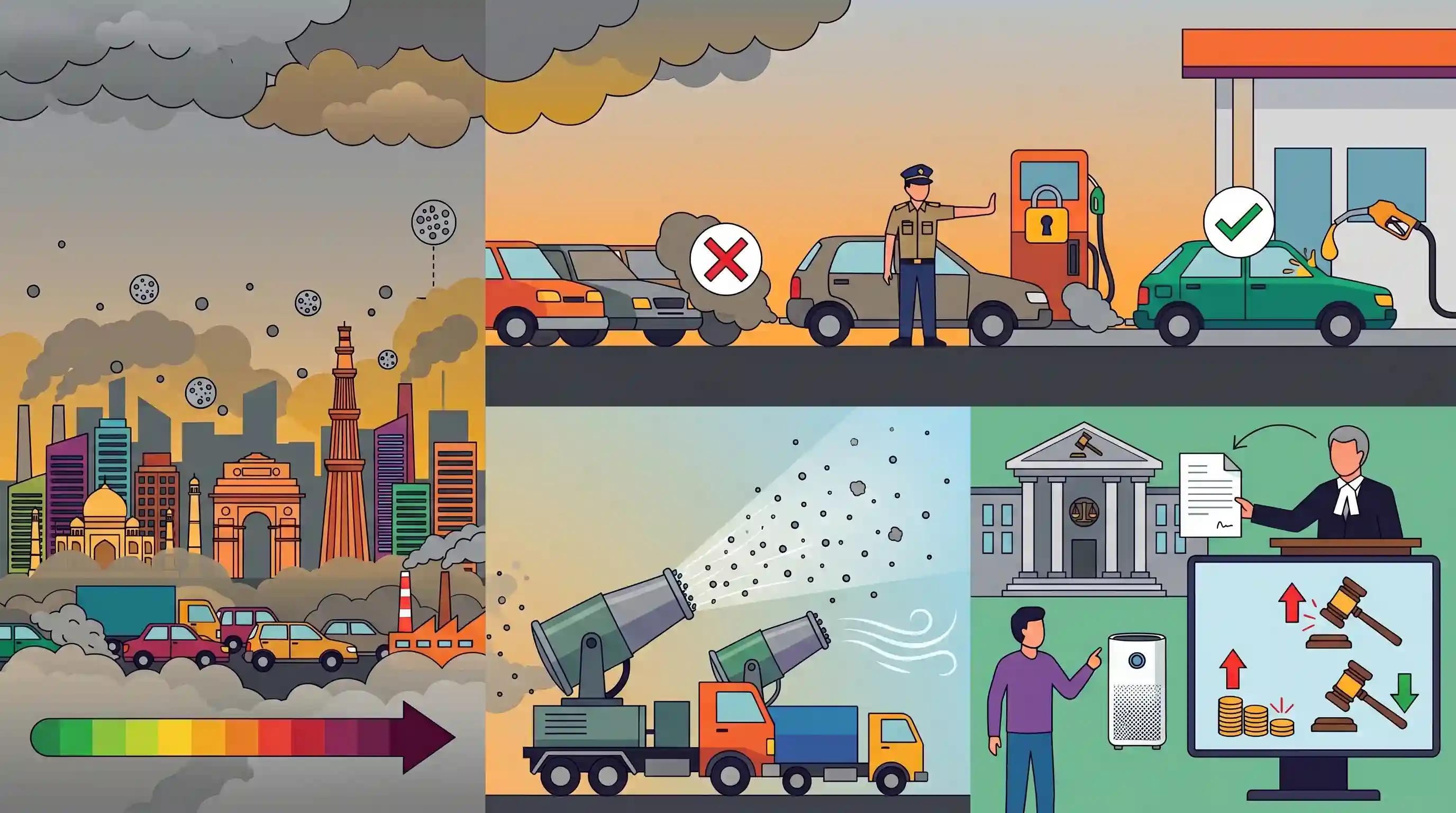
Delhi's air quality has remained in the 'very poor' category, with the Air Quality Index (AQI) recorded at 355 by the Central Pollution Control Board (CPCB), exacerbated by dense fog. To curb the worsening pollution, authorities are enforcing measures such as the 'No PUC, No Fuel' rule to tackle vehicular emissions and are utilizing anti-smog guns. Additionally, the Delhi High Court has sought the Centre's response regarding a plea to reduce the GST on air purifiers.
Key Points
- Delhi's overall Air Quality Index (AQI) was recorded at 355, placing it in the 'very poor' category amid persistent foggy conditions.
- Authorities are enforcing the 'No PUC, No Fuel' rule and deploying anti-smog guns to mitigate air pollution in the city.
- The Central Pollution Control Board (CPCB) categorizes AQI levels, defining 301-400 as 'very poor' and 401-500 as 'severe'.
- The Delhi High Court has directed the Centre to respond to a plea seeking a reduction of GST on air purifiers.
Important Terms
Air Quality Index (AQI)

A tool for communicating air quality status by translating pollutant data (PM2.5, NO2, etc.) into a single number (0-500) and color-coded categories to indicate public health risk levels.
UPSC context
GS Paper III (Environment). Understanding pollution standards, health impacts, and the 'Very Poor' (301-400) category frequently cited in exams.
Central Pollution Control Board (CPCB)
A statutory body established under the Water Act (1974) and Air Act (1981) that provides technical services, sets national environmental standards, and monitors air and water quality.
UPSC context
GS Paper II/III (Statutory Bodies/Environment). Vital for questions on India's environmental institutional framework and regulatory powers.
No PUC, No Fuel rule
An enforcement policy in Delhi prohibiting fuel stations from selling petrol, diesel, or CNG to vehicles without a valid Pollution Under Control (PUC) certificate, aimed at curbing tailpipe emissions.
UPSC context
GS Paper III (Environment/Governance). Examples of urban emission control measures and implementation challenges under the Graded Response Action Plan (GRAP).
Anti-Smog Guns
Devices that spray atomized water into the atmosphere to settle dust and particulate matter (PM2.5/PM10), used as a localized temporary measure to reduce urban air pollution and smog.
UPSC context
GS Paper III (S&T/Environment). Technical interventions for mitigating local dust, frequently discussed in the context of urban pollution and judicial mandates.
Delhi High Court (Pollution Plea)
The court recently heard a plea to classify air purifiers as "medical devices" rather than luxury items, seeking to reduce their GST from 18% to 5% during health emergencies.
UPSC context
GS Paper II (Judiciary). Examines judicial activism and the interpretation of the Right to Health (Article 21) versus the government's fiscal policies.
Prelims Trap
Carbon Dioxide (CO2) is one of the eight pollutants measured to calculate the National Air Quality Index (AQI).
AQI measures Carbon Monoxide (CO), not Carbon Dioxide (CO2). CO2 is a greenhouse gas, while AQI focuses strictly on criteria pollutants affecting immediate human health.
Static Concepts Connected
How does the CPCB derive its statutory powers?
- Water Act 1974: The Central Pollution Control Board was established under the Water (Prevention and Control of Pollution) Act, 1974.
- Air Act 1981: It was later entrusted with additional regulatory and enforcement powers under the Air (Prevention and Control of Pollution) Act, 1981.
- Environment Act 1986: It also provides technical services to the Ministry of Environment, Forest and Climate Change under the Environment (Protection) Act, 1986.
What is the difference between pollutants tracked under AQI and NAAQS?
- AQI (8 pollutants): AQI measures 8 pollutants: PM10, PM2.5, NO2, SO2, CO, O3, NH3, and Lead. It translates complex air quality data into a single public-friendly number.
- NAAQS (12 pollutants): NAAQS covers 12 pollutants: the 8 AQI pollutants plus Benzene, Benzo(a)Pyrene, Arsenic, and Nickel, setting long-term legal regulatory limits.
Cross-Topic Patterns
GST Council + Environmental Goods
The HC plea for reducing GST on air purifiers connects environmental rights (Article 21) with the GST Council's fiscal federalism mandate on setting tax slabs for essential goods.
Climatology + Winter Smog Formation
Delhi's landlocked geography creates winter 'temperature inversions' trapping pollutants. This meteorological phenomenon is frequently tested alongside smog formation and urban heat islands in GS1.

Expect a multi-statement 2026 prelims question linking CAQM/CPCB statutory mandates, the 8 AQI pollutants (trap: CO2), and winter inversion.
Linked PYQs · 3
Linked PYQs · 3
- 2022PrelimsGS1
In the context of WHO Air Quality Guidelines, consider the following statements: 1. The 24-hour mean of PM2.5 should not exceed 15 µg/m³ and annual mean of PM2.5 should not exceed 5 µg/m³. 2. In a year, the highest levels of ozone pollution occur during the periods of inclement weather. 3. PM10 can penetrate the lung barrier and enter the bloodstream. 4. Excessive ozone in the air can trigger asthma. Which of the statements given above are correct?
- 2025PrelimsGS1
Artificial way of causing rainfall to reduce air pollution makes use of
- 2023MainsGS3
The adoption of electric vehicles is rapidly growing worldwide. How do electric vehicles contribute to reducing carbon emissions and what are the key benefits they offer compared to traditional combustion engine vehicles?
