Delhi air quality plunges to severe category post Deepavali
Source:The Hindu ↗
Why It Matters
Urban air pollution, specifically the winter smog in Delhi-NCR, is a recurrent theme in UPSC Prelims and Mains. It tests candidates on AQI parameters, WHO guidelines, emission reduction strategies (green crackers, GRAP, NCAP), and the interplay of meteorology and human activities.
Summary
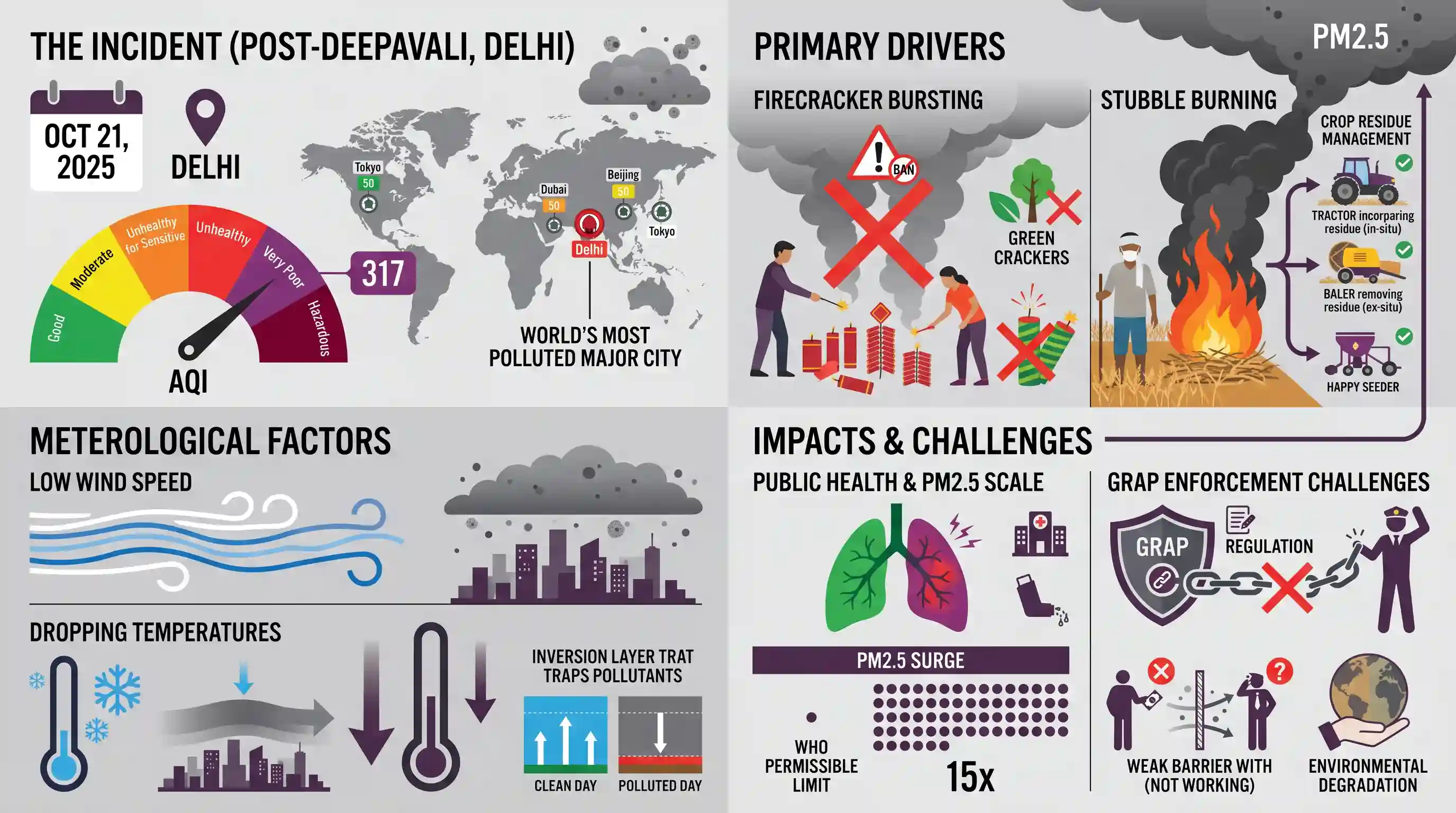
On the morning following Deepavali (October 21, 2025), Delhi's air quality deteriorated to the "very poor" category, recording an AQI of 317 and making it the world's most polluted major city per IQAir. PM2.5 levels surged to over 15 times the WHO's 24-hour permissible limit. The severe pollution was driven by a combination of rampant firecracker bursting—in defiance of bans and the mandated use of "green crackers"—alongside stubble burning and unfavorable meteorological conditions like low wind speeds and dropping temperatures. The situation highlights ongoing enforcement challenges of environmental regulations like GRAP in the National Capital Region.
Key Points
- Following Deepavali, Delhi's Air Quality Index (AQI) dropped to 317 ('very poor'), ranking it as the world's most polluted major city according to IQAir.
- The PM2.5 concentration spiked to 226.4 µg/m³, which is 15.1 times the World Health Organization's (WHO) 24-hour permissible limit of 15 µg/m³.
- Despite explicit bans and Supreme Court directives, the use of traditional firecrackers was widespread, and the less-polluting 'green crackers' were largely unavailable or ignored.
- Pollution was severely exacerbated by regional meteorological factors, including dropping temperatures and calm winds, along with ongoing stubble burning in neighboring states.
- The persistent smog underscores significant gaps in enforcing anti-pollution measures like the Graded Response Action Plan (GRAP) during the winter months.
Important Terms
Air Quality Index (AQI)

A color-coded numerical scale (0–500) launched in 2014 to communicate daily air quality and health risks using eight key pollutants (PM2.5, PM10, NO2, SO2, CO, O3, NH3, Pb).
UPSC context
GS Paper III (Environment); vital for prelims (pollutant list) and mains (pollution management).
Graded Response Action Plan (GRAP)
An emergency framework for Delhi-NCR that activates progressively stricter pollution-control measures (Stage I to IV) based on deteriorating air quality levels, now implemented by the CAQM.
UPSC context
GS Paper III (Environmental Pollution); tests understanding of emergency administrative interventions.
National Clean Air Programme (NCAP)
The first national framework (2019) targeting a 40% reduction in particulate matter concentrations by 2026 across 131 'non-attainment' cities using city-specific action plans.
UPSC context
GS Paper III (Environment/Schemes); focus on time-bound targets and non-attainment city concepts.
Central Pollution Control Board (CPCB)
A statutory body established under the Water Act (1974) and Air Act (1981) that serves as India's apex regulator for pollution control and environmental standards.
UPSC context
GS Paper II/III; relevant for statutory bodies and environmental governance.
Green Crackers
Fireworks developed by CSIR-NEERI that reduce emissions by ~30% by eliminating barium nitrate and utilizing dust-suppressing mechanisms like water vapor release (SWAS, STAR, SAFAL).
UPSC context
GS Paper III (Science & Tech/Environment); tests knowledge of eco-friendly innovations.
PM 2.5
Microscopic particles with a diameter ≤2.5 micrometers that can bypass lung barriers and enter the bloodstream; India’s limit (60 µg/m³) exceeds the WHO 24-hour guideline (15 µg/m³).
UPSC context
GS Paper III (Pollution/Health); tests technical understanding of hazardous pollutants.
Supreme Court of India (Environmental Mandates)
The apex judicial authority which, through the M.C. Mehta cases, mandated the implementation of GRAP and banned traditional firecrackers to protect the fundamental right to a clean environment.
UPSC context
GS Paper II (Judiciary); tests judicial activism and the 'Polluter Pays Principle.'
IQAir
A Swiss-based technology company that tracks real-time global air quality, often cited in reports highlighting Delhi as one of the world's most polluted cities.
UPSC context
GS Paper III; useful for citing global data benchmarks and comparative urban pollution levels.
Prelims Trap
"Green crackers completely eliminate particulate emissions and are 100% pollution-free."
Green crackers only reduce particulate matter (PM) emissions by around 30% and eliminate specific toxics like barium nitrate; they still emit pollutants.
Static Concepts Connected
What is Temperature Inversion and how does it worsen winter smog?
- Mechanism: A meteorological condition where a layer of warmer air traps colder, denser air near the surface, reversing the normal temperature lapse rate.
- Impact: It suppresses vertical atmospheric mixing, preventing vehicle and crop-residue pollutants from dispersing upwards.
- Topographical Factor: Delhi-NCR's landlocked, basin-like geography exacerbates this effect, effectively creating an inescapable 'smog dome' during calm winter months.
Which 8 pollutants are measured in India's National Air Quality Index (AQI)?
- Primary Gases & PM: PM10, PM2.5, Nitrogen Dioxide (NO2), Sulphur Dioxide (SO2), and Carbon Monoxide (CO).
- Secondary & Others: Ozone (O3), Ammonia (NH3), and Lead (Pb). Note that Carbon Dioxide (CO2) is a greenhouse gas and is NOT included in the AQI calculation.
Cross-Topic Patterns
WHO Guidelines vs. India's NAAQS
UPSC frequently tests the gap between the WHO's strict 24-hour PM2.5 limit (15 µg/m³) and India's relatively relaxed National Ambient Air Quality Standards (NAAQS).
CAQM and Cooperative Federalism
The Commission for Air Quality Management (CAQM) overrides state pollution boards, raising persistent federal debates over managing inter-state externalities like stubble burning.

Expect a 2026 prelims question combining CAQM's statutory powers, the 8 AQI pollutants (excluding CO2), and green cracker chemistry.
Linked PYQs · 3
Linked PYQs · 3
- 2022PrelimsGS1
In the context of WHO Air Quality Guidelines, consider the following statements: 1. The 24-hour mean of PM2.5 should not exceed 15 µg/m³ and annual mean of PM2.5 should not exceed 5 µg/m³. 2. In a year, the highest levels of ozone pollution occur during the periods of inclement weather. 3. PM10 can penetrate the lung barrier and enter the bloodstream. 4. Excessive ozone in the air can trigger asthma. Which of the statements given above are correct?
- 2016PrelimsGS1
In the cities of our country, which among the following atmospheric gases are normally considered in calculating the value of Air Quality Index? 1. Carbon dioxide 2. Carbon monoxide 3. Nitrogen dioxide 4. Sulfur dioxide 5. Methane Select the correct answer using the code given below.
- 2020MainsGS3
What are the key features of the National Clean Air Programme (NCAP) initiated by the Government of India?
