Bihar Cabinet Approves Power Delegation for Rural Development Schemes
Source:bihar-infra-tales ↗
Why It Matters
Decentralization of technical and administrative sanction powers is a significant governance reform designed to improve public service delivery and scheme implementation at the grassroots. BPSC frequently tests rural welfare initiatives, administrative reorganizations, and poverty attenuation programs like JEEVIKA.
Summary
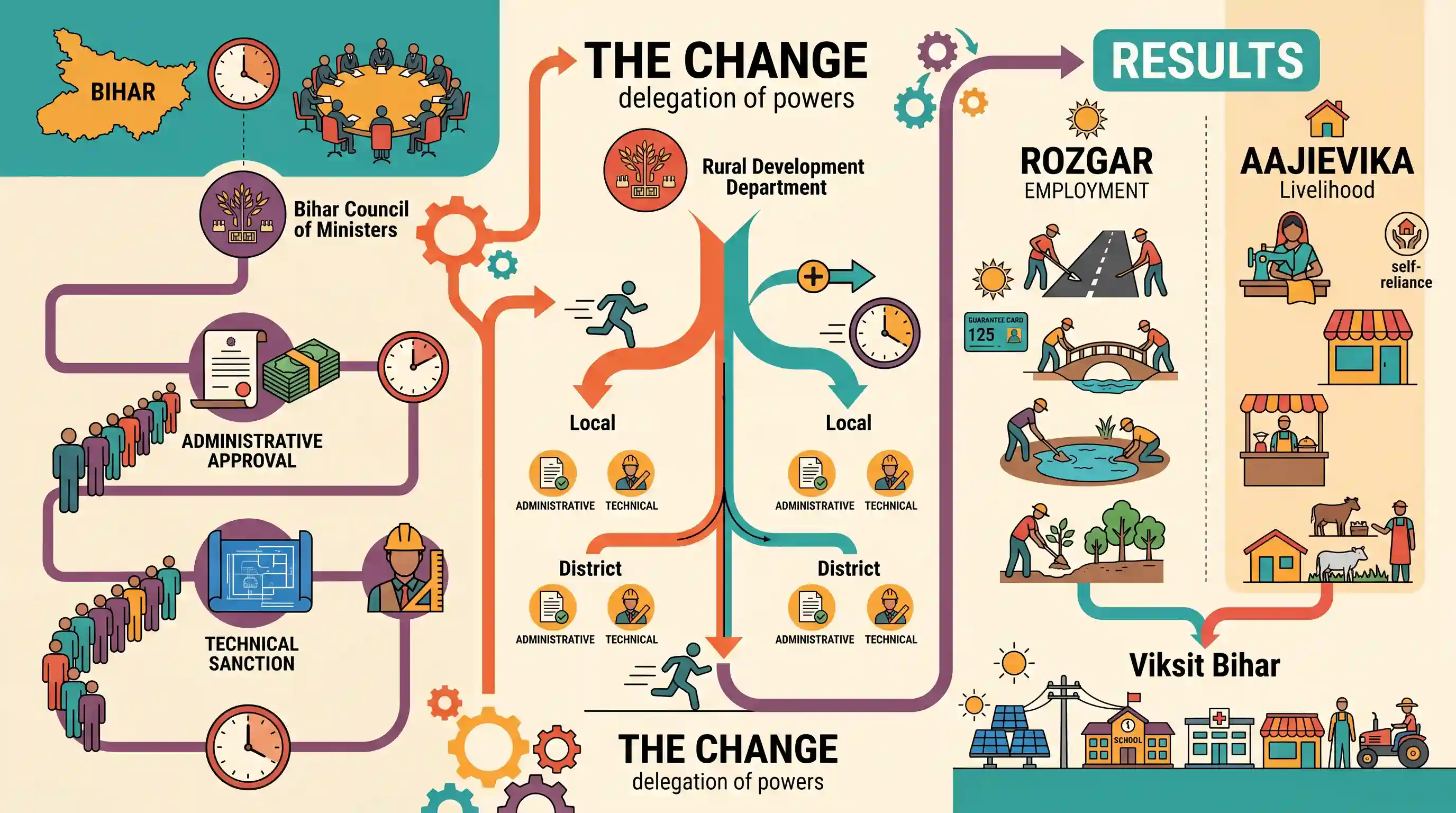
On June 24, 2026, the Bihar Council of Ministers approved a proposal by the Rural Development Department to delegate administrative and technical sanctioning powers for the schemes of the 'Viksit Bharat-Rozgar Evam Aajeevika Guarantee Mission (Gramin), Bihar, 2026'. This step aims to streamline governance, decentralize power, and fast-track the implementation of rural livelihood and employment programs in Bihar.
Key Points
- The Bihar Cabinet, on June 24, 2026, approved the delegation of technical and administrative sanction powers under the Rural Development Department.
- The delegation of authority is meant for implementing schemes under the 'Viksit Bharat-Rozgar Evam Aajeevika Guarantee Mission (Gramin), Bihar, 2026'.
- This administrative reform aims to decentralize decision-making and accelerate the execution of rural livelihood and employment projects by eliminating procedural delays.
- No specific financial layout was earmarked for this policy decision, as it focuses on structural power delegation.
Important Terms
Viksit Bharat - Guarantee for Rozgar and Ajeevika Mission (Gramin) (VB-G RAM G)

A landmark Indian social welfare scheme launched on July 1, 2026, replacing MGNREGA, guaranteeing 125 days of unskilled manual wage employment per financial year to rural households.
UPSC context
GS Paper II (Welfare Schemes) & GS Paper III (Employment). Tests critical understanding of rural safety nets and policy transitions.
Administrative Decentralization
The transfer of administrative authority, decision-making powers, resources, and operational responsibilities from higher levels of government to subordinate or local administrative units to enhance governance efficiency.
UPSC context
GS Paper II (Governance). Tests concepts of administrative reforms, public service delivery, and cooperative federalism.
Bihar Council of Ministers
The constitutional executive body headed by the Chief Minister of Bihar that aids and advises the Governor in exercising state executive functions under Article 163 of the Indian Constitution.
UPSC context
GS Paper II (Polity - State Executive). Tests structural understanding of state-level cabinet systems and executive decision-making.
Rural Development Department, Bihar
The administrative department of the Bihar Government responsible for executing rural poverty alleviation, housing, employment, and infrastructure programs, including the state rollout of VB-G RAM G.
UPSC context
GS Paper II (Governance - institutional frameworks). Tests state-level execution mechanisms for social security and rural development.
Prelims Trap
VB-G RAM G retains MGNREGA's funding pattern, with the Central Government fully financing the unskilled wage component.
Under the new VB-G RAM G Act, the entire funding is shared on a 60:40 ratio (general states), unlike MGNREGA where the Centre absorbed nearly 90% of overall costs, including 100% of unskilled wages.
Static Concepts Connected
What is the difference between delegation and devolution of administrative powers?
- Delegation: Temporary transfer of authority to lower levels where ultimate sovereignty and control rest with the delegating center.
- Devolution: Constitutional or statutory transfer of power to autonomous local units, ensuring permanent administrative and financial autonomy.
- Revocability: Delegated powers can be retrieved via executive decree, while devolved powers require legislative or constitutional amendments.
How do Centrally Sponsored Schemes differ from Central Sector Schemes?
- Funding source: 100% funded by the Union, whereas Centrally Sponsored Schemes (CSS) are co-funded on shared ratios like 60:40.
- Execution machinery: CSS are implemented by state government machinery; Central Sector Schemes are executed directly by Union ministries.
Cross-Topic Patterns
Fiscal Federalism + Rural Safety Nets
Shifting the rural safety net to a 60:40 fiscal split tests states' fiscal health, potentially widening regional disparities in welfare delivery.
Wage Floor Reforms + Inflation
Statutory wage floor hikes (to Rs 300) directly impact agricultural labor costs, shaping rural demand dynamics and RBI inflation targeting.

The transition from MGNREGA to VB-G RAM G, emphasizing changed sharing ratios and wage floors, is a top-tier GS-II topic for 2026.
Linked PYQs · 2
Linked PYQs · 2
- 2016BPSC_PRELIMSGS1
'JEEVIKA' is an initiative of Bihar Govt for:
- 2022BPSC_PRELIMSGS1
The new ministry proposed in the Bihar Budget for the year 2021-22 focuses on
