Industrial Revival Initiatives in Rohtas District
Source:thesuncitynews ↗
Why It Matters
Industrialization is a core focus area for BPSC GS papers. The revival of historical industrial hubs like Dalmianagar through BIADA illustrates the state's economic strategy to attract investment and create jobs, making it highly relevant for questions on Bihar's economic development and regional geography.
Summary
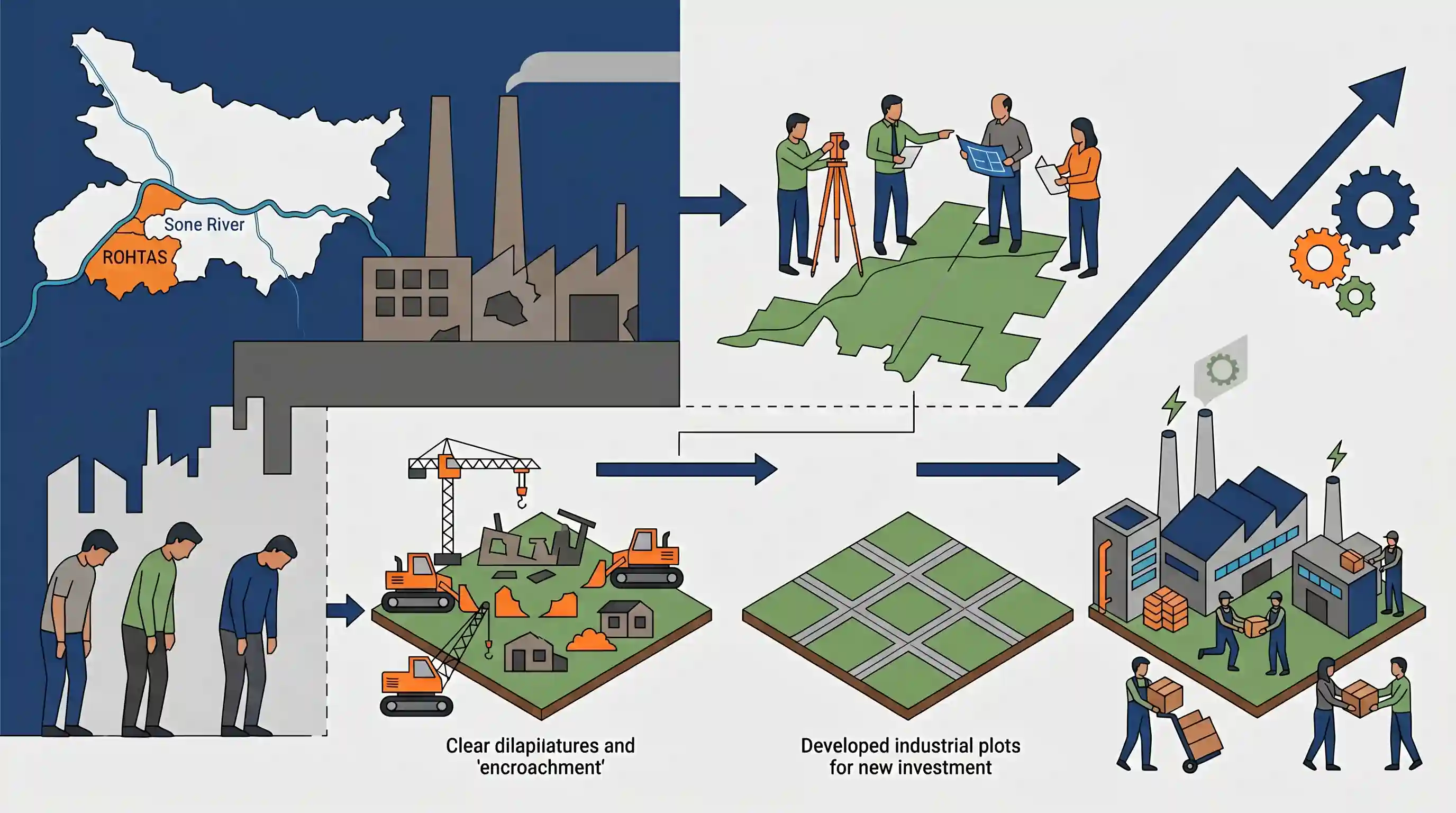
The Bihar government, in coordination with the Bihar Industrial Area Development Authority (BIADA), is taking concrete steps to revive the once-flourishing industrial zone of Dehri Dalmianagar in Rohtas district. Following a joint inspection of around 250 acres of land, efforts are underway to clear encroachments and develop the area for new industrial investments. The initiative seeks to restore Dalmianagar's lost industrial glory, historically known for its cement factories, thereby addressing the pressing issue of local unemployment and driving regional economic growth.
Key Points
- The Bihar government has initiated steps to revive the historic industrial hub of Dehri Dalmianagar in Rohtas district.
- A joint inspection of approximately 250 acres of land spanning five villages was conducted by district officials and BIADA.
- Dalmianagar was once renowned for its thriving cement factories and other industries, which are now defunct, leading to severe local unemployment.
- The Bihar Industrial Area Development Authority (BIADA) will spearhead the land development and plot allocation to attract new entrepreneurs and investors.
- The revival aims to generate substantial employment opportunities, check out-migration, and stimulate the regional economy.
Important Terms
Bihar Industrial Area Development Authority (BIADA)

A statutory body established under the 1974 Act, serving as Bihar's nodal agency for acquiring land and developing infrastructure for industrial estates and investment promotion.
UPSC context
GS-II/III: Important for Bihar-specific governance, industrial policy, and state-led economic development initiatives.
Rohtas Industries Limited
A massive historical industrial conglomerate in Dalmianagar that produced cement, paper, and sugar; its 1984 closure remains a symbol of Bihar’s industrial decline.
UPSC context
GS-I/III: Relevant for economic history and the study of regional industrial sickness and deindustrialization.
Pyrites, Phosphates and Chemicals Limited (PPCL)
A Government of India PSU based in Amjhore, Rohtas, formerly significant for mining pyrites to produce sulfuric acid and fertilizers before being declared a sick unit.
UPSC context
GS-I/III: Essential for mineral geography and the status of Public Sector Undertakings (PSUs) in Bihar.
Jhula Udyog Unit
A specific manufacturing wing within the Rohtas Industries complex, famously known for producing 'Jhoola' brand vanaspati (hydrogenated vegetable oil), once a household name in Bihar.
UPSC context
GS-III: Case study for regional economic revival and the branding history of Bihar's vanished industries.
Dalmianagar
A historic industrial township in Rohtas district on the Son River, once nicknamed the 'Jamshedpur of Bihar' due to its vast integrated industrial complex.
UPSC context
GS-I: Geography of Bihar; significant as a hub on the Grand Chord railway section.
Prelims Trap
Bihar possesses no significant metallic or non-metallic mineral reserves following the creation of Jharkhand.
Aspirants often assume all significant minerals went to Jharkhand in 2000. However, Rohtas (Bihar) holds ~95% of India's Pyrite reserves and massive Vindhyan limestone deposits.
Static Concepts Connected
What is the economic significance of the Vindhyan Rock System in India?
- Formation & Composition: These are ancient sedimentary rocks formed in shallow oceans, largely devoid of metalliferous minerals but highly rich in non-metallics.
- Limestone source: It is the primary source of high-quality limestone, which acts as the foundational raw material for India's cement industry.
- Sandstone and Diamonds: It yields crucial building materials (red sandstone used in historic forts) and houses diamond-bearing conglomerates (Panna and Golconda).
What is Pyrite and where are its primary reserves located in India?
- Chemical nature: Often called "Fool's Gold," pyrite is an iron sulfide (FeS2) mineral with a metallic luster and pale brass-yellow hue.
- Industrial uses: Though it contains iron, it is primarily historically mined for sulfur to produce sulfuric acid and fertilizers.
- Monopoly in Bihar: Bihar (specifically Amjhor in Rohtas district) possesses approximately 95% of India's total pyrite resources.
Cross-Topic Patterns
Freight Equalization & Eastern De-industrialization
Historic policies like the Freight Equalization Policy disproportionately stripped eastern states (Bihar, Bengal) of their natural locational advantage in resources, creating a legacy of industrial decay that states are now trying to reverse.
Industrial Decay and Demographic Drift
The collapse of legacy heavy-industry hubs like Dalmianagar directly correlates with Bihar's high out-migration. Reviving these zones is often cited in GS1/GS3 as essential for stabilizing regional demography.

Expect a Prelims pair-matching question linking Pyrite to Amjhor (Rohtas) and limestone to the Vindhyan rock system in Bihar.
Linked PYQs · 5
Linked PYQs · 5
- 2022BPSC_PRELIMSGS1
Which district of Bihar has mica deposits?
- 2024-IBPSC_PRELIMSGS1
In which district of Bihar, wheat crop production is maximum?
- 2018BPSC_PRELIMSGS1
In Bihar, during April-June 2018, which sector has attracted the highest FDI equity inflow?
- 2024-IBPSC_PRELIMSGS1
The 60.2 percent share in GSDP of Bihar in 2019 – 20 was of
- 2025BPSC_PRELIMSGS1
According to PLFS 2023-24, which of the following statements best describe the nature of employment among women in Bihar?
