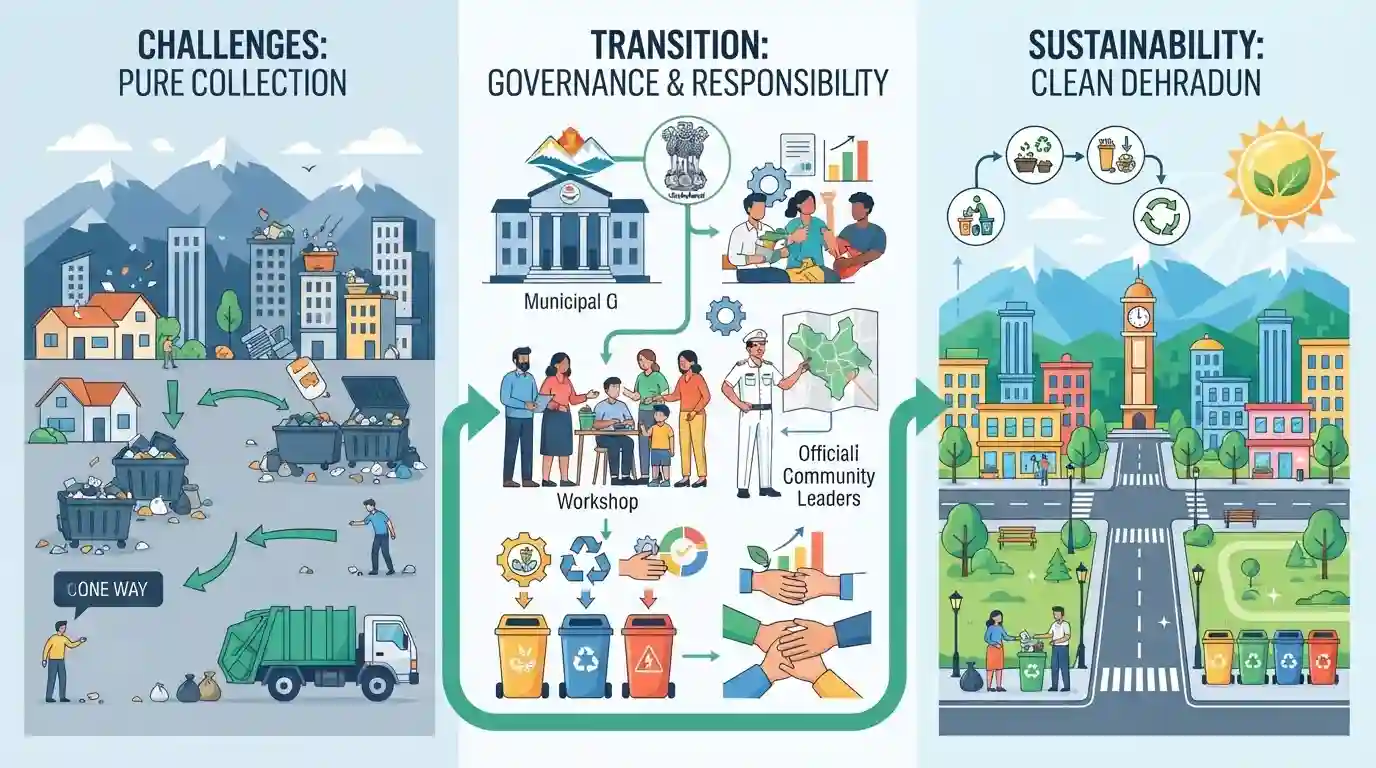
Dehradun transitions waste management toward civic responsibility
Source:garhwalpost ↗
Why It Matters
Important for understanding urban governance challenges, municipal solid waste management, and civic engagement initiatives in the capital city of Uttarakhand.
Summary
An analysis of Dehradun's journey toward urban cleanliness, highlighting the shift from mere waste collection to fostering civic responsibility, public participation, and sustainable solid waste management practices within Uttarakhand's urban framework.
Key Points
- Dehradun is transitioning its approach to urban cleanliness from routine waste collection toward community-led civic responsibility and sustainable waste management.
- Effective solid waste management requires active public participation, segregation at source, and strict municipal governance.
- Urban local bodies in Uttarakhand face unique waste management challenges due to tourism influx and urban expansion.
Important Terms
Swachh Bharat Mission

A nationwide flagship campaign launched by the Government of India to achieve universal sanitation coverage, promote scientific solid waste management, and foster public participation in urban cleanliness.
UPSC context
UKPSC Mains Paper V (Science, Tech & Governance) and Essay; tests policies on urban sanitation, public health, and sustainable development.
Municipal Solid Waste Management Rules
Statutory guidelines issued by the Ministry of Environment, Forest and Climate Change governing the segregation, collection, storage, transportation, processing, and disposal of municipal solid waste in urban areas.
UPSC context
UKPSC Mains Paper V (Environment & Ecology); tests statutory frameworks for pollution control and urban waste governance.
Dehradun Municipal Corporation
The apex urban local body responsible for municipal administration, civic infrastructure maintenance, and solid waste management services within the capital city of Uttarakhand.
UPSC context
UKPSC Prelims/Mains (Uttarakhand Polity & Administration); tests decentralization, urban local governance, and civic service delivery.
Prelims Trap
Dehradun manages its highest-in-state solid waste volume through centralized municipal dumping yards.
Aspirants often assume Dehradun's 737 MT daily waste is managed entirely by centralized municipal dumping, ignoring successful decentralized models like Nathuawala's Sanitation Park.
Static Concepts Connected
What are the key provisions of the Solid Waste Management Rules, 2016 in India?
- Source Segregation: Mandates source segregation of waste into wet, dry, and domestic hazardous waste by all waste generators.
- EPR Mandate: Introduces Extended Producer Responsibility (EPR) for manufacturers of packaging products.
- ULB Responsibility: Makes local authorities responsible for setting up infrastructure for collection, storage, segregation, transportation, and processing of waste.
Cross-Topic Patterns
Himalayan Tourism & Eco-Sensitivity
Uttarakhand's Nagar Palikas face severe waste surges during Char Dham and peak tourist seasons, mirroring similar systemic pressures in other fragile Himalayan eco-sensitive hill stations.
Grassroots Democracy & Urban Governance
The transition from top-down municipal collection to community-led sanitation parks connects urban governance reforms with grassroots participatory democracy at the ULB level.

Dehradun's decentralized Sanitation Park model and Uttarakhand ULB waste data are high-probability statement-based prelims fodder.
