Uttarakhand Initiates Phased Abolition of Revenue Police System
Source:jagran ↗
Why It Matters
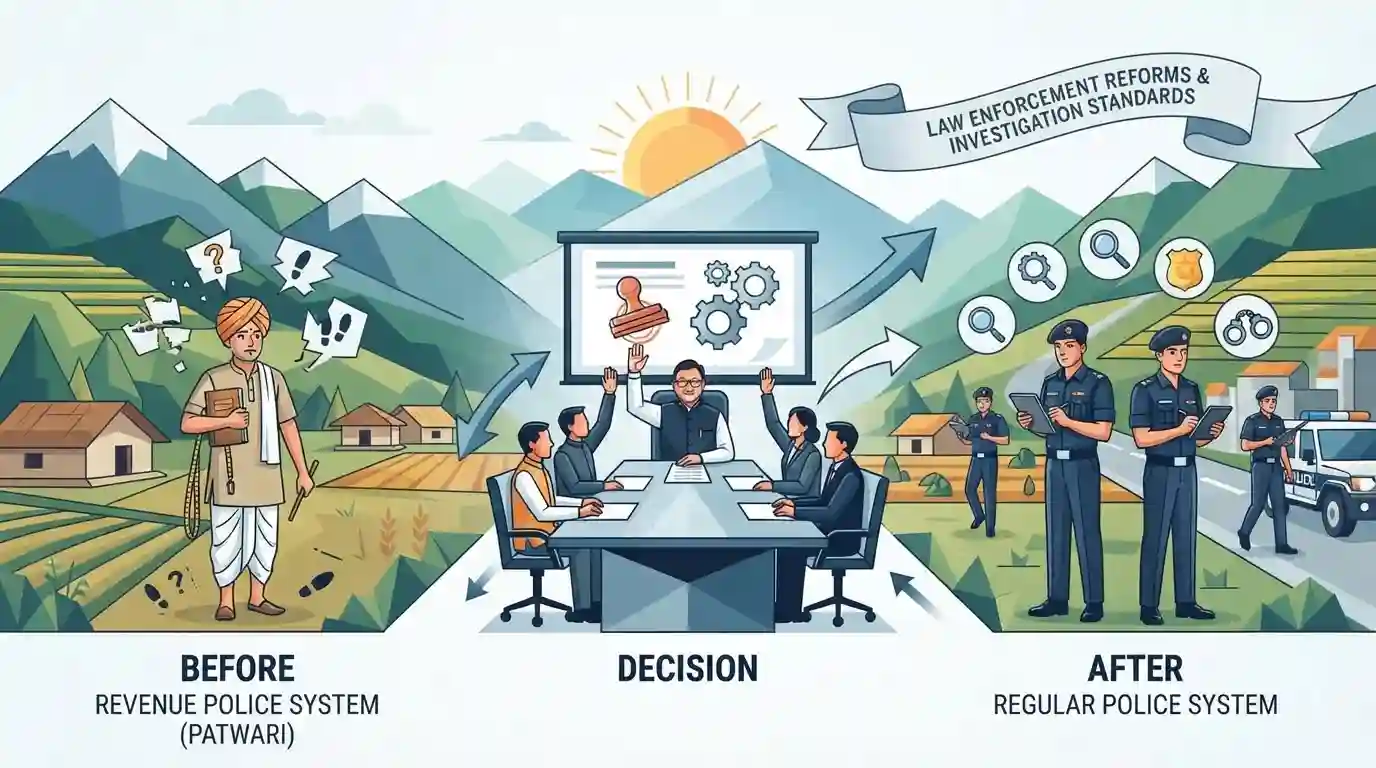
The abolition of the colonial-era revenue police system is a major administrative and policing reform in Uttarakhand, transitioning remote and hill areas to regular police jurisdiction for better criminal investigation and security governance.
Summary
The Uttarakhand Cabinet, led by Chief Minister Pushkar Singh Dhami, decided to phase out the historic Revenue Police System (Patwari policing) across the state, bringing areas previously managed by revenue officials for policing under the regular police system to strengthen law enforcement and investigation standards.
Key Points
- The Uttarakhand government initiated the process of abolishing the colonial-era Revenue Police System (Patwari Policing) in a phased manner.
- Under this system, revenue officials (like Patwaris) historically exercised police powers for investigating crimes in certain rural and hill areas of Uttarakhand.
- The phased transition aims to bring these areas under the regular regular police framework to improve law enforcement, criminal investigation, and security.
Important Terms
Revenue Police System (Patwari Policing)

A historic colonial-era policing arrangement in Uttarakhand where revenue officials like patwaris exercised police powers in hilly and rural areas, now being phased out for regular policing.
UPSC context
Crucial for UKPSC Mains (GS Paper V - Uttarakhand Governance & Administration), testing knowledge of historical administrative structures, legal reforms, and public safety issues.
Uttarakhand Cabinet
The apex decision-making body of the state government headed by the Chief Minister, responsible for executive policy formulation, administrative reforms, and financial approvals in Uttarakhand.
UPSC context
Important for UKPSC polity questions regarding state executive powers, cabinet decision-making processes, and policy implementation in hill states.
State Government of Uttarakhand
The sub-national governing authority of Uttarakhand comprising the Governor, Council of Ministers, and state bureaucracy, responsible for governance and law enforcement within the state.
UPSC context
Tested in UKPSC GS syllabus covering state administration, constitutional machinery, and state-level governance initiatives.
Prelims Trap
The Uttarakhand government immediately and completely abolished the Revenue Police System across all districts in a single step.
Aspirants often assume the Revenue Police System was entirely abolished in a single gazette notification, whereas the Dhami cabinet initiated its removal in a phased, incremental manner across notified villages.
Static Concepts Connected
What is the historical background and structure of the Revenue Police System in Uttarakhand?
- Colonial Origin: Introduced by the British in the 19th century to administer remote hill tracts with minimal administrative costs.
- Dual Function: Revenue officials such as Patwaris, Lekhpals, and Tehsildars were empowered with police powers to investigate cognizable offences.
- Abolition Phase: Gradually phased out due to lack of specialized training for heinous crimes and systemic investigative lapses.
Cross-Topic Patterns
Colonial Administrative Legacies vs Modern Policing
The abolition of patwari policing highlights the administrative friction between colonial-era administrative legacies and modern criminal jurisprudence in hill states.

UKPSC often tests unique regional administrative mechanisms like the Revenue Police System; expect questions on its origin and phase-out rationale.
Linked PYQs · 2
Linked PYQs · 2
- 2025UKPSC_PRELIMSGS1
Consider the following statements with reference to Uttarakhand and choose the correct answer: 1. The executive of Uttarakhand includes Governor as the head of the state. 2. It also includes the Chief Minister and his/her council of ministers.
- 2025UKPSC_PRELIMSGS1
Consider the following statements and select the correct answer from the options given below : Statement 1 : The State Council for Climate Change (SCCC) of Uttarakhand was established in the year 2011. Statement 2 : The responsibility of preparing Uttarakhand Action Plan on Climate Change (UAPCC) was given to the State Revenue Department.
