Dengue Vaccine Rollout Strategy and Public Health Impact
Source:Indian Express ↗
Why It Matters
Understanding the introduction of new vaccines like Qdenga for vector-borne diseases is vital for evaluating India's public health preparedness and disease management strategies under GS Paper III.
Summary
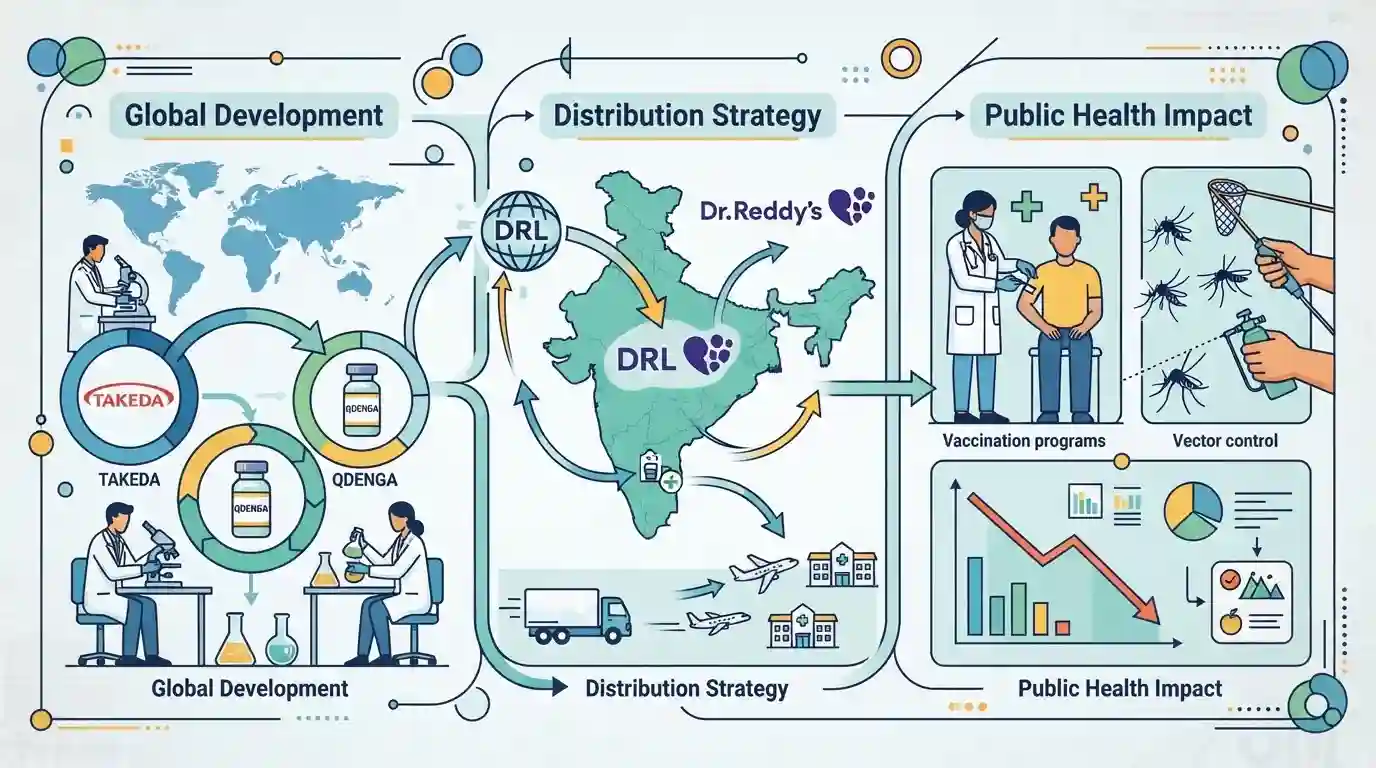
Dr Reddy's Laboratories is set to distribute Qdenga, a globally recognized dengue vaccine developed by Takeda, in India by 2027. This move aims to combat the high burden of dengue fever in the country, complementing ongoing vector control measures and expanding public health interventions.
Key Points
- Dr Reddy's Laboratories plans to introduce Qdenga, a dengue vaccine developed by Takeda, in India by 2027.
- The vaccine rollout will target addressing India's high burden of dengue cases across multiple serotypes.
- The partnership highlights private sector participation in expanding immunization and vector-borne disease management.
Important Terms
Qdenga

A globally recognized live-attenuated dengue vaccine developed by Takeda, approved as India's first dengue vaccine to combat the high burden of dengue fever.
UPSC context
Important for GS Paper II (Health Infrastructure, Disease Control and Management), testing knowledge of new vaccine approvals and vector-borne disease interventions in India.
Dr Reddy's Laboratories
A major Indian multinational pharmaceutical company partnering with Takeda to distribute the Qdenga vaccine in India's private market.
UPSC context
Important for GS Paper III (Industry, Biotechnology), testing the role of private pharmaceutical firms in public health distribution and vaccine rollouts.
Takeda Pharmaceutical Company
A major Japanese multinational pharmaceutical company and developer of Qdenga, partnering for regulatory and public market management in India.
UPSC context
Important for GS Paper II/III (International Pharma Collaborations and Public Health), highlighting global biopharmaceutical partnerships in combating tropical diseases.
Static Concepts Connected
What are the key epidemiological and regulatory features of Dengue management in India?
- Serotypes: Tetravalent nature: Dengue has four distinct serotypes (DENV-1 to DENV-4); primary infection provides lifelong immunity to that serotype only, while secondary infection with a different serotype increases risk of severe dengue.
- Vector Role: Vector dynamics: Primarily transmitted by the Aedes aegypti mosquito, which breeds in clean stagnant water and bites during daytime hours.
- CDSCO Approval: Regulatory body: CDSCO under the Ministry of Health and Family Welfare approves vaccines and drugs under the Drugs and Cosmetics Act, 1940.
Cross-Topic Patterns
Vaccines + Make in India PLI Schemes
Dengue vaccine deployment relies on supply chain security under Make in India, connecting health infrastructure with pharmaceutical manufacturing incentives (PLI schemes).

Expect a statement-based question pairing live-attenuated tetravalent dengue vaccines with CDSCO marketing authorization rules and IVM limits.
Linked PYQs · 3
Linked PYQs · 3
- 2023PrelimsGS1
'Wolbachia method' is sometimes talked about with reference to which one of the following?
- 2021PrelimsGS1
With reference to recent developments regarding 'Recombinant Vector Vaccines', consider the following statements : 1. Genetic engineering is applied in the development of these vaccines. 2. Bacteria and viruses are used as vectors. Which of the statements given above is/are correct?
- 2022MainsGS3
The increase in life expectancy in the country has led to newer health challenges in the community. What are those challenges and what steps need to be taken to meet them?
