India Set to Update GDP Base Year Data
Source:Indian Express ↗
Why It Matters
GDP measurement methodology is a core component of the GS3 syllabus. Understanding the nuances of base year revisions, the limitations of WPI as a deflator, and the role of new data sources (like HCES and ASUSE) is critical for Mains answers on economic growth and for Prelims questions on inflation indices.
Summary
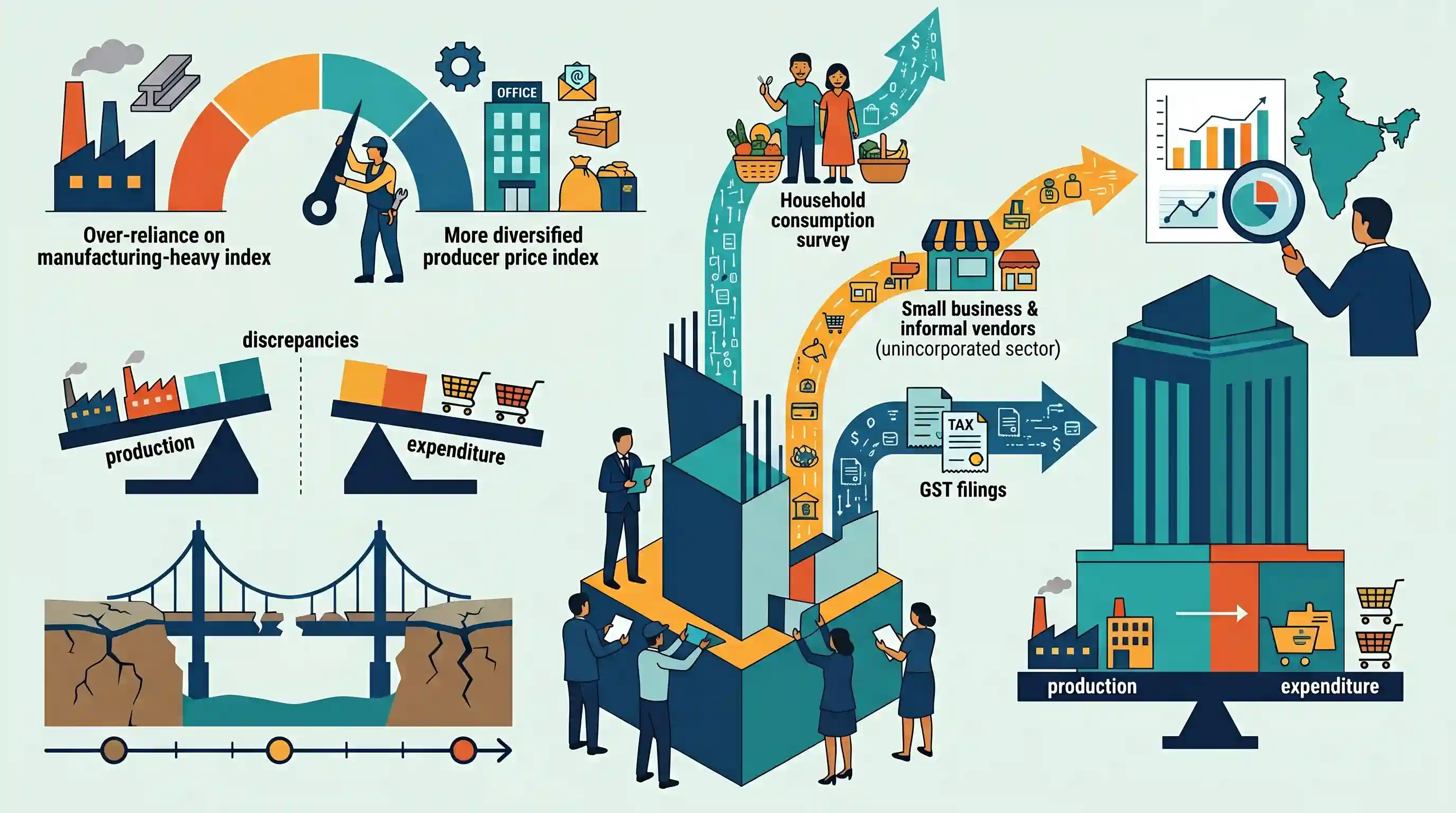
India's Ministry of Statistics and Programme Implementation (MoSPI) is preparing to revise the GDP base year, resolving a historically long 11-year gap since the 2011-12 series was introduced in 2015. This comprehensive update addresses structural flaws in current national accounts, particularly the widening "discrepancies" between the production and expenditure estimates of GDP. A central focus is refining inflation deflators—moving away from an over-reliance on the manufacturing-heavy Wholesale Price Index (WPI) towards more representative metrics like a Producer Price Index (PPI). This will better capture service sector dynamics and mitigate the overestimation risks caused by the single-deflation method during commodity price fluctuations. Furthermore, the revision will integrate new, high-frequency data sources including GST filings, the Household Consumption Expenditure Survey (HCES), and the Annual Survey of Unincorporated Sector Enterprises (ASUSE). These changes are essential for capturing India's burgeoning services sector and vast informal economy, providing policymakers with a credible and precise macroeconomic foundation.
Key Points
- India is preparing to revise its GDP base year, ending a historic 11-year gap since the current 2011-12 base was adopted in 2015.
- The revision seeks to address the widening "discrepancies" in national income accounts—the divergence between GDP measured via the production/income method and the expenditure method.
- A major methodological overhaul will involve updating deflators, potentially transitioning from the manufacturing-heavy Wholesale Price Index (WPI) to better indices like a Producer Price Index (PPI) to accurately capture service sector inflation and fix single-deflation biases.
- The new series will integrate contemporary, robust data sources such as the Household Consumption Expenditure Survey (HCES), GST data, and the Annual Survey of Unincorporated Sector Enterprises (ASUSE) to better reflect informal and service-driven economic activity.
Important Terms
Household Consumption Expenditure Survey (HCES)

A periodic NSSO survey measuring household spending patterns on goods and services. It is used to revise poverty lines, update the Consumer Price Index (CPI) basket, and estimate private consumption in GDP.
UPSC context
GS-III: Poverty, growth, and inflation. Tests understanding of consumption dynamics and its role in re-basing macroeconomic indices.
Annual Survey of Unincorporated Sector Enterprises (ASUSE)
A survey assessing the performance, employment, and value addition of India's non-agricultural informal sector. It provides critical data for national accounts to capture the unorganized economy's contribution to GDP.
UPSC context
GS-III: Informal sector and employment. Tests ability to analyze the unorganized economy's contribution to GDP and resource mobilization.
Producer Price Index (PPI)
An index measuring average price changes received by domestic producers for their output. Unlike WPI, it excludes taxes and distribution margins and includes services, offering a more accurate GDP deflator.
UPSC context
GS-III: Economic growth and inflation. Tests understanding of modernizing national accounting and improving GDP deflator accuracy for services.
MCA-21 Database
A Ministry of Corporate Affairs portal for digital filing by companies. Its database on financial performance is the primary source for estimating value addition in India’s private corporate sector.
UPSC context
GS-III: Macroeconomic indicators. Tests knowledge of data-driven GDP estimation and the challenges of measuring the formal private sector.
National Statistical Office (NSO)
The nodal statistical body under MoSPI, formed by merging CSO and NSSO. It is responsible for compiling and releasing India's GDP, inflation (CPI), and industrial production (IIP) data.
UPSC context
GS-III: National Income Accounting. Tests familiarity with institutional frameworks responsible for India’s official macroeconomic statistics and planning.
Wholesale Price Index (WPI)
An index measuring price changes at the bulk transaction level before goods reach consumers. It primarily covers manufacturing, fuel, and primary articles, excluding services, and is used for inflation tracking.
UPSC context
GS-III: Indian Economy. Tests understanding of inflation measurement and the limitations of wholesale-level price tracking for national accounts.
Prelims Trap
India currently uses the Producer Price Index (PPI) as the primary deflator for estimating real GDP.
Currently, India relies heavily on the WPI to deflate nominal GDP, causing distortions as WPI ignores services. The shift to a PPI is a proposed reform for the new base year, not existing practice.
Static Concepts Connected
What is the difference between single and double deflation in GDP calculation?
- Single Deflation: Output and intermediate inputs are deflated using the same price index. This can artificially inflate or deflate real GVA if input costs diverge from output prices.
- Double Deflation: Gross output and intermediate inputs are deflated separately using their respective, distinct price indices, yielding a much more accurate real GVA during volatile commodity cycles.
What do "discrepancies" represent in India's National Income Accounts?
- Statistical Residual: It is the statistical residual representing the exact difference between GDP calculated via the production/income method (GVA) and the expenditure method.
- Balancing Figure: Because real-time consumption and expenditure data is often delayed, the production-side (GVA) is treated as firmer. "Discrepancies" is added to the expenditure side to balance the ledger.
Cross-Topic Patterns
Base Year + Informal Economy Mapping
Integrating GST data and the ASUSE survey shifts national accounting from using proxy growth rates to direct tracking of India's vast unincorporated and informal sectors.
Deflator divergence + Inflation metrics
GDP estimation’s current reliance on WPI creates distortions during commodity shocks. A shift to PPI connects directly to broader macroeconomic debates on inflation targeting versus actual producer realization.

Concepts of single/double deflation, base year revisions, and the exact components of PPI vs WPI are highly likely in 2026 Prelims.
Linked PYQs · 2
Linked PYQs · 2
- 2021MainsGS3
Explain the difference between computing methodology of India's Gross Domestic Product (GDP) before the year 2015 and after the year 2015.
- 2020PrelimsGS1
Consider the following statements: 1. The weightage of food in Consumer Price Index (CPI) is higher than that in Wholesale Price Index (WPI). 2. The WPI does not capture changes in the prices of services, which CPI does. 3. Reserve Bank of India has now adopted WPI as its key measure of inflation and to decide on changing the key policy rates. Which of the statements given above is/are correct?
