Administrative measures to protect students from severe air pollution
Source:Indian Express ↗
Why It Matters
The issue is a practical example of how environmental degradation (air pollution) directly impacts fundamental rights (Right to Health under Article 21) and forces administrative bodies and the judiciary to intervene to protect vulnerable populations like children. It serves as a good case study for answers on environmental governance and judicial activism.
Summary
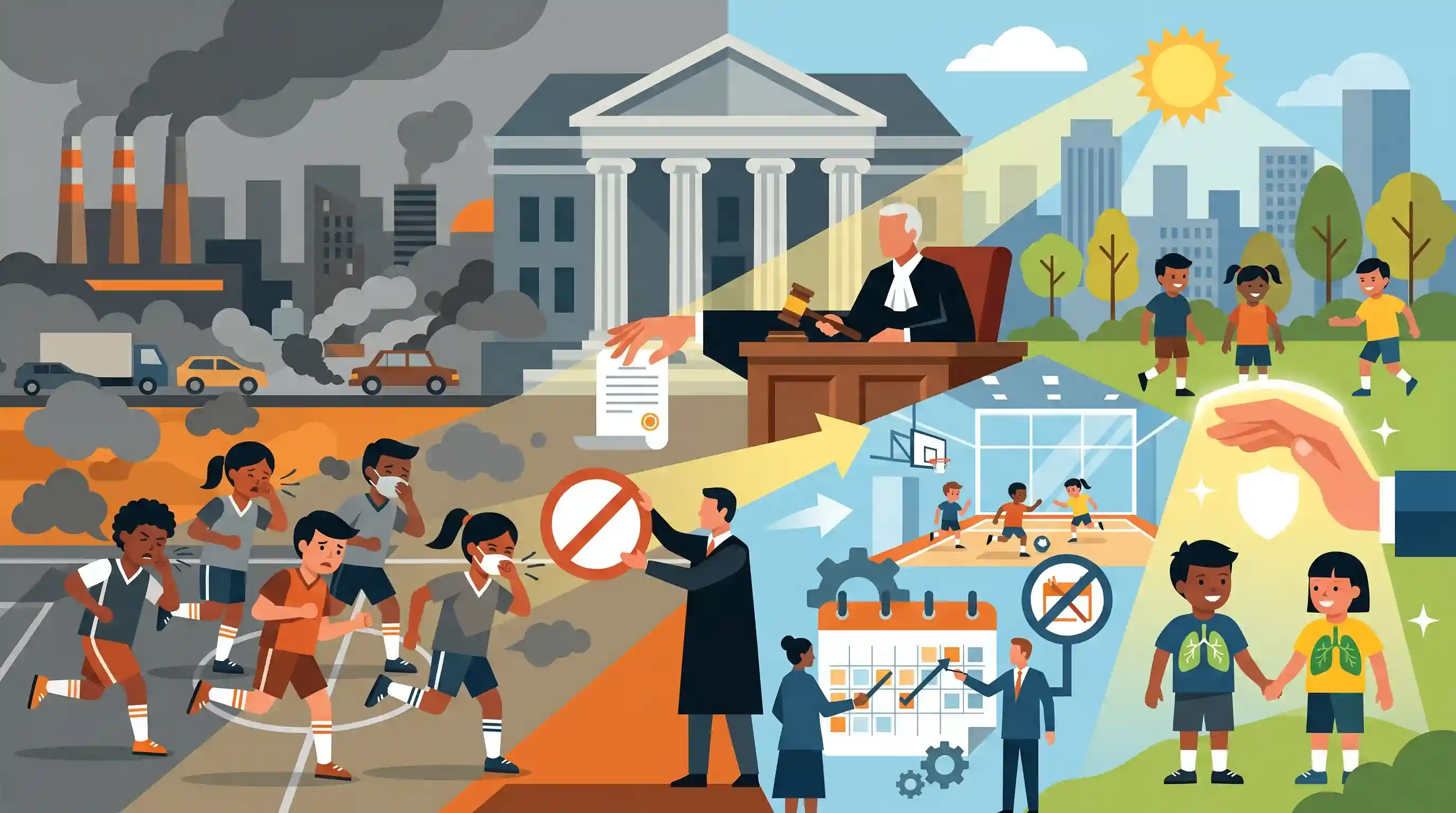
In response to severe air pollution in the national capital, the Delhi government has informed the Delhi High Court that it is open to deferring sports tournaments for school students. This administrative flexibility aims to safeguard children from the severe health risks associated with outdoor physical exertion during periods of toxic air quality. The case highlights the ongoing environmental crisis in Delhi and demonstrates the critical role of judicial oversight in prompting state action to protect public health and the right to a clean environment under Article 21.
Key Points
- The Delhi government informed the Delhi High Court of its willingness to defer sports tournaments for school students due to severe air pollution.
- The decision is a measure to protect children, a vulnerable demographic, from the hazardous health impacts of toxic air quality during outdoor physical activities.
- The development underscores the role of judicial intervention in ensuring that the government takes active steps to protect citizens' right to health and a clean environment.
- It highlights the broader administrative challenges of managing educational and extracurricular schedules in the face of recurrent environmental crises in the National Capital Region.
Important Terms
Graded Response Action Plan (GRAP)

A set of emergency measures implemented in phases to combat deteriorating air quality in Delhi-NCR, triggered when the Air Quality Index (AQI) crosses specific thresholds.
UPSC context
GS Paper 3 (Environment); critical for understanding pollution mitigation strategies and administrative responses in the National Capital Region.
Commission for Air Quality Management (CAQM)
A statutory body established under a 2021 Act to coordinate, research, and resolve air quality issues in Delhi-NCR and adjoining states.
UPSC context
GS Paper 2 (Statutory Bodies) and GS Paper 3 (Environment); tests institutional frameworks for environmental governance.
Article 21 (Right to a Clean Environment)
A constitutional provision guaranteeing life and liberty, judicially expanded to include the fundamental right to breathe clean air and live in a healthy environment.
UPSC context
GS Paper 2 (Fundamental Rights); essential for analyzing judicial interpretation and the evolution of environmental jurisprudence.
Air Quality Index (AQI)
A numerical scale (0–500) used to communicate air pollution levels based on eight pollutants, ranging from 'Good' to 'Severe Plus'.
UPSC context
GS Paper 3 (Pollution); fundamental for Prelims (pollutants monitored) and Mains (evaluating urban health).
Judicial Oversight
The proactive role of the judiciary in reviewing state actions to ensure the enforcement of environmental laws and protection of public health.
UPSC context
GS Paper 2 (Governance); examines the judiciary's role in addressing executive policy gaps and protecting constitutional rights.
Prelims Trap
"The Right to a clean environment is explicitly enshrined under Article 21."
It is an implicit right deduced by the Supreme Court (e.g., Subhash Kumar case), not explicitly written in the constitutional text of Article 21.
Static Concepts Connected
What is the statutory mandate and jurisdiction of the CAQM?
- Statutory Body: Established under the CAQM Act 2021, replacing the Supreme Court-mandated EPCA to consolidate pollution control efforts.
- Broad Jurisdiction: Covers Delhi and adjoining areas in Punjab, Haryana, Rajasthan, and UP to manage the airshed comprehensively.
- Overriding Powers: CAQM directives override orders issued by State Governments or State Pollution Control Boards in case of a conflict.
How is the Graded Response Action Plan (GRAP) structured for the NCR?
- AQI Triggers: Divided into four stages based on Air Quality Index (AQI): Stage I (Poor), Stage II (Very Poor), Stage III (Severe), and Stage IV (Severe Plus).
- Enforcement: Directed by CAQM, compelling states to enforce progressive restrictions like halting construction, banning diesel vehicles, and closing schools.
Cross-Topic Patterns
Judicial activism in environmental policy
The HC's intervention in school sports scheduling illustrates the ongoing judicialization of environmental governance, where courts step in to enforce Article 21 when executive action lags.
Tech mitigations vs. administrative bans
Administrative halts like sports bans are increasingly evaluated alongside technological stopgaps like Cloud Seeding or smog towers under the Science & Tech syllabus.

Expect a multi-statement question combining CAQM's statutory override powers over State Boards with specific GRAP stage triggers in 2026.
Linked PYQs · 2
Linked PYQs · 2
- 2022MainsGS2
“The most significant achievement of modern law in India is the constitutionalization of environmental problems by the Supreme Court.” Discuss this statement with the help of relevant case laws.
- 2015MainsGS2
Does the right to clean environment entail legal regulations on burning crackers during Diwali? Discuss in the light of Article 21 of the Indian Constitution and Judgement(s) of the Apex Court in this regard.
