Election Commission Special Intensive Revision of Electoral Rolls
Source:The Hindu ↗
Why It Matters
This topic highlights the procedural challenges in maintaining accurate electoral rolls and the Election Commission's proactive measures (like SIR). It emphasizes the constitutional mandate of the ECI to ensure free and fair elections, which is a frequent theme in GS-II (Polity and Governance - Electoral Reforms).
Summary
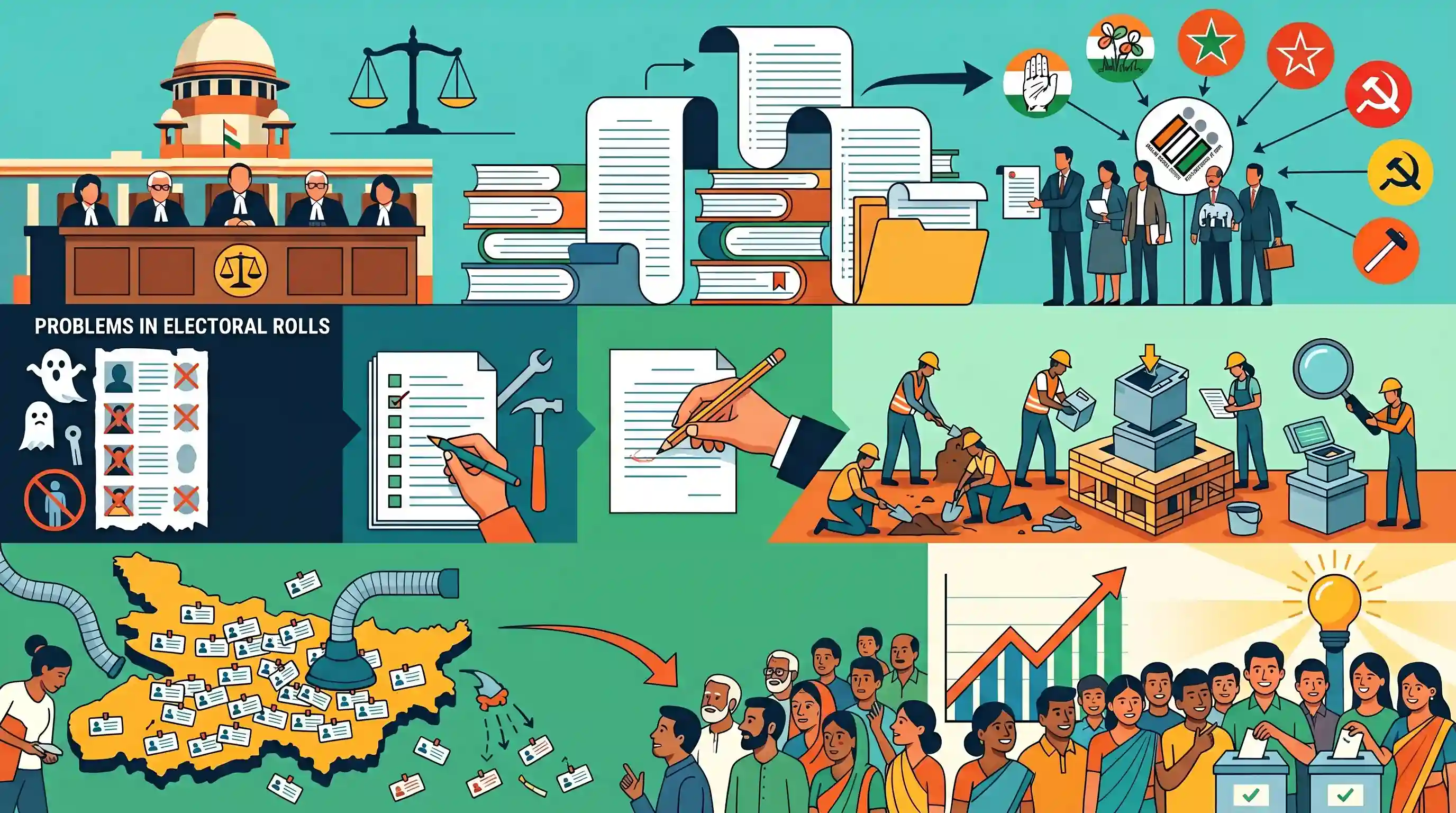
The Election Commission of India (ECI) has defended its decision to conduct a Special Intensive Revision (SIR) of Bihar's electoral rolls before the Supreme Court. Citing a 625-page annexure of complaints from multiple political parties (including AAP, Congress, BJP, AIADMK, and Shiv Sena), the ECI highlighted systemic inaccuracies in voter lists, such as the inclusion of deceased or ineligible voters and the exclusion of genuine ones. While summary revisions only update existing rolls, the SIR is a foundational, ground-up exercise. The ongoing revision may lead to the removal of around 66 lakh names in Bihar. The move aims to address opposition concerns over electoral manipulation and restore public confidence in the democratic process.
Key Points
- The Election Commission of India (ECI) is defending its decision in the Supreme Court to conduct a Special Intensive Revision (SIR) of Bihar's electoral rolls.
- The ECI initiated the SIR in response to widespread complaints from various political parties about inaccuracies in the voter lists, including the inclusion of deceased/ineligible individuals and exclusion of eligible voters.
- Unlike regular summary revisions, an SIR involves a comprehensive, ground-up preparation of the electoral rolls to ensure accuracy and transparency.
- The first phase of the SIR in Bihar may result in approximately 66 lakh names being struck off the draft electoral roll.
- The article highlights the ongoing tension and judicial scrutiny regarding the ECI's administrative processes to maintain the integrity of elections.
Important Terms
Election Commission of India (ECI)

An autonomous constitutional body under Article 324 responsible for administering Union and State election processes in India, including the preparation of electoral rolls.
UPSC context
GS II: Constitutional Bodies. Essential for questions on electoral integrity, independence of institutions, and Article 324 powers.
Special Intensive Revision (SIR)
A comprehensive, house-to-house verification and fresh enumeration of voters to ensure an accurate, error-free electoral register, usually triggered by large-scale inaccuracies.
UPSC context
GS II: Electoral Reforms. Tests understanding of the administrative procedures used to maintain the sanctity of the 'one person, one vote' principle.
Representation of the People Act, 1950
A central law providing the legal framework for seat allocation in legislatures, delimitation of constituencies, and the qualifications and registration of voters in electoral rolls.
UPSC context
GS II: Salient features of the Representation of People's Act. A core static topic frequently appearing in both Prelims and Mains.
Electoral Rolls
The official list of citizens eligible to vote in a specific constituency, maintained under the superintendence, direction, and control of the Election Commission.
UPSC context
GS II: Governance & Elections. Crucial for understanding the foundational requirements of democratic representation and voter inclusivity.
Summary Revision
A routine annual update of the voter list where changes are made based on claims and objections without a complete house-to-house enumeration.
UPSC context
GS II: Election Management. Differentiates between regular administrative updates and large-scale 'intensive' reforms in electoral governance.
Supreme Court of India
The highest judicial forum and final interpreter of the Constitution, which adjudicates on the legality of electoral procedures and the protection of fundamental rights.
UPSC context
GS II: Judiciary. Relevant for cases involving the balance between executive/administrative action and the constitutional rights of citizens.
Prelims Trap
The preparation, revision, and updating of electoral rolls are governed by the Representation of the People Act, 1951.
Preparation of electoral rolls falls under the RPA 1950, not 1951. Aspirants frequently confuse the two Acts; the 1951 Act governs the actual conduct of elections and disqualifications.
Static Concepts Connected
What is the statutory difference between RPA 1950 and RPA 1951?
- RPA 1950: Governs allocation of seats, delimitation of constituencies, and the preparation/revision of electoral rolls.
- RPA 1951: Regulates the actual conduct of elections, qualifications and disqualifications of MPs/MLAs, and corrupt practices.
What are the key constitutional provisions regarding electoral rolls?
- Article 324: Vests the superintendence, direction, and control of electoral roll preparation in the Election Commission of India.
- Article 325: Mandates a single general electoral roll for every territorial constituency; prohibits discrimination on grounds of religion, race, caste, or sex.
- Article 329(b): Bars judicial interference in electoral matters after the election process begins, though pre-election roll preparation remains subject to review.
Cross-Topic Patterns
Judicial Review vs. Article 329 immunity
The Supreme Court distinguishes between the 'conduct of elections' (immune from judicial intervention under Art 329) and 'preparation of electoral rolls', which remains open to judicial review for transparency.
ECI Autonomy and recent legislative changes
Judicial scrutiny of ECI's administrative actions (like SIR) connects directly to recent debates and the CEC Act 2023 regarding the functional autonomy and appointment process of Election Commissioners.

Expect a 2026 Prelims question contrasting RPA 1950 (electoral rolls) with RPA 1951 (election conduct), paired with Art 329 limitations.
Linked PYQs · 5
Linked PYQs · 5
- 2022MainsGS2
Discuss the role of the Election Commission of India in the light of the evolution of the Model Code of Conduct.
- 2017MainsGS2
To enhance the quality of democracy in India the Election Commission of India has proposed electoral reforms in 2016. What are the suggested reforms and how far are they significant to make democracy successful?
- 2017PrelimsGS1
For election to the Lok Sabha, a nomination paper can be filed by
- 2017PrelimsGS1
Consider the following statements: 1. The Election Commission of India is a five-member body. 2. Union Ministry of Home Affairs decides the election schedule for the conduct of both general elections and bye-elections. 3. Election Commission resolves the disputes relating to splits/mergers of recognised political parties. Which of the statements given above is/are correct?
- 2017PrelimsGS1
Right to vote and to be elected in India is a
