Assam Illegal Infiltration and Demographic Security Debate
Source:The Hindu ↗
Why It Matters
The issue of illegal immigration from Bangladesh into Assam has profound implications for internal security, demographic stability, and cultural identity. It frequently appears in UPSC questions regarding border management and demographic shifts. The political debate also touches upon constitutional protections for linguistic minorities and the State's duty against 'external aggression' under Article 355.
Summary
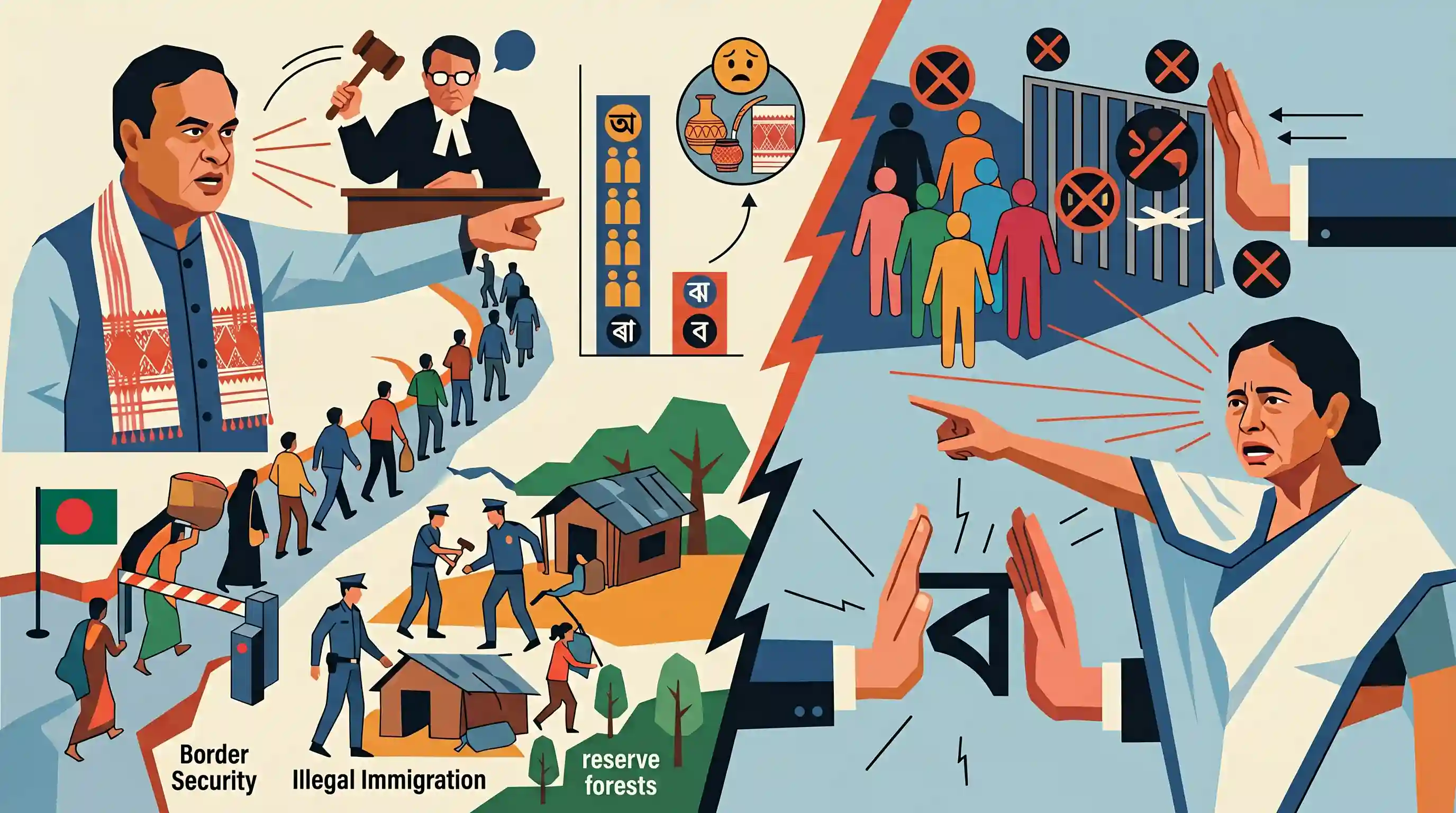
Assam Chief Minister Himanta Biswa Sarma countered allegations from West Bengal CM Mamata Banerjee regarding a divisive political agenda by defending eviction drives in Assam aimed at clearing encroachers from government lands and reserve forests. Sarma highlighted the demographic shift caused by the unchecked infiltration of Muslims from Bangladesh, referencing a Supreme Court observation that labeled the influx as 'external aggression'. Additionally, he raised concerns over linguistic identity politics, claiming that Bengali-speakers are deliberately recording Bengali as their mother tongue in the Census to artificially reduce the percentage of Assamese speakers, thereby threatening Assam's cultural foundation. Banerjee, in turn, labeled such linguistic pressure as unconstitutional.
Key Points
- Assam CM Himanta Biswa Sarma stated that unchecked infiltration from Bangladesh has caused a severe demographic shift, citing a Supreme Court observation that termed the influx as 'external aggression'.
- He defended the state's eviction drives targeting encroachers on government lands and reserve forests, denying allegations of a divisive communal agenda.
- The CM claimed that Bengali-speakers in Assam were intentionally recording Bengali as their mother tongue in the Census to reduce the official proportion of Assamese speakers, posing a threat to the state's cultural foundation.
- West Bengal CM Mamata Banerjee criticized the eviction drives and rhetoric, arguing that threatening citizens for upholding their linguistic identity is unconstitutional.
Important Terms
Article 355

Constitutional provision mandating the Union to protect States against 'external aggression' and 'internal disturbance'. The Supreme Court famously interpreted unchecked illegal migration into Assam as a form of external aggression under this Article.
UPSC context
GS Paper II (Governance/Constitution); tests Union-State relations and the Union's security obligations toward states under emergency-like conditions.
Sarbananda Sonowal v. Union of India (2005)
A 2005 landmark Supreme Court judgment that struck down the IMDT Act, 1983, as unconstitutional. It ruled that the influx of illegal migrants in Assam constituted 'external aggression', necessitating federal protection.
UPSC context
GS Paper II (Judiciary/Citizenship); essential for questions on the legal history of the National Register of Citizens (NRC).
Foreigners Act, 1946
A 1946 statute regulating the entry, stay, and departure of foreigners. Crucially, Section 9 places the 'burden of proof' on the individual to prove they are not a foreigner, unlike standard criminal law.
UPSC context
GS Paper II & III; tests understanding of the legal mechanism for identifying illegal immigrants and its procedural differences from the IMDT Act.
Article 29
A Fundamental Right under the Indian Constitution that permits any section of citizens with a 'distinct language, script, or culture' the right to conserve the same.
UPSC context
GS Paper II (Fundamental Rights); relevant for issues concerning linguistic and cultural identity vs. state-led assimilation or demographic shifts.
Linguistic Minorities
A group whose mother tongue is different from that of the majority in a State or UT. In India, they are protected via Articles 29, 30, and the Special Officer for Linguistic Minorities (Article 350B).
UPSC context
GS Paper II (Social Justice); tests the rights of non-dominant language speakers and the constitutional safeguards for India's pluralism.
Assam Accord (1985)
A 1985 tripartite Memorandum of Settlement between the Government of India, the Government of Assam, and student leaders. It established March 24, 1971, as the cut-off date for detecting and deporting foreigners.
UPSC context
GS Paper I (Post-Independence History) and GS Paper III (Internal Security); the foundation for current citizenship and NRC disputes in the Northeast.
Prelims Trap
Illegal immigration is considered 'external aggression' allowing the President to invoke a National Emergency under Article 352.
The SC used 'external aggression' only to invoke the Union's protective duty under Article 355. It does not qualify as the military aggression required for an Article 352 National Emergency.
Static Concepts Connected
What is the constitutional significance of Article 355 regarding internal security?
- Union's Duty: Mandates the Union government to protect every State against external aggression and internal disturbance, ensuring constitutional governance.
- Judicial Expansion: The Supreme Court expanded 'external aggression' to include unchecked, large-scale illegal immigration, notably in the 2005 Sarbananda Sonowal case.
- Not an Emergency: Unlike Article 352, invoking Article 355 is a protective duty that does not suspend fundamental rights or fundamentally alter federal power distribution.
How does the Constitution protect linguistic minorities and cultural identity?
- Article 29: Protects the right of *any* section of citizens to conserve their distinct language, script, or culture (it is not restricted only to minorities).
- Assam Accord Clause 6: Provides specific constitutional, legislative, and administrative safeguards to protect the cultural, social, and linguistic identity of the Assamese people.
- Article 350A: Directs states to provide adequate facilities for instruction in the mother tongue at the primary education stage for linguistic minority groups.
Cross-Topic Patterns
Horizontal Federalism & Demographics
Spats between states over eviction drives and linguistic demographics highlight issues in horizontal federalism, linking GS2 (Inter-state relations) directly to GS1 (Population dynamics).
Border Management vs Citizen Rights
Eviction drives merge GS3 (border management/illegal immigration) with GS2 (Constitutional rights), demonstrating how demographic anxieties translate into state-level internal security enforcement.

A multi-statement question parsing Article 355's 'external aggression' vs Article 352, linked to linguistic rights, is highly probable.
Linked PYQs · 3
Linked PYQs · 3
- 2020MainsGS3
Analyze internal security threats and transborder crimes along Myanmar, Bangladesh and Pakistan borders including Line of Control (LoC). Also discuss the role played by various security forces in this regard.
- 2014MainsGS3
How does illegal transborder migration pose a threat to India's security? Discuss the strategies to curb this, bringing out the factors which give impetus to such migration.
- 2023PrelimsGS1
Consider the following statements: 1. According to the Constitution of India, the Central Government has a duty to protect States from internal disturbances. 2. The Constitution of India exempts the States from providing legal counsel to a person being held for preventive detention. 3. According to the Prevention of Terrorism Act, 2002, confession of the accused before the police cannot be used as evidence. How many of the above statements are correct?
