India Defence Diplomacy and Indo Pacific Security Cooperation
Source:The Hindu ↗
Why It Matters
Understanding India's active defence diplomacy and strategic alignments at international forums like the Shangri-La Dialogue is crucial for analyzing India's approach to the Indo-Pacific security architecture and its relations with global powers like the US and NATO.
Summary
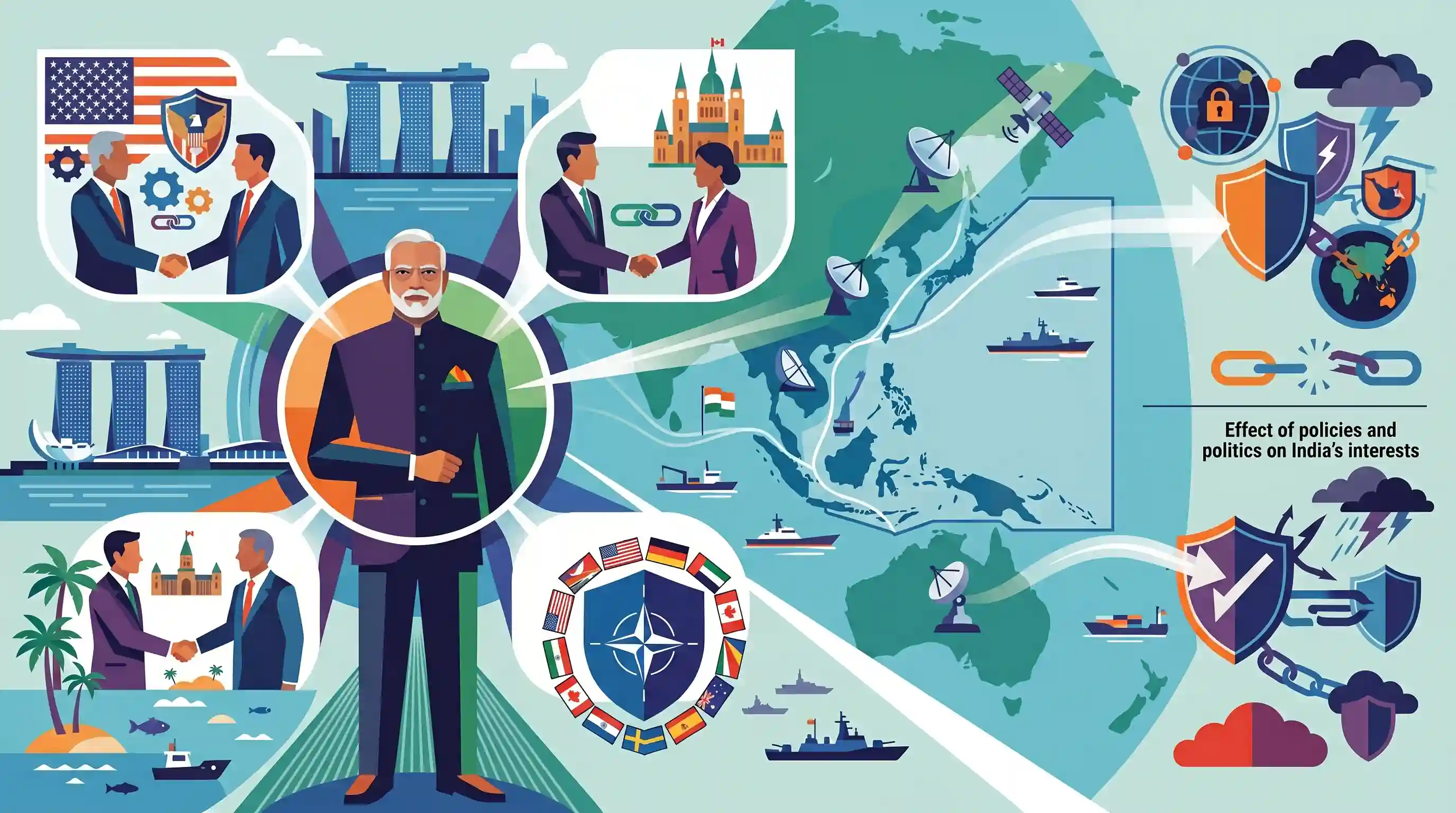
At the Shangri-La Dialogue 2026 in Singapore, India's Defence Secretary Rajesh Kumar Singh held a series of high-level bilateral meetings aimed at bolstering Indo-Pacific security and maritime collaboration. Engaging with top military and defence officials from the Seychelles, Canada, the United States, and NATO, Singh emphasized the strengthening of strategic defence partnerships and military-to-military cooperation. He reiterated India's commitment to a stable, secure, and inclusive Indo-Pacific and discussed strategies for addressing emerging global security challenges through robust defence diplomacy.
Key Points
- Defence Secretary Rajesh Kumar Singh engaged in significant bilateral meetings at the Shangri-La Dialogue 2026 in Singapore to enhance Indo-Pacific security cooperation.
- Discussions with Seychelles, Canada, and the U.S. focused on deepening maritime security collaboration in the Indian Ocean Region and expanding strategic defence ties.
- Interactions with the NATO Military Committee Chair highlighted India's commitment to engaging with major multilateral defence organizations to tackle global security challenges.
- Singh outlined India's vision for a free, open, secure, and inclusive Indo-Pacific through proactive defence diplomacy.
Important Terms
Shangri-La Dialogue

An annual inter-governmental 'Track One' security summit in Singapore, organized by the International Institute for Strategic Studies (IISS), where defense ministers and military chiefs discuss Asia-Pacific security challenges.
UPSC context
GS Paper 2 (International Relations/Global Groupings). Tests knowledge of regional security architectures and India’s strategic outreach in the Indo-Pacific.
U.S. Indo-Pacific Command (USINDOPACOM)
The largest and oldest of the U.S. unified combatant commands, responsible for the Indo-Pacific region. Its area of responsibility extends from the U.S. west coast to India's western border.
UPSC context
GS Paper 2 (Bilateral/Global Groupings). Crucial for understanding India-U.S. defense ties, the 'Major Defense Partner' status, and maritime security.
NATO Military Committee
The senior military authority in NATO, providing advice to the North Atlantic Council. It translates political decisions into military direction and consists of the Chiefs of Defence of member nations.
UPSC context
GS Paper 2 (International Institutions). Tests understanding of India's evolving engagement with Western military alliances and convergence on global security threats.
Seychelles Armed Forces
The unified military force of Seychelles, a strategic maritime partner for India. It collaborates with India on maritime domain awareness through initiatives like the Colombo Security Conclave.
UPSC context
GS Paper 2 (Bilateral Relations/Indian Ocean). Relevant for India’s SAGAR vision and its role as a 'net security provider' in the IOR.
National Defence (Canada)
The Government of Canada department that supports the Canadian Armed Forces. It manages defense policy and military cooperation, including burgeoning Indo-Pacific maritime security partnerships with India.
UPSC context
GS Paper 2 (Bilateral Relations). Highlights the renewal of India-Canada strategic ties and cooperation in the Indo-Pacific region.
Prelims Trap
"The Shangri-La Dialogue is a formal defense summit hosted annually by ASEAN."
Though it functions as a Track-1 inter-governmental forum, it is organized by the International Institute for Strategic Studies (IISS), an independent UK-based think tank, not ASEAN.
Static Concepts Connected
What are the different tracks of diplomacy in international relations?
- Track 1: Official government-to-government diplomatic engagement conducted by authorized state representatives.
- Track 1.5: Joint engagement involving both government officials (often acting in a personal, off-the-record capacity) and non-governmental experts.
- Track 2: Unofficial dialogue between non-state actors, such as academics, NGOs, and think tanks, to build trust.
What are India's key frameworks for Maritime Domain Awareness in the IOR?
- SAGAR Doctrine: An overarching strategic doctrine aimed at ensuring "Security and Growth for All in the Region," shaping India's regional maritime posture.
- IFC-IOR: A hub based in Gurugram that collates and shares maritime data with partner nations to track shipping and maritime threats.
- White Shipping Agreements: Bilateral agreements signed with various nations to exchange advance information on the movement of commercial, non-military vessels.
Cross-Topic Patterns
Non-Treaty NATO Engagement
India sustains political dialogue with NATO without treaty obligations, balancing Western strategic alignment with its core tenet of strategic autonomy and multipolarity.
Seychelles & Maritime Chokepoints
Bilateral military ties with Seychelles directly operationalize India's SAGAR doctrine to secure vital chokepoints and counter China's expanding 'String of Pearls' footprint in the Western Indian Ocean.

Expect a Prelims 'match-the-following' question pairing major security dialogues (Shangri-La, Raisina, Munich) with their organizers.
Linked PYQs · 3
Linked PYQs · 3
- 2020MainsGS2
What is the significance of Indo-US defence deals over Indo-Russian defence deals? Discuss with reference to stability in the Indo-Pacific region.
- 2023MainsGS2
‘The expansion and strengthening of NATO and a stronger US-Europe strategic partnership works well for India.’ What is your opinion about this statement ? Give reasons and examples to support your answer.
- 2014MainsGS2
With respect to the South China sea, maritime territorial disputes and rising tension affirm the need for safeguarding maritime security to ensure freedom of navigation and over flight throughout the region. In this context, discuss the bilateral issues between India and China.
