India and Israel strengthen bilateral defence cooperation framework
Source:The Hindu ↗
Why It Matters
The meeting highlights the growing institutionalization of defence ties between India and Israel, reflecting their shared security concerns, particularly regarding state-sponsored and international terrorism, which is relevant for India's foreign policy and security strategies.
Summary
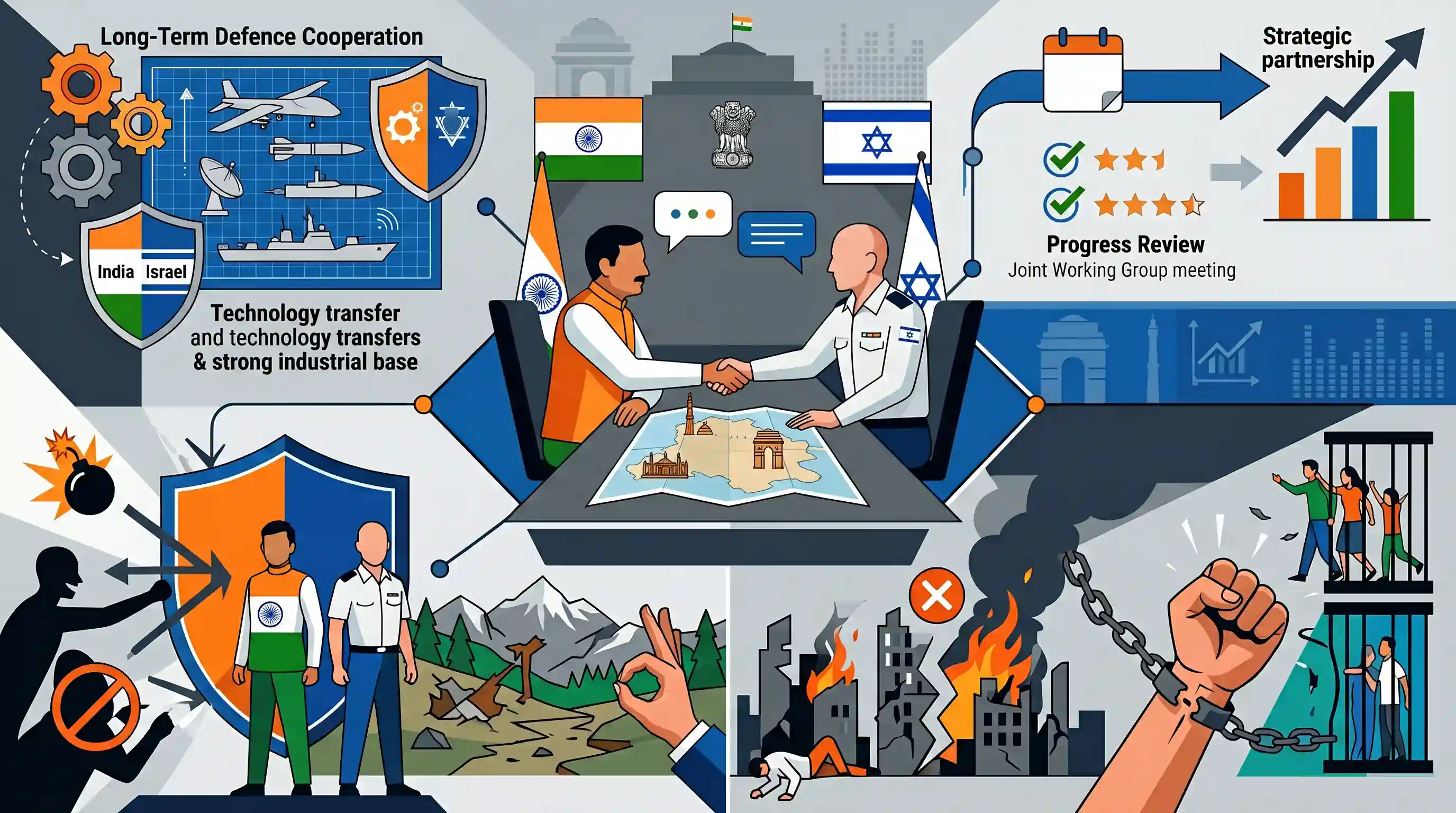
Defence Secretary Rajesh Kumar Singh held a bilateral meeting with the Director General of the Israeli Ministry of Defence, Major General (Res) Amir Baram, in New Delhi to enhance the India-Israel strategic partnership. The two sides focused on developing an institutional framework for long-term defence cooperation and reviewed progress since their July 2024 Joint Working Group meeting. The discussions also highlighted a shared stance against terrorism; Israel condemned the Pahalgam terrorist attack, while India reiterated its zero-tolerance approach to terrorism, condemning the October 7 attacks and calling for the release of hostages.
Key Points
- India and Israel held a bilateral meeting in New Delhi to strengthen their strategic partnership and defence ties.
- Both nations agreed to work towards developing an institutional framework for deepening long-term defence cooperation.
- The Israeli Director General condemned the recent Pahalgam terrorist attack, reaffirming support for India\'s fight against terrorism.
- India reiterated its zero-tolerance policy towards terrorism, condemned the October 7 attacks in Israel, and called for the release of all hostages.
- The officials reviewed the progress of ongoing defence collaboration activities since the previous Joint Working Group meeting in July 2024.
Important Terms
India-Israel Special Strategic Partnership

The highest tier of bilateral engagement between India and Israel, upgraded in February 2026, focusing on security, innovation, agriculture, and emerging technologies like AI.
UPSC context
GS Paper II: International Relations. Relevant for bilateral agreements and strategic shifts in West Asian diplomacy.
Joint Working Group (JWG) on Defence
The apex institutional mechanism co-chaired by India's Defence Secretary and Israel's MoD Director General to review, guide, and formulate long-term roadmaps for bilateral defence cooperation.
UPSC context
GS Paper II: Bilateral Groupings. Tests knowledge of structured mechanisms that sustain long-term strategic and military partnerships.
Zero-Tolerance Approach to Terrorism
India’s foundational foreign policy stance that rejects any justification for terrorism and demands the complete dismantling of terrorist ecosystems, funding, and safe havens.
UPSC context
GS Paper III: Internal Security. A core doctrine used to evaluate India's global counter-terrorism diplomacy and legislative frameworks.
De-hyphenation Policy
The diplomatic strategy of maintaining independent, standalone relations with Israel and Palestine, ensuring that engagement with one does not negatively impact the relationship with the other.
UPSC context
GS Paper II: India’s Foreign Policy. Explains the shift from ideological to interest-based realism in West Asia.
Co-development and Co-production
A shift from a buyer-seller relationship to collaborative manufacturing where both nations jointly design, develop, and produce advanced military equipment, aligning with 'Atmanirbhar Bharat'.
UPSC context
GS Paper III: Indigenisation of Technology. Crucial for understanding self-reliance in the defence industrial base.
Technology Transfer
The transfer of technical knowledge and manufacturing rights from a foreign entity to an Indian partner, often a prerequisite for defence procurement to boost domestic industry.
UPSC context
GS Paper III: Science and Technology. Relevant for discussions on 'Make in India' and reducing import dependency.
Prelims Trap
"India and Israel's defence relationship is strictly a buyer-seller arrangement for importing finished arms."
India-Israel defence ties have evolved far beyond basic imports into a comprehensive "Strategic Partnership" involving joint R&D and co-production (e.g., Barak-8, UAVs).
Static Concepts Connected
What distinguishes a Strategic Partnership from a Military Alliance?
- Military Alliance: Entails a binding mutual defence pact (e.g., NATO's Article 5) where an attack on one member requires a military response from all.
- Strategic Partnership: Focuses on shared security, economic interests, and joint capacity building without binding mutual defence treaty obligations, as seen with India and Israel.
- Strategic Autonomy: Partnerships allow India to maintain its fundamental policy of strategic autonomy, unlike the restrictive constraints of formal alliances.
What are the flagship joint defence productions between India and Israel?
- Barak-8 Missile: A Long-Range Surface-to-Air Missile (LRSAM) jointly developed by India's DRDO and Israel Aerospace Industries (IAI).
- UAV Co-production: The Drishti 10 Starliner (Hermes 900) is manufactured by Adani Defence under a technology-transfer agreement from Israel's Elbit Systems.
- Phalcon AWACS: Airborne Warning and Control System (AWACS) combining Israeli radar systems mounted on Russian IL-76 aircraft, operated by the IAF.
Cross-Topic Patterns
Tech-transfer meets Atmanirbhar Bharat
The shift from importing Israeli arms to co-producing them (e.g., Drishti 10 drones) highlights the integration of foreign tech-transfers with India's Atmanirbhar Bharat defense indigenization goals.
De-hyphenation policy in West Asia
India condemns the October 7 attacks and strengthens defence ties with Israel, yet simultaneously maintains strategic relations with Arab states, demonstrating its successful 'de-hyphenation' policy in the Middle East.

Expect a 2026 multi-statement Prelims question mixing India's West Asia de-hyphenation policy with specific co-productions like Barak-8.
Linked PYQs · 2
Linked PYQs · 2
- 2018MainsGS2
“India’s relations with Israel have, of late, acquired a depth and diversity, which cannot be rolled back.” Discuss.
- 2025MainsGS3
Terrorism is a global scourge. How has it manifested in India? Elaborate with contemporary examples. What are the counter measures adopted by the State? Explain.
