Defence Review and Air Defence Preparedness at Bhuj Station
Source:The Hindu ↗
Why It Matters
High-level defense reviews amidst active border hostilities highlight the volatile nature of India's western frontier and the critical role of air defense infrastructure. Furthermore, the visit to the Smritivan memorial serves as a reminder of India's vulnerability to seismic hazards, tying directly into GS-3 Disaster Management.
Summary
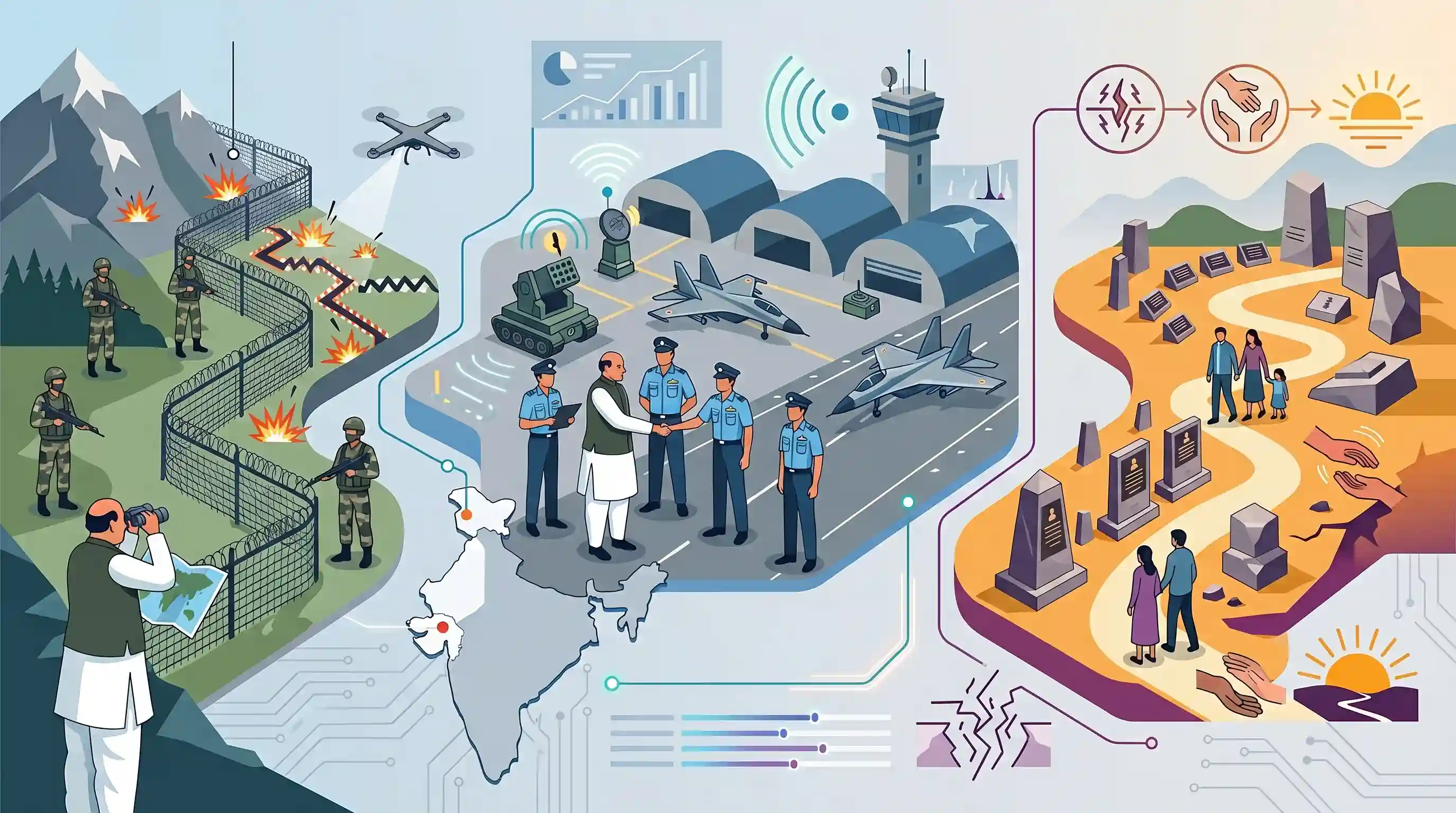
Defence Minister Rajnath Singh visited the Bhuj Air Force Station in Gujarat following recent attacks by the Pakistan military, aiming to interact with air warriors and assess preparedness. This visit came shortly after he reviewed the security situation along the Line of Control (LoC) and International Border in Jammu and Kashmir. Additionally, he visited Smritivan, a memorial dedicated to the victims of the 2001 Gujarat earthquake, highlighting both India's military readiness and its historical context of disaster management.
Key Points
- Defence Minister Rajnath Singh visited the Bhuj Air Force Station in Gujarat, which was targeted by the Pakistan military the previous week.
- The visit followed a review of the security situation along the Line of Control (LoC) and International Border in Jammu and Kashmir.
- The Defence Minister also visited Smritivan, a memorial and museum envisioned by PM Narendra Modi to honor the victims of the 2001 Gujarat earthquake.
- The high-level visits underscore India's focus on operational readiness and air defense infrastructure amidst active cross-border hostilities.
Important Terms
Bhuj Air Force Station

A strategic Indian Air Force base in Kutch, Gujarat, vital for western border surveillance and air defense near the India-Pakistan frontier; famously rebuilt by local women during the 1971 war.
UPSC context
GS-III: Internal Security; tests knowledge of strategic military installations and historical resilience in border defense.
Smritivan
A memorial and museum on Bhujiyo Hill dedicated to the 2001 Gujarat earthquake victims, serving as a center for disaster resilience and education on seismology and recovery.
UPSC context
GS-III: Disaster Management; tests understanding of post-disaster rehabilitation, community resilience, and scientific awareness.
Line of Control (LoC)
The de facto military boundary between India and Pakistan in Jammu and Kashmir, originating from the 1948 ceasefire line and formalized under the 1972 Simla Agreement.
UPSC context
GS-II/GS-III: International Relations and Security; crucial for understanding territorial disputes and ceasefire protocols.
International Border (IB)
The legally recognized and internationally demarcated boundary between sovereign nations, such as the 1947 Radcliffe Line between India and Pakistan in Gujarat and Punjab.
UPSC context
GS-III: Border Management; tests knowledge of border demarcation types and related security challenges.
Operation Sindoor
A specific 2025 Indian military operation where the IAF destroyed terror infrastructure in Pakistan within 23 minutes following a terrorist attack in Pahalgam.
UPSC context
GS-III: Security/Current Affairs; tests awareness of active military responses and national defense doctrines against cross-border terrorism.
Indian Air Force (IAF)
The aerial warfare branch of the Indian Armed Forces responsible for safeguarding Indian airspace and conducting aerial warfare during armed conflicts.
UPSC context
GS-III: Security Forces; tests role, commands, and modern technological capabilities like the BrahMos missile integration.
Prelims Trap
The entire India-Pakistan boundary, including the International Border and the LoC, is guarded by the Indian Army.
The Indian Army guards the active, de facto Line of Control (LoC). The Border Security Force (BSF) secures the formally recognized International Border (IB).
Static Concepts Connected
How does the BIS classify India's seismic zones?
- Zones II to V: The Bureau of Indian Standards (BIS) groups India into four seismic zones: II, III, IV, and V. The erstwhile Zone I was merged into Zone II.
- Zone V (Very High): Comprises highly active macro-seismic regions including Kutch (Bhuj), the entire Northeast, parts of J&K, Himachal Pradesh, Uttarakhand, and the Andaman & Nicobar Islands.
- Zone IV (High Risk): Covers areas with significant vulnerability, including the National Capital Region (Delhi), the Indo-Gangetic basin, and remaining parts of the Himalayas.
What distinguishes the Line of Control from the International Border?
- LoC origins: A de facto military boundary demarcating physical control, formally redesignated from the 1949 Ceasefire Line following the 1972 Shimla Agreement between India and Pakistan.
- IB recognition: The International Border is a legally recognized, formalized boundary based on the Radcliffe Line, extending from Gujarat up to the international border sector in Jammu.
- Guarding mandates: Under the 'One Border, One Force' principle, the Indian Army guards the volatile LoC, while the BSF secures the International Border.
Cross-Topic Patterns
Sir Creek and Gujarat's maritime border
Border security in Gujarat is complicated by the Sir Creek dispute in the Rann of Kutch, linking shifting marshland geography with international maritime boundary principles under UNCLOS.
Bhuj 2001: The Disaster Management catalyst
The 2001 Bhuj earthquake was the critical catalyst that shifted India from a reactive, relief-centric approach (under the Agriculture Ministry) to a proactive institutional framework via the Disaster Management Act, 2005.

Expect a prelims question mapping India's Seismic Zones (like Kutch in Zone V) against recent disaster management initiatives by the NDMA.
Linked PYQs · 3
Linked PYQs · 3
- 2020MainsGS3
Analyze internal security threats and transborder crimes along Myanmar, Bangladesh and Pakistan borders including Line of Control (LoC). Also discuss the role played by various security forces in this regard.
- 2024MainsGS3
India has a long and troubled border with China and Pakistan fraught with contentious issues. Examine the conflicting issues and security challenges along the border. Also give out the development being undertaken in these areas under the Border Area Development Programme (BADP) and Border Infrastructure and Management (BIM) Scheme.
- 2021MainsGS3
Discuss about the vulnerability of India to earthquake related hazards. Give examples including the salient features of major disasters caused by earthquakes in different parts of India during the last three decades.
