Indigenous Aero-Engine Development for AMCA and Strategic Autonomy
Source:The Hindu ↗
ఇది ఎందుకు ముఖ్యం
Aero-engine development is the pinnacle of aerospace engineering and defence manufacturing. India's push to indigenize engines for its fifth-generation AMCA addresses crucial strategic autonomy gaps, making it highly relevant for GS3 questions on security, indigenization, and technology.
సారాంశం
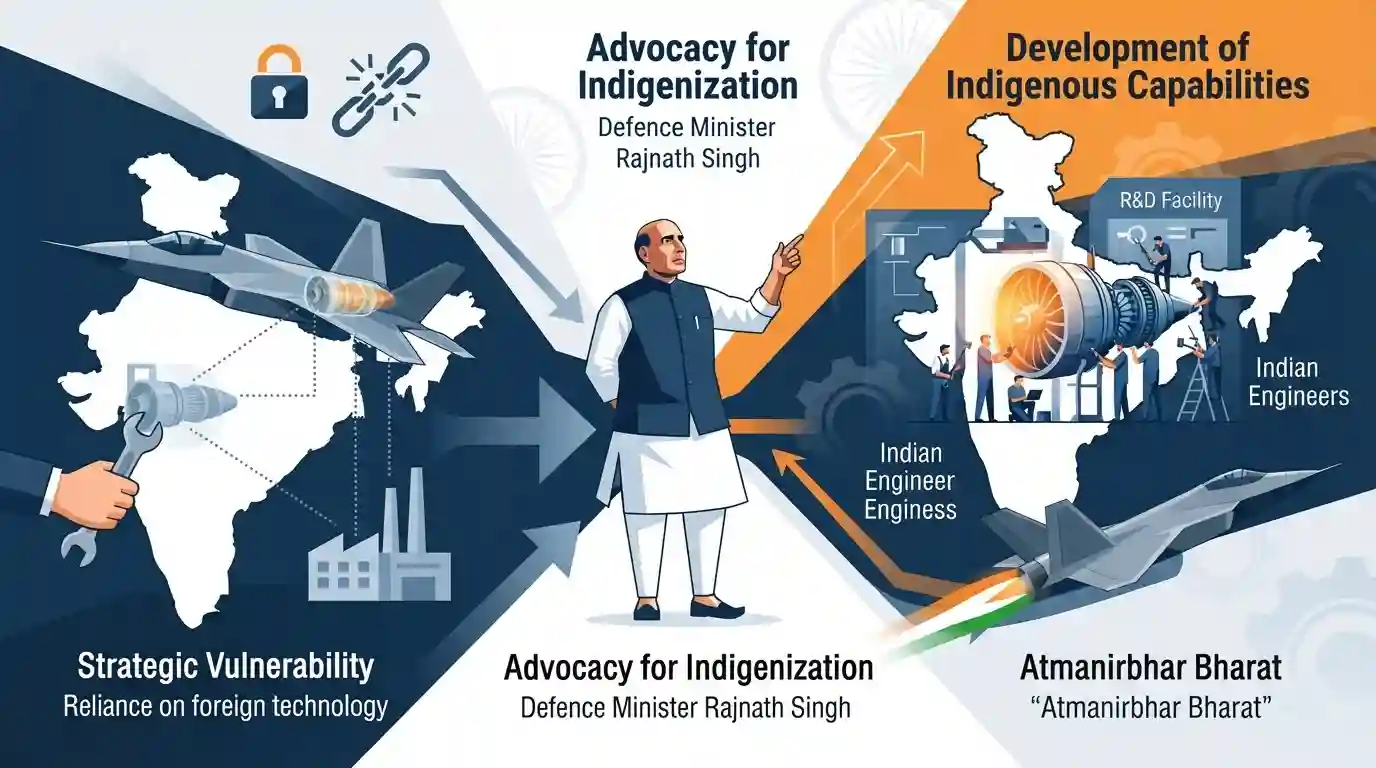
Defence Minister Rajnath Singh has strongly advocated for the development of indigenous aero-engine capabilities to power India's futuristic Advanced Medium Combat Aircraft (AMCA). Highlighting the strategic vulnerabilities of relying on foreign powerplants for critical military platforms, the push underscores India's focus on achieving technological self-reliance and boosting domestic defence manufacturing ecosystems under Atmanirbhar Bharat.
ముఖ్య అంశాలు
- Defence Minister Rajnath Singh emphasized the urgent need to develop indigenous aero-engine capabilities for India's fifth-generation Advanced Medium Combat Aircraft (AMCA).
- Aero-engine technology remains one of the most technologically complex and closely guarded domains globally, making indigenization crucial for strategic autonomy.
- The push aligns with India's broader defence manufacturing goals of achieving self-reliance (Atmanirbhar Bharat) and reducing high import dependency for critical military hardware.
ముఖ్యమైన పదాలు
Advanced Medium Combat Aircraft (AMCA)

India's indigenous initiative to develop a twin-engine, fifth-generation stealth multirole fighter aircraft for the Indian Air Force, featuring low observability, internal weapons, and advanced sensor fusion.
UPSC context
UPSC Mains Paper III: Security — Indigenisation of technology and critical military platform development.
Ministry of Defence
The apex central government body charged with formulating national defence policy and managing India's armed forces, including the Departments of Defence, Military Affairs, and Defence Production.
UPSC context
UPSC Mains Paper II / III: Governance and Security — Organization, mandate, and policy-making of executive ministries.
ప్రిలిమ్స్ ఉచ్చు
India's fifth-generation AMCA will be entirely powered by an indigenous engine developed under Atmanirbhar Bharat from its initial rollout.
Aspirants often assume the entire AMCA program will feature an indigenous engine from Day 1, missing that initial Mk1 variants rely on imported GE F414 engines.
అనుసంధానమైన స్థిర భావనలు
What are the key phases and technological bottlenecks in India's indigenous aero-engine development?
- GTRE & Kaveri: Kaveri engine project initiated by GTRE in 1989 faced severe weight, thrust-to-weight ratio, and high-temperature metallurgy challenges, leading to its bifurcation into a dry engine for UAVs.
- Complex Metallurgy: Single-crystal blade casting, ceramic matrix composites (CMCs), and high-pressure turbine cooling are closely guarded technologies mastered by very few nations (US, UK, France, Russia).
- Phased Strategy: AMCA Mk1 uses imported GE F414 engines, while AMCA Mk2 targets an indigenous high-thrust engine co-developed with international partners featuring full ToT.
అంతర-అంశ నమూనాలు
Defence Indigenization + Critical Minerals Supply Chains
Advanced aerospace manufacturing requires rare earth permanent magnets and superalloys, linking critical minerals extraction directly to domestic defence production targets.
Defence Technology Transfer + Strategic Autonomy
Joint venture co-development models with firms like Safran test India's capability to leverage technology transfer clauses within broader strategic partnership frameworks.

AMCA Mk1 vs Mk2 engine strategy (imported GE F414 vs co-developed high-thrust engine) is prime material for a statement-based prelims question.
