Deesa Fire Tragedy: Supreme Court Plea Seeks Independent Probe
Source:Indian Express ↗
Why It Matters
This case highlights the use of constitutional remedies by citizens to seek independent investigations outside state jurisdiction when they suspect local biases. It also underscores the issue of accountability and adequate compensation following urban or industrial disasters.
Summary
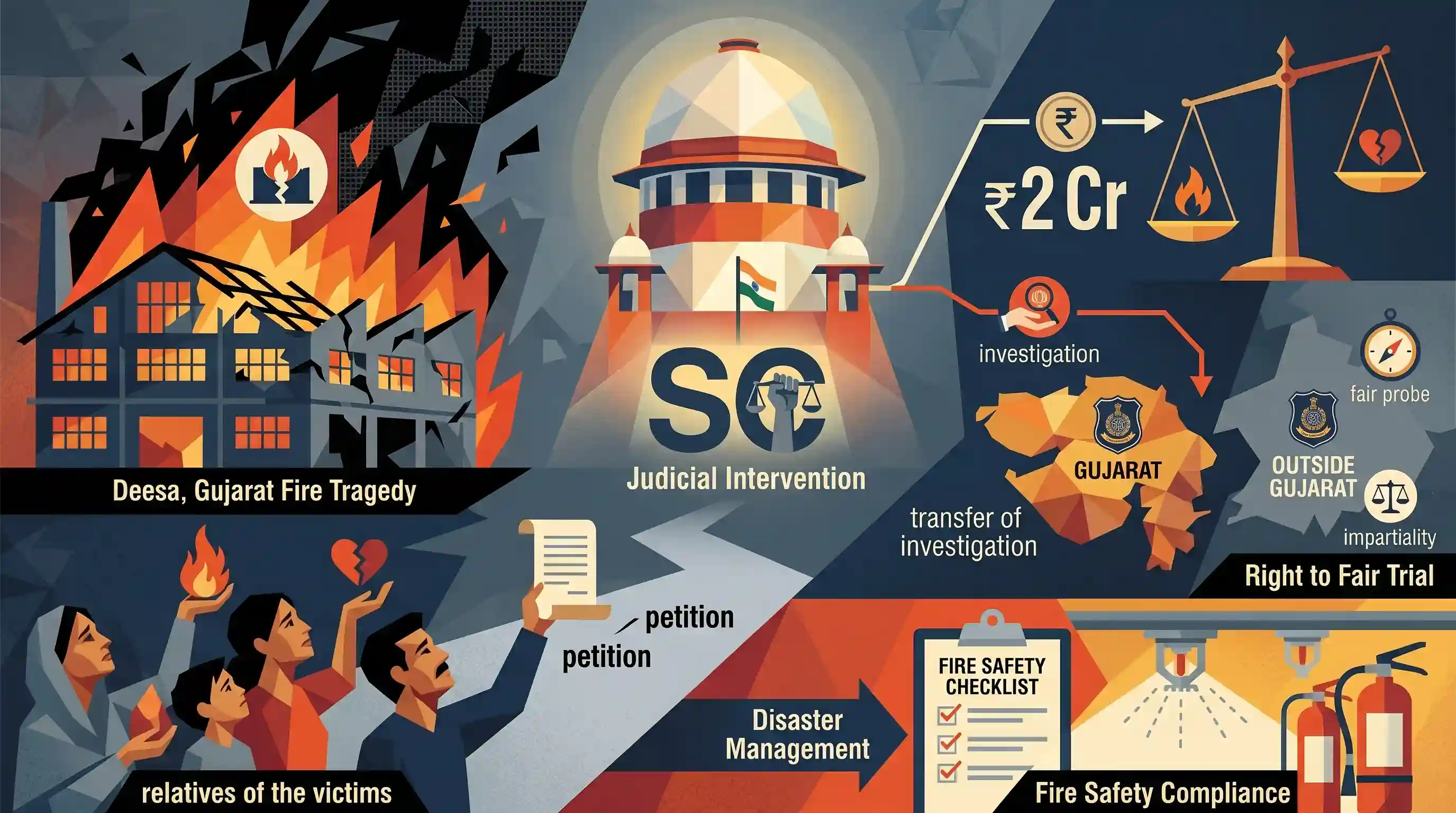
Following the fire tragedy in Deesa, Gujarat, the relatives of the victims have filed a petition in the Supreme Court. They are seeking a compensation of Rs 2 crore per victim and have demanded that the investigation be transferred outside the state of Gujarat to ensure impartiality and a fair probe.
Key Points
- Relatives of the Deesa fire tragedy victims have approached the Supreme Court seeking judicial intervention.
- The petitioners have demanded a compensation of Rs 2 crore for each victim of the tragedy.
- They have also requested the Supreme Court to transfer the investigation outside Gujarat to ensure a fair and impartial probe.
Important Terms
Article 32

A Fundamental Right empowering citizens to directly approach the Supreme Court for the enforcement of other Fundamental Rights through writs like Habeas Corpus and Mandamus.
UPSC context
GS Paper II (Polity); tests understanding of constitutional remedies and the Supreme Court's role as the 'guarantor' of rights.
Public Interest Litigation (PIL)
A legal mechanism allowing any public-spirited individual to move the court to protect the interests of the public or marginalized groups who cannot seek justice themselves.
UPSC context
GS Paper II (Governance/Judiciary); tests knowledge of judicial activism and democratization of access to justice.
Right to Fair Trial
Implicitly guaranteed under Article 21, this principle ensures that the investigative process and subsequent judicial proceedings are impartial, transparent, and free from administrative bias.
UPSC context
GS Paper II (Polity); examines the intersection of individual liberty and the State's duty to ensure unbiased justice.
Constitutional Compensation
Monetary relief awarded by courts for the violation of fundamental rights or damage caused by state negligence, moving beyond traditional civil liability under tort law.
UPSC context
GS Paper II (Judiciary/Governance); tests understanding of the State’s financial accountability for administrative lapses and right to life violations.
Absolute Liability
A legal doctrine (established in MC Mehta v. Union of India) holding enterprises engaged in hazardous activities liable for any harm caused, regardless of negligence or precautions taken.
UPSC context
GS Paper II & III (Judiciary/Disaster Management); tests application of judicial precedents in industrial and fire-safety disasters.
Explosives Act
The 1884 legislation (and 1908 Substances Act) regulating the manufacture, possession, use, sale, transport, and import of explosives to ensure public safety and safety standards.
UPSC context
GS Paper III (Internal Security/Disaster Management); tests awareness of regulatory frameworks for hazardous industries and public safety compliance.
Prelims Trap
"The National Building Code (NBC) rules for fire safety are mandatory Union laws directly enforced across all states."
Fire services are a State subject (usually delegated to municipalities under the 12th Schedule). NBC and NDMA fire safety guidelines are recommendatory until formally adopted into local municipal bye-laws.
Static Concepts Connected
What is the doctrine of "Constitutional Tort" under Indian polity?
- State Liability: A legal doctrine holding the State vicariously liable for the actions of its servants that violate fundamental rights, particularly Article 21.
- Monetary Compensation: Allows Constitutional Courts to award direct monetary compensation to victims as a public law remedy, independent of private civil damages.
- No Sovereign Immunity: The State cannot claim the defense of 'sovereign immunity' for violations of fundamental rights by its officials (established in cases like Nilabati Behera).
How can the Supreme Court transfer criminal investigations or trials outside a state?
- Article 142: The Supreme Court can invoke its extraordinary jurisdiction to pass orders transferring investigations to ensure "complete justice" and a fair trial under Article 21.
- Statutory Powers: Section 406 of CrPC (now Section 447 of BNSS) explicitly empowers the SC to transfer cases or appeals from a court in one state to a court in another.
Cross-Topic Patterns
Fire safety & 12th Schedule implementation
Frequent urban fire tragedies highlight capacity deficits in Urban Local Bodies. Delegated under Article 243W, municipal fire services suffer from inadequate finances and failure to formalize National Building Code norms into local bye-laws.
Constitutional torts & right to fair trial
Seeking mass compensation from the SC directly links the Right to Life (Article 21) with public law remedies, showcasing how the judiciary bypasses sluggish civil trials for urgent disaster relief.

Urban fire tragedies, Article 21's 'Constitutional Tort' remedy, and 12th Schedule municipal capacities will likely combine in a 2026 Mains Q.
Linked PYQs · 3
Linked PYQs · 3
- 2024MainsGS2
Explain the reasons for the growth of public interest litigation in India. As a result of it, has the Indian Supreme Court emerged as the world's most powerful judiciary ?
- 2020MainsGS2
Judicial Legislation is antithetical to the doctrine of separation of powers as envisaged in the Indian Constitution. In this context justify the filing of large number of public interest petitions praying for issuing guidelines to executive authorities.
- 2019MainsGS3
Vulnerability is an essential element for defining disaster impacts and its threat to people. How and in what ways can vulnerability to disasters be characterized? Discuss different types of vulnerability with reference to disasters.
