DeepSeek Open Source Strategy for AI Inference Engines
Source:Indian Express ↗
Why It Matters
The distinction between genuine open-source technology and proprietary models utilizing open-source elements is crucial for understanding global AI governance, technology sovereignty, and data privacy. It highlights the complexities of open-source licensing (like MIT) and OSI standards, relevant to both GS3 Science & Technology and Prelims IT/Computer awareness.
Summary
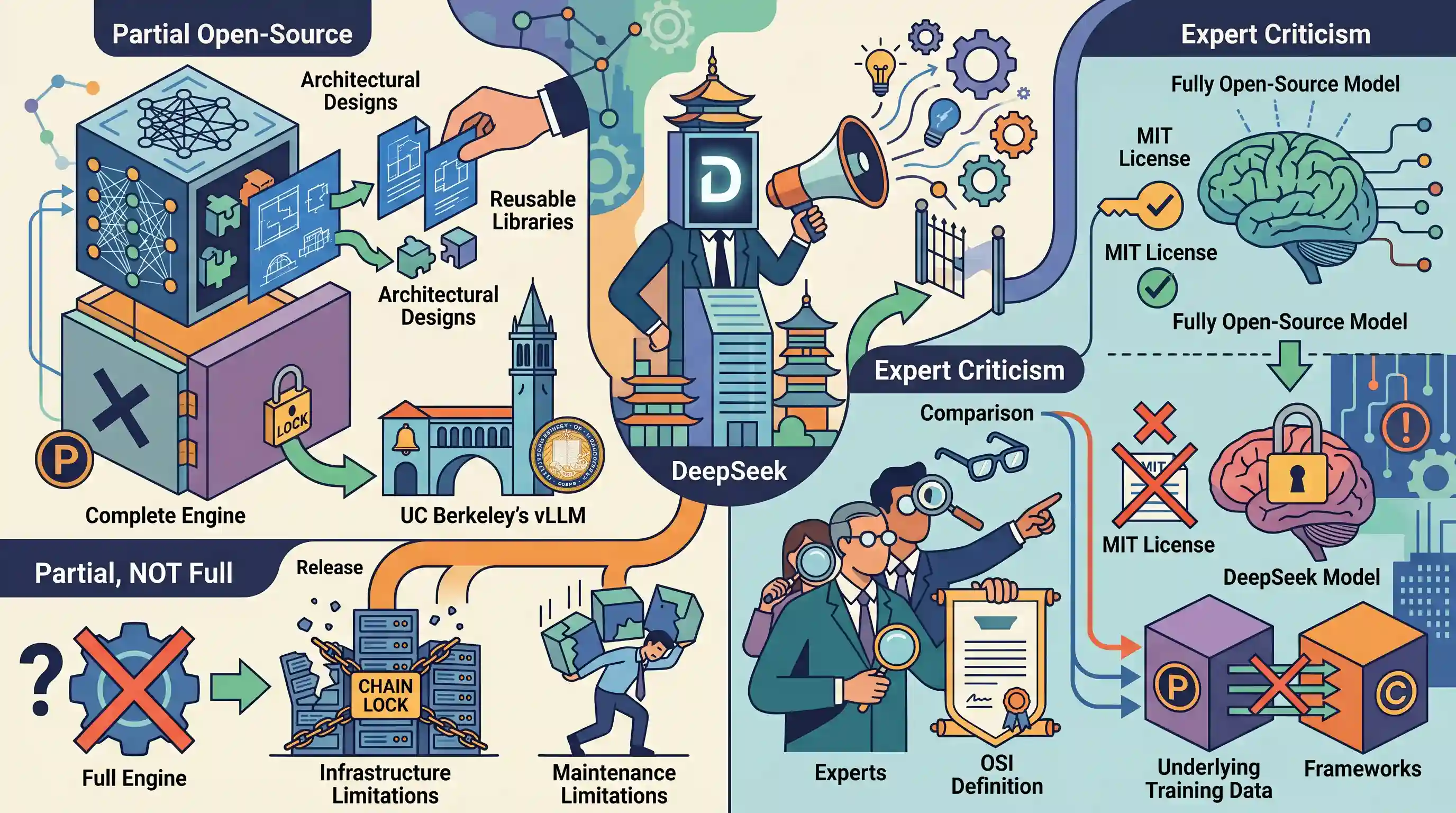
DeepSeek, a Chinese AI startup, has announced a push to partially open-source its AI inference engine by sharing architectural designs and reusable libraries rather than releasing the complete engine. While it utilizes vLLM—an open-source library from UC Berkeley—infrastructure and maintenance limitations prevent a full open-source release. Furthermore, technology experts point out that despite public perception, DeepSeek's models do not fully adhere to the Open Source Initiative (OSI) definition, since underlying training data and frameworks remain proprietary and lack permissive licenses like the MIT license.
Key Points
- Chinese AI startup DeepSeek plans to share architectural design details and standalone reusable libraries of its AI inference engine, rather than open-sourcing the entire engine.
- The startup utilizes a modified version of vLLM, an open-source library originating from UC Berkeley, for its AI inference.
- A full open-source release is restricted by maintenance bandwidth, infrastructural constraints, and a highly customized codebase.
- DeepSeek’s models, such as R1, do not completely fulfill the Open Source Initiative (OSI) definition of open-source AI, as essential components like training data and frameworks lack permissive licenses.
Important Terms
DeepSeek

A Chinese artificial intelligence startup known for developing high-performance, cost-effective models like DeepSeek-V3, which rival major US-based AI systems at significantly lower training costs.
UPSC context
GS Paper 3: Science and Technology. Relevant for AI rivalry, cost-efficient innovation, and China's growing tech influence.
Open Source Initiative (OSI)
An American non-profit organization that maintains the 'Open Source Definition,' the globally recognized standard for software that can be legally and technically labeled as open source.
UPSC context
GS Paper 3: IT and Intellectual Property Rights. Tests knowledge of global standards for digital public goods.
MIT License
A highly permissive software license that allows users to freely use, modify, and distribute code for commercial or private use, provided the original copyright notice is included.
UPSC context
GS Paper 3: Intellectual Property Rights. Important for understanding software copyright models and open innovation frameworks.
AI Inference
The process where a pre-trained AI model applies its learned patterns to new, real-world data to generate outputs (e.g., text or predictions), distinct from the resource-intensive training phase.
UPSC context
GS Paper 3: Science and Technology. Crucial for understanding the AI lifecycle and computational efficiency in technology deployment.
vLLM
An open-source library (developed at UC Berkeley) optimized for high-throughput AI model serving, using 'PagedAttention' to manage GPU memory more efficiently during inference.
UPSC context
GS Paper 3: Awareness in the field of IT. Represents specific technical advancements in making AI systems scalable and accessible.
Prelims Trap
AI models that freely release their trained model weights fully satisfy the Open Source Initiative (OSI) criteria.
True open-source AI requires access to source code, frameworks, and detailed training data under permissive licenses. Releasing only model weights is termed "open-washing."
Static Concepts Connected
What is the technical difference between AI Training and AI Inference?
- AI Training: The initial learning phase where models process vast datasets to recognize patterns and adjust internal parameters (weights) through high computational power.
- AI Inference: The application phase where a pre-trained model applies learned logical rules to process new, unseen data and generate real-time outputs.
What defines Open Source Software (OSS) and how is it used in Indian governance?
- Core Philosophy: Software where the original source code is made freely available for users to view, modify, and distribute under permissive licenses like MIT or Apache.
- Copyleft vs Permissive: Copyleft (e.g., GPL) requires derivative works to also be open-source, whereas permissive licenses allow integration into proprietary, closed software.
- India's Adoption: The GoI promotes OSS to ensure interoperability and avoid vendor lock-in. Key platforms like Aarogya Setu, DigiLocker, and CoWIN are built on OSS platforms.
Cross-Topic Patterns
Open-washing vs Green-washing paradigms
Much like green-washing in corporate ESG claims, "open-washing" in tech involves deceptively marketing AI models as fully open-source while hiding critical proprietary components like training datasets and architecture.
Open-source foundations of India's DPI
India’s DPI frameworks (like ONDC and DIKSHA) rely heavily on open-source foundations. Global debates over true open-source AI directly impact how developing nations build scalable digital governance without foreign vendor lock-in.
AI training data and global IPR conflicts
Keeping training datasets proprietary highlights the ongoing global IPR conflict. AI companies often shield these datasets to avoid legal scrutiny over unauthorized scraping of copyrighted digital content.

Expect a 2026 Prelims statement differentiating AI 'inference' from 'training' alongside the criteria for Open Source Software (OSS).
Linked PYQs · 3
Linked PYQs · 3
- 2022PrelimsGS1
Consider the following : 1. Aarogya Setu 2. CoWIN 3. DigiLocker 4. DIKSHA Which of the above are built on top of open-source digital platforms?
- 2023MainsGS3
Introduce the concept of Artificial Intelligence (AI). How does Al help clinical diagnosis? Do you perceive any threat to privacy of the individual in the use of Al in healthcare?
- 2015MainsGS3
India's Traditional Knowledge Digital Library (TKDL), which has a database containing formatted information on more than 2 million medicinal formulations is proving a powerful weapon in the country's fight against erroneous patents. Discuss the pros and cons of making this database publicly available under open-source licensing.
