Supreme Court Ruling on Child Trafficking Conviction
Source:Indian Express ↗
Why It Matters
The issue of child trafficking spans multiple dimensions of the UPSC syllabus, including the exploitation of vulnerable populations (GS1 and GS2), the functioning of child protection laws and the judiciary (GS2), and the linkages of human trafficking with organized crime (GS3). Understanding the Supreme Court's stance is crucial for answers involving fundamental rights, social justice, and law enforcement.
Summary
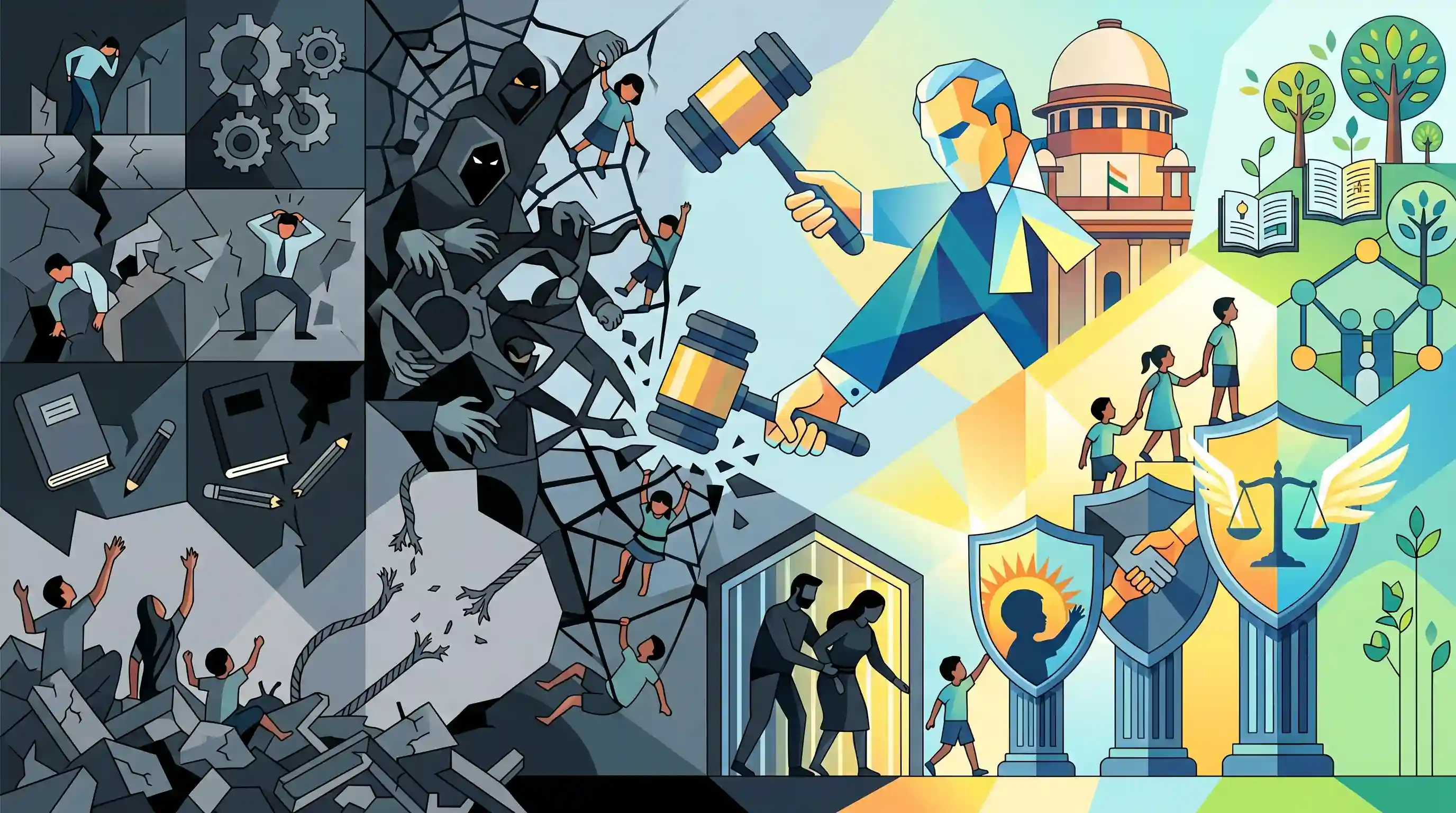
The Supreme Court of India recently upheld the conviction of a couple involved in child trafficking and sexual abuse, calling the prevalence of child exploitation in the country a "deeply disturbing reality." The apex court's observations highlight how systemic issues such as poverty, lack of education, and inadequate social safety nets leave children highly vulnerable to organized trafficking networks. The judgment underscores the urgent need for the strict implementation of protective legislation like the POCSO Act and the Immoral Traffic (Prevention) Act, emphasizing the judiciary's proactive role in safeguarding the rights of the most vulnerable sections of society.
Key Points
- The Supreme Court upheld the conviction of a couple for child trafficking and sexual abuse, terming the prevalence of such crimes a 'deeply disturbing reality' in India.
- The judgment draws attention to the exploitation of systemic vulnerabilities, where poverty and lack of social safety nets drive human trafficking networks.
- Highlights the critical need for strict enforcement of existing legal frameworks, including the POCSO Act and ITPA, to deter crimes against children.
- Underscores the intersection of social justice and internal security, as human trafficking often links with broader organized crime networks.
Important Terms
Protection of Children from Sexual Offences (POCSO) Act

A 2012 gender-neutral legislation protecting individuals under 18 from sexual assault, harassment, and pornography. It mandates Special Courts for trials and provides for stringent punishments, including the death penalty for aggravated offences.
UPSC context
GS Paper II (Social Justice/Vulnerable Sections); tests knowledge of legal protections and recent amendments for child safety.
Immoral Traffic (Prevention) Act (ITPA)
The primary legislation aimed at curbing human trafficking and commercial sexual exploitation in India. It criminalizes systemic exploitation, such as brothel keeping and pimping, while focusing on victim rehabilitation.
UPSC context
GS Paper II (Social Justice) and GS Paper III (Internal Security); relevant for organized crime and trafficking challenges.
Juvenile Justice (Care and Protection of Children) Act
The principal law governing children in conflict with the law and those in need of care. It notably allows juveniles aged 16-18 to be tried as adults for heinous crimes.
UPSC context
GS Paper II (Governance/Social Justice); tests understanding of child welfare mechanisms and the juvenile justice reform.
Article 23 of the Indian Constitution
A fundamental right that prohibits traffic in human beings, begar (forced labor), and similar forms of exploitation, making any such contravention a punishable offense.
UPSC context
GS Paper II (Constitution); essential for topics on the Right Against Exploitation and protection of vulnerable groups.
Child Welfare Committee (CWC)
A district-level statutory body under the JJ Act with judicial powers to handle cases regarding the care, protection, and rehabilitation of children in need.
UPSC context
GS Paper II (Statutory/Regulatory Bodies); critical for understanding the grassroots implementation of child protection laws.
Supreme Court of India
The highest judicial forum and final court of appeal, acting as the guardian of fundamental rights through proactive interpretation of the Constitution to protect marginalized sections.
UPSC context
GS Paper II (Judiciary); tests judicial activism and the court's role in advancing social justice and human rights.
Prelims Trap
The POCSO Act is designed exclusively to protect minor female children from sexual offences and harassment.
The POCSO Act is entirely gender-neutral. It defines a "child" as any person below the age of 18 years, providing equal protection to boys, girls, and transgender children.
Static Concepts Connected
What are the key Constitutional safeguards against human exploitation?
- Article 23: Prohibits traffic in human beings, begar, and other similar forms of forced labour, making it a punishable offence.
- Article 24: Bans the employment of children below the age of 14 years in factories, mines, or any other hazardous activities.
- Article 39(e) & (f): Directive Principle instructing the State to ensure children and youth are protected against exploitation and moral or material abandonment.
What are the unique legal features of the POCSO Act (2012)?
- Gender-Neutral: Protects all individuals under the age of 18 from sexual offences, regardless of their gender.
- Special Courts: Mandates the establishment of designated courts in each district to ensure child-friendly, speedy trials within one year.
- Reverse Burden: Shifts the burden of proof to the accused in cases of aggravated penetrative sexual assault, unlike general criminal law.
Cross-Topic Patterns
Trafficking + NIA Jurisdiction
The NIA Act was amended in 2019 to include human trafficking, linking this social justice issue directly to internal security, transnational syndicates, and federal counter-terrorism efforts.
Climate Migration + Child Trafficking
Climate-induced displacement from disaster-prone regions like the Sundarbans creates extreme economic vulnerability, acting as a major push factor that feeds organized human trafficking networks.

Expect a 2026 Mains question linking Article 23, the NIA's expanded mandate on trafficking, and the organized crime-terror nexus.
Linked PYQs · 2
Linked PYQs · 2
- 2018MainsGS3
India's proximity to two of the world's biggest illicit opium-growing states has enhanced her internal security concerns. Explain the linkages between drug trafficking and other illicit activities such as gunrunning, money laundering and human trafficking. What counter-measures should be taken to prevent the same?
- 2019MainsGS2
Performance of welfare schemes that are implemented for vulnerable sections is not so effective due to absence of their awareness and active involvement at all stages of policy process. Discuss.
