Cyber Police Busting Deepfake Stock Fraud Syndicate Using Crypto
Source:Indian Express ↗
Why It Matters
It demonstrates the practical application of emerging technologies (AI/Deepfakes and Cryptocurrency) in committing and concealing organized financial crimes, directly relevant to the GS3 syllabus topics of cyber security challenges, money laundering, and technology implications.
Summary
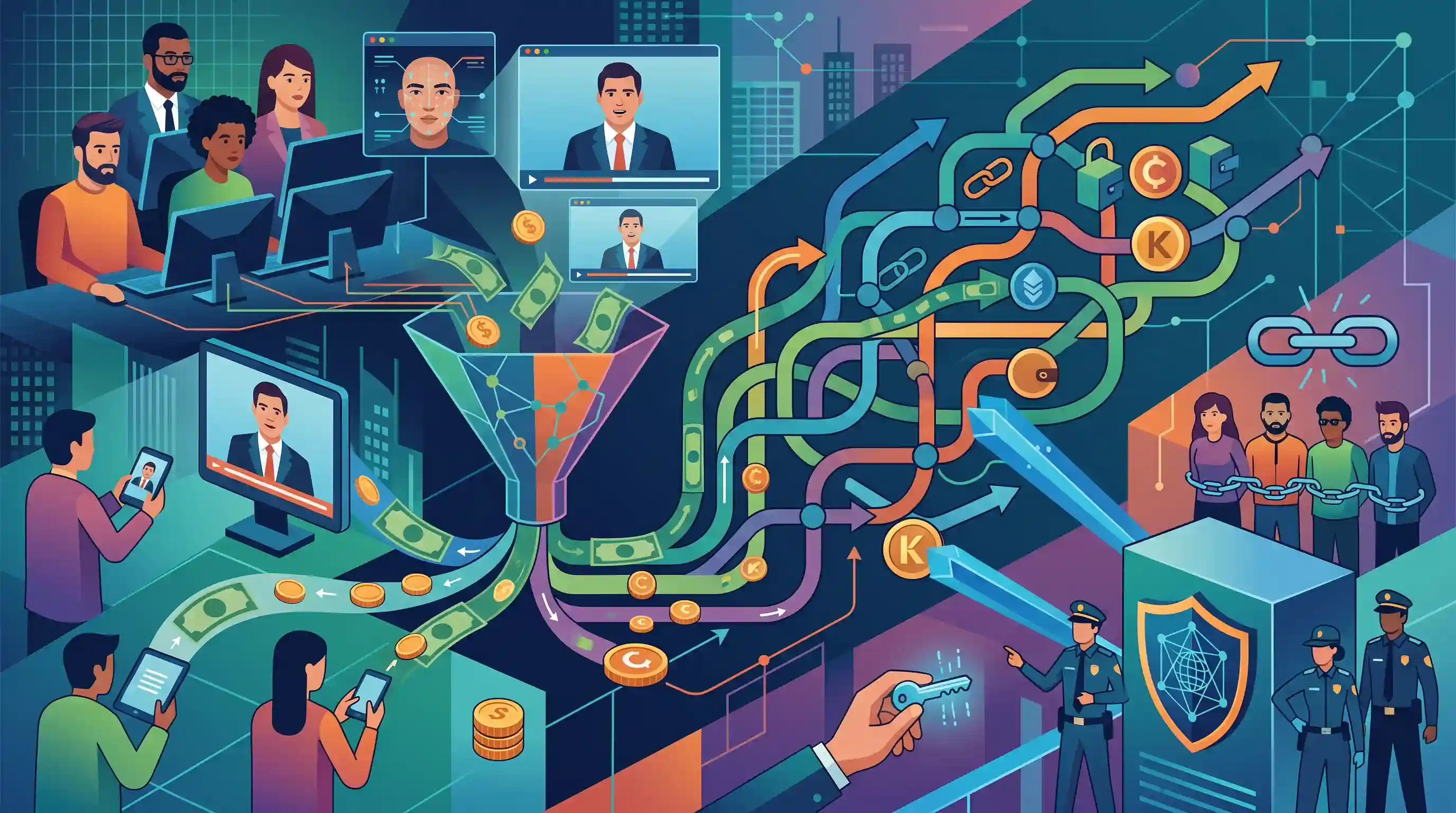
Pune Cyber Police have dismantled a cybercrime network, arresting five individuals from Delhi and Madhya Pradesh for orchestrating a share-trading fraud. The syndicate utilized artificial intelligence-generated deepfake videos to deceive victims into transferring funds. To complicate law enforcement tracking and launder the proceeds, the criminals subsequently routed the stolen money through cryptocurrency channels, highlighting a dangerous intersection of AI misuse and decentralized financial platforms in modern cybercrimes.
Key Points
- Fraudsters used deepfake videos to manipulate and trick victims into investing in a fraudulent share trading scheme.
- Five individuals part of an organized cybercrime syndicate were arrested from Delhi and Madhya Pradesh.
- Stolen funds were siphoned off using cryptocurrency channels, highlighting how decentralized finance is misused to quickly move illicit money and evade traditional banking surveillance.
- The incident showcases the rising threat of 'AI-facilitated financial crimes' that merge deepfake technology with money laundering.
Important Terms
Deepfake

Synthetic media where a person's likeness is replaced using AI, specifically deep learning, to create highly convincing but fabricated audio-visual content.
UPSC context
GS Paper 3: Science & Tech and Internal Security. Tests awareness of emerging technological threats and regulatory challenges.
Virtual Digital Assets (VDA)
Digitally represented values using cryptography, legally defined in India as Virtual Digital Assets (VDAs) to address taxation and financial integrity risks.
UPSC context
GS Paper 3: Economy and Internal Security. Relevant for financial regulation and money laundering prevention.
Money Laundering
The process of concealing the origins of illegally obtained money, typically by means of transfers involving foreign banks or legitimate businesses.
UPSC context
GS Paper 3: Internal Security. Focuses on the Prevention of Money Laundering Act (PMLA) and financial crimes.
Mule Accounts
Legitimately opened bank accounts used by criminals to receive and transfer illegally obtained funds, helping to mask the identity of the primary fraudsters.
UPSC context
GS Paper 3: Internal Security. Related to the mechanics of cyber-enabled financial fraud and organized crime.
Cyber Security
The protection of computer systems and networks from information disclosure, theft, or damage to their hardware, software, or electronic data.
UPSC context
GS Paper 3: Internal Security. Essential for understanding national strategies against evolving digital threats.
Phishing
A form of fraud where criminals use deceptive emails, messages, or videos (like deepfakes) to trick victims into revealing sensitive information or transferring money.
UPSC context
GS Paper 3: Internal Security. Tests knowledge of various modes of cyber-attacks and individual digital safety.
Prelims Trap
"India has enacted dedicated legislation specifically to regulate deepfakes and AI synthetic media."
India currently lacks a dedicated deepfake law; instead, deepfake-related offenses are prosecuted under Section 66D of the IT Act, 2000, and IT Rules, 2021.
Static Concepts Connected
How do Generative Adversarial Networks (GANs) create deepfake media?
- The Generator: An algorithm that studies original datasets and generates highly realistic synthetic audio or video.
- The Discriminator: A competing algorithm that tries to detect flaws and distinguish the fake from real data.
- Continuous Loop: They compete iteratively until the generator's output successfully fools the discriminator, resulting in convincing deepfakes.
How does India legally tackle crypto-enabled money laundering?
- PMLA Ambit: Transactions involving Virtual Digital Assets (VDAs) have been explicitly brought under the Prevention of Money Laundering Act (PMLA).
- FIU-IND Registration: Crypto exchanges act as 'reporting entities' and must register with the Financial Intelligence Unit (FIU-IND) to enforce strict KYC norms.
- Tax Trail: A 30% tax and 1% TDS on VDA transactions create a traceable financial footprint for enforcement agencies.
Cross-Topic Patterns
Cybercrime + Intermediary Liability limits
Deepfake financial frauds test the IT Rules 2021, which mandate platforms to remove impersonation content within 24 hours or lose 'safe harbour' immunity under Section 79 of the IT Act.
AI placement + Crypto layering under PMLA
This highlights the 'layering' stage of money laundering, where AI-generated initial fraud (placement) is rapidly obscured through decentralized, cross-border crypto channels to evade traditional banking surveillance.

Expect a 2026 Prelims multi-statement question merging GANs (Deepfakes), VDA inclusion under PMLA, and platform safe-harbour rules.
Linked PYQs · 4
Linked PYQs · 4
- 2021MainsGS3
Discuss how emerging technologies and globalisation contribute to money laundering. Elaborate measures to tackle the problem of money laundering both at national and international levels.
- 2020MainsGS3
Discuss different types of cyber crimes and measures required to be taken to fight the menace.
- 2024PrelimsGS1
Consider the following statements: I. It is expected that Majorana 1 chip will enable quantum computing. II. Majorana 1 chip has been introduced by Amazon Web Services (AWS). III. Deep learning is a subset of machine learning. Which of the statements given above are correct?
- 2018PrelimsGS1
The terms 'WannaCry, Petya and EternalBlue' sometimes mentioned in the news recently are related to
