Deepfake Regulation and Freedom of Speech Implications
Source:Indian Express ↗
Why It Matters
The regulation of AI and deepfakes is a highly relevant governance issue. Understanding the friction between swift regulatory mandates and constitutional free speech guarantees is vital for questions on fundamental rights (GS2) and cyber security/technology management (GS3).
Summary
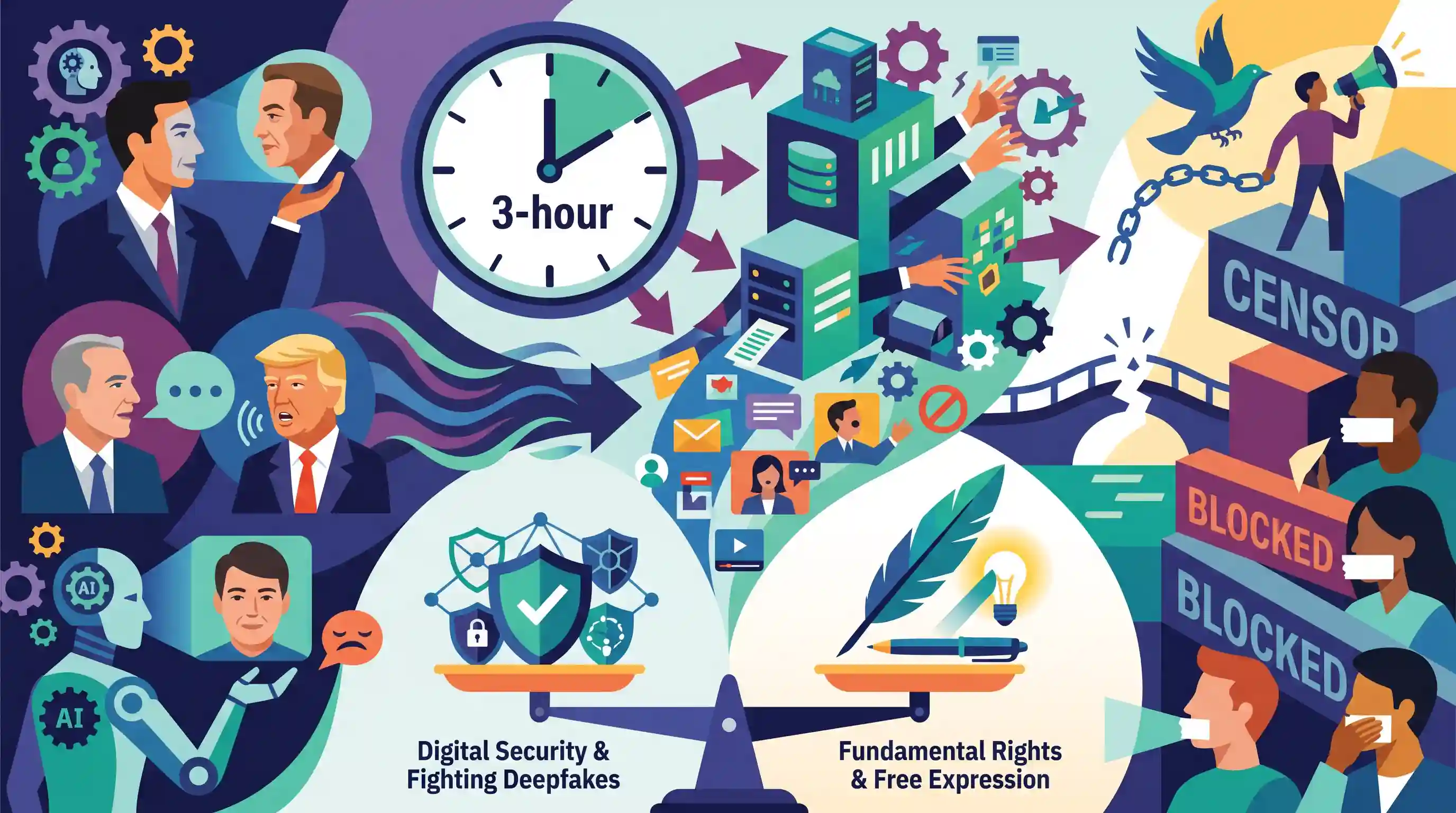
The article examines the implications of a new 3-hour takedown mandate under India's IT Rules aimed at combating deepfake media. While acknowledging the severe threat posed by AI-generated misinformation, the author warns that such a tight timeframe forces intermediaries into a dynamic of over-compliance. This risks arbitrary censorship without proper human review, thereby restricting legitimate free speech and potentially violating constitutional rights. It underscores the delicate balance policymakers must strike between securing the digital space from malicious AI and upholding fundamental democratic freedoms.
Key Points
- A new 3-hour takedown rule for deepfake media has been introduced to rapidly curb the spread of AI-generated misinformation.
- Critics argue that this stringent timeline may force social media platforms to rely on automated removals without adequate human review, leading to over-censorship.
- Such over-compliance risks infringing upon the fundamental right to freedom of speech and expression guaranteed under Article 19(1)(a) of the Constitution.
- The ongoing challenge for policymakers is balancing effective regulation of emerging AI technologies with the preservation of constitutional democratic rights.
Important Terms
Information Technology (IT) Rules

Rules under the IT Act, 2000, regulating intermediaries and digital media, recently amended to mandate a 3-hour takedown for deepfakes and AI-generated misinformation.
UPSC context
GS Paper 2 & 3: Governance, government policies, and internal security/cybersecurity. Tests understanding of digital regulation frameworks.
Social Media Intermediaries
Platforms (like WhatsApp, X, Facebook) that enable user interaction and content sharing; they must perform due diligence to maintain legal immunity for third-party content.
UPSC context
GS Paper 2 & 3: Issues related to digital platforms, accountability, and the regulatory role of the state.
Safe Harbour Protection
Legal immunity granted to intermediaries under Section 79 of the IT Act, 2000, protecting them from liability for user-generated content provided they follow government-prescribed due diligence.
UPSC context
GS Paper 2 & 3: Legal frameworks for digital economy and intermediary liability; critical for debates on free speech.
Deepfakes
Synthetically generated media (audio, video, or images) created using AI/Machine Learning that realistically mimics real persons or events, often used for misinformation or fraud.
UPSC context
GS Paper 3: Science & Technology and Cybersecurity. Tests awareness of emerging technological threats and ethical implications.
Article 19(1)(a)
A fundamental right under the Indian Constitution, subject to 'reasonable restrictions' (Article 19(2)) such as national security, public order, and decency or morality.
UPSC context
GS Paper 2: Indian Constitution and Polity. Central to discussions on censorship, digital rights, and democratic freedoms.
Prelims Trap
Social media platforms possess absolute Safe Harbour immunity for third-party content under Section 79.
Safe Harbour is strictly conditional. It is stripped if platforms fail to observe 'due diligence' or miss mandated takedown windows (like the 3-hour deepfake rule) upon government/court notification.
Static Concepts Connected
What is the 'Safe Harbour' principle under Section 79 of the IT Act?
- Legal Immunity: Shields intermediaries (like social media platforms) from legal liability for user-generated content hosted on their networks.
- Conditionality: Immunity requires observing specific 'due diligence' and not modifying or initiating the transmission of the content.
- Shreya Singhal (2015): Ruled that content takedowns generally require a court order or authorized government notification, preventing arbitrary private censorship.
What are the 'reasonable restrictions' on Free Speech under Article 19(2)?
- Primary Grounds: Sovereignty and integrity of India, security of the State, friendly relations with foreign states, public order, decency, or morality.
- Legal Exceptions: Free speech can also be restricted in relation to contempt of court, defamation, or incitement to an offence.
Cross-Topic Patterns
AI deepfakes and Election Integrity (MCC)
The rapid spread of synthetic media threatens electoral integrity, prompting debates on whether the Election Commission needs statutory backing to regulate AI-generated political ads during the Model Code of Conduct.
EU AI Act vs India's reactive IT Rules
While the EU AI Act adopts a comprehensive, risk-based categorization of AI systems, India addresses AI harms reactively through intermediary liability tweaks under the IT Act.
Right to Privacy and DPDP Act linkages
Non-consensual deepfakes infringe on the Right to Privacy (Article 21), bridging intermediary liability with the Digital Personal Data Protection (DPDP) Act's frameworks for processing biometric/personal data.

Expect a multi-statement Prelims question merging Section 79 Safe Harbour, Shreya Singhal limits, and 2026 IT Rule deepfake mandates.
Linked PYQs · 4
Linked PYQs · 4
- 2024MainsGS3
Social media and encrypting messaging services pose a serious security challenge. What measures have been adopted at various levels to address the security implications of social media? Also suggest any other remedies to address the problem.
- 2016MainsGS3
Use of Internet and social media by non-state actors for subversive activities is a major security concern. How have these been misused in the recent past? Suggest effective guidelines to curb the above threat.
- 2020MainsGS3
Discuss different types of cyber crimes and measures required to be taken to fight the menace.
- 2017MainsGS2
Examine the scope of Fundamental Rights in the light of the latest judgement of the Supreme Court on Right to Privacy.
