Regulatory Takedown Timelines and Free Speech Rights
Source:Indian Express ↗
Why It Matters
Regulating emerging technologies like generative AI and deepfakes while preserving democratic freedoms is a critical governance challenge. The topic overlaps with GS2 (Fundamental Rights, Government Policies) and GS3 (Internal Security, Cyber Security, Technology), making it highly relevant for Mains questions on social media regulation and state overreach.
Summary
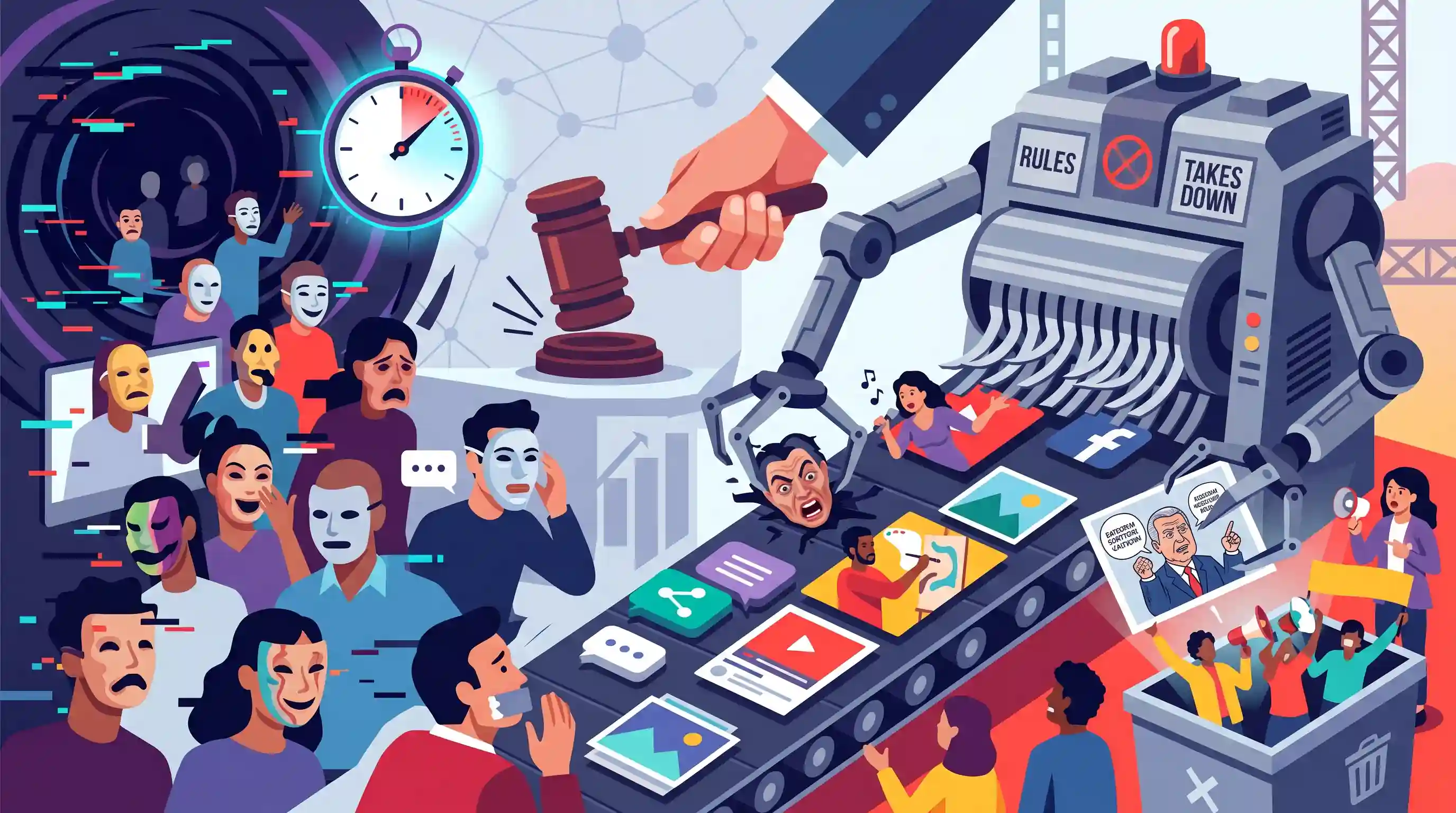
The article analyzes the newly proposed IT Rules 2026 in India, focusing on the mandate for social media platforms to take down deepfake media within three hours of a complaint. While acknowledging the genuine threat deepfakes pose to privacy, security, and democratic processes, the author warns that such a rushed takedown timeline threatens the constitutional right to free speech. It could force platforms into aggressive, automated censorship to avoid regulatory penalties, risking the removal of legitimate expression and satire without due process.
Key Points
- The proposed IT Rules 2026 introduce a stringent 3-hour takedown mandate for social media intermediaries to remove reported deepfake content.
- While aimed at mitigating the rapid spread of malicious AI-generated media and protecting individuals, the rule risks violating the fundamental right to freedom of speech and expression.
- The tight timeframe places a massive compliance burden on platforms, likely leading to over-censorship where platforms preemptively remove legitimate content (such as satire or political commentary) to avoid penalties.
- Effective deepfake regulation requires a balance between curbing misinformation/cyber threats and safeguarding digital rights, necessitating nuanced frameworks rather than blunt executive mandates.
Important Terms
IT Rules 2026

The 2026 amendments to the 2021 IT Rules mandate 3-hour takedowns for deepfakes, compulsory AI-labeling, and provenance metadata to combat synthetically generated misinformation.
UPSC context
GS Paper II (Governance) and III (Cyber Security); tests understanding of digital content regulation and intermediary liability.
Information Technology Act, 2000
India's primary legislation for electronic commerce and cybercrime, providing the legal framework for digital signatures, data protection, and intermediary accountability under Section 79.
UPSC context
GS Paper III (Internal Security); fundamental for understanding the legal basis of India's digital ecosystem.
Ministry of Electronics and Information Technology (MeitY)
The nodal agency of the Government of India responsible for IT policy, electronics manufacturing, and internet governance, including the enforcement of the IT Rules.
UPSC context
GS Paper II (Statutory/Regulatory Bodies); important for identifying the executive authority behind digital India initiatives.
Deepfake (Synthetically Generated Information)
Legally termed "Synthetically Generated Information" (SGI), these are AI-manipulated media (audio/video) that convincingly mimic real individuals or events, now requiring mandatory disclosure labels.
UPSC context
GS Paper III (S&T/Security); examines the ethical and security challenges posed by generative AI.
Safe Harbour Protection
Legal immunity granted to internet intermediaries under Section 79 of the IT Act, exempting them from liability for user-generated content provided they perform due diligence.
UPSC context
GS Paper II (Justice/Rights); critical for discussions on platform accountability vs. freedom of expression.
Significant Social Media Intermediary (SSMI)
A social media platform with a large user base (exceeding a government-defined threshold) that faces enhanced due diligence obligations, such as appointing grievance officers.
UPSC context
GS Paper II (Governance); highlights the tiered regulatory approach for major global tech platforms.
Prelims Trap
Social media platforms face direct criminal liability under the IT Rules if users post deepfakes.
Platforms do not automatically face criminal charges; they lose "Safe Harbour" immunity (Section 79), exposing them to third-party liability. It is a loss of legal protection, not a direct penal provision.
Static Concepts Connected
What is the "Safe Harbour" protection for intermediaries in India?
- Legal Immunity: Section 79 of the IT Act, 2000 protects platforms (like X or Meta) from legal liability for third-party content posted by users.
- Conditional Protection: Immunity applies only if the platform acts as a mere conduit, does not initiate the transmission, and observes required 'due diligence' (like taking down flagged content).
- Shreya Singhal (2015): In 2015, the SC ruled that takedowns require a court order or government notification, preventing arbitrary censorship by platforms themselves.
What are the constitutional grounds for restricting Freedom of Speech?
- Article 19(2): Article 19(2) allows the State to impose 'reasonable restrictions' on the exercise of free speech under Article 19(1)(a).
- State Security: Sovereignty and integrity of India, security of the state, and friendly relations with foreign states.
- Public Order & Morality: Public order, decency or morality, contempt of court, defamation, or incitement to an offence. Deepfake regulation usually invokes decency/morality or public order.
Cross-Topic Patterns
Deepfakes, Elections & Internal Security
The weaponization of AI for election manipulation links GS2 (Elections/Democracy) with GS3 (Internal Security). UPSC often tests how novel cyber threats outpace traditional legislative frameworks like the IT Act.
Patchwork Rules vs. Comprehensive AI Laws
India’s reliance on executive rule-making (IT Rules) rather than parliamentary legislation contrasts sharply with the EU's statutory Artificial Intelligence (AI) Act, highlighting a key governance gap often probed in Mains.

Expect a GS2/GS3 blended question evaluating if India’s executive IT Rules are constitutionally sound compared to the EU's statutory AI Act.
Linked PYQs · 3
Linked PYQs · 3
- 2024MainsGS3
Social media and encrypting messaging services pose a serious security challenge. What measures have been adopted at various levels to address the security implications of social media? Also suggest any other remedies to address the problem.
- 2016MainsGS3
Use of Internet and social media by non-state actors for subversive activities is a major security concern. How have these been misused in the recent past? Suggest effective guidelines to curb the above threat.
- 2017MainsGS2
Examine the scope of Fundamental Rights in the light of the latest judgement of the Supreme Court on Right to Privacy.
