Role of Bilateral Trade Agreements in Rupee Internationalisation
Source:Indian Express ↗
Why It Matters
The internationalisation of the rupee is a major policy objective of the RBI to safeguard India from external currency shocks. UPSC candidates must understand the nexus between trade policy, exchange rates, and currency convertibility, especially in the context of global shifts towards de-dollarisation and bilateral trade arrangements.
Summary
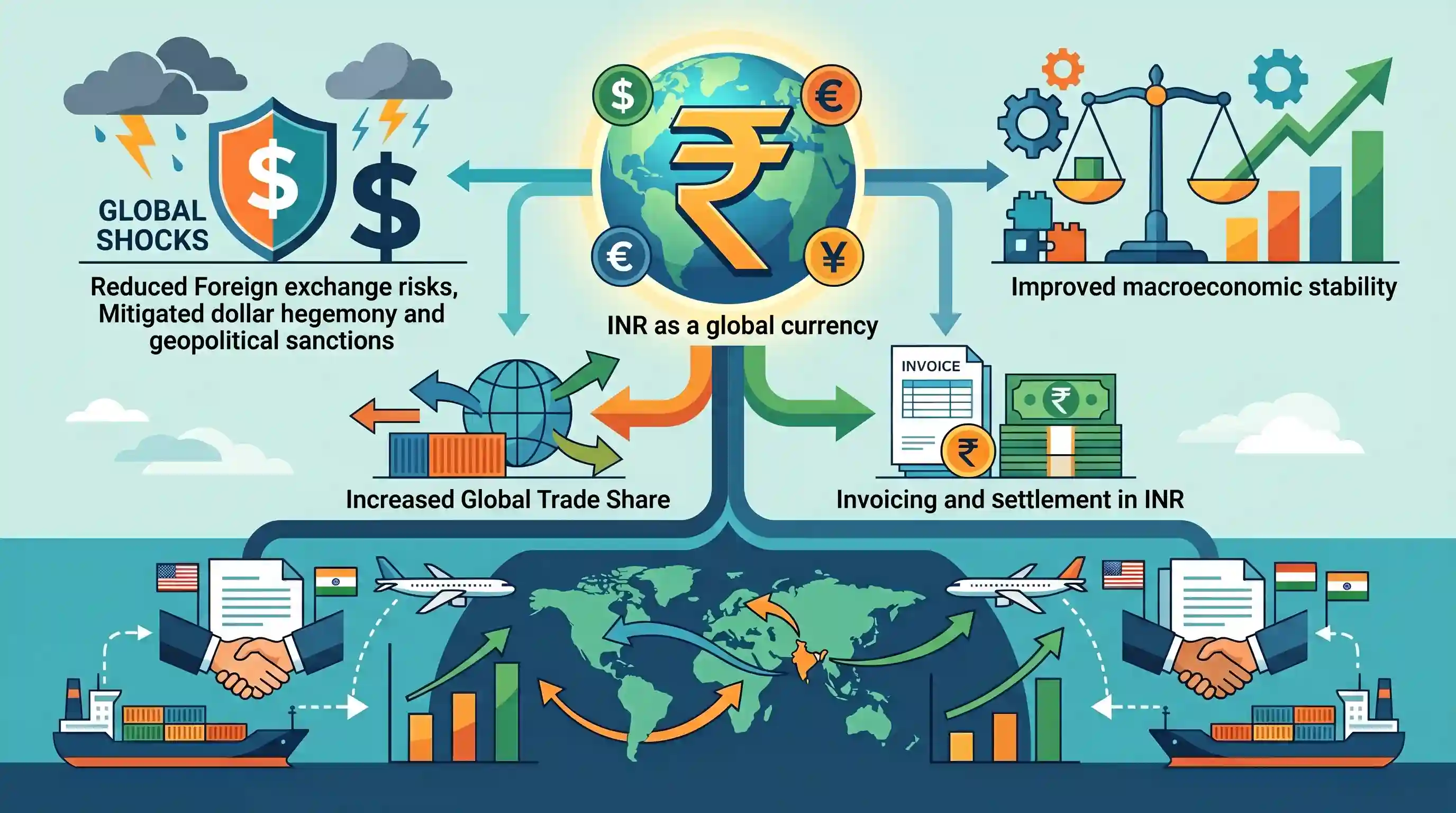
The article argues that the internationalisation of the Indian Rupee cannot be achieved solely through financial mechanisms, but fundamentally requires deeper bilateral and multilateral trade ties. To encourage other nations to invoice and settle trade in INR, India must increase its share in global trade and engage in comprehensive Free Trade Agreements (FTAs). Promoting the rupee as a global currency reduces foreign exchange risks, mitigates the impact of global shocks such as dollar hegemony or geopolitical sanctions, and improves macroeconomic stability. Establishing robust, high-volume trade partnerships is the essential stepping stone for the widespread global acceptance of the Rupee.
Key Points
- Currency internationalisation is directly proportional to a country's share in global trade; higher trade volumes generate organic demand for the domestic currency.
- Financial mechanisms like Vostro accounts are insufficient on their own; real economic integration and deeper bilateral trade ties are essential to encourage INR invoicing.
- Wider acceptance of the Rupee for trade settlement helps mitigate exchange rate volatility and reduces structural dependence on the US Dollar (de-dollarisation).
- Enhancing export competitiveness and integrating into Global Value Chains (GVCs) are critical prerequisites for making the Rupee an internationally acceptable currency.
- While full capital account convertibility may be a long-term goal, the immediate priority is to facilitate seamless current account transactions in INR with key trading partners.
Important Terms
Internationalisation of the Rupee

The process of increasing the use of the Indian Rupee (INR) in cross-border trade, investments, and as a global reserve currency to reduce dependence on foreign hard currencies.
UPSC context
GS Paper 3 (Economy); tests external sector reforms, currency volatility, and India's global economic influence.
Free Trade Agreements (FTAs)
Formal treaties between countries to reduce or eliminate tariffs and trade barriers, aimed at deepening economic integration and market access for goods and services.
UPSC context
GS Paper 2 & 3; tests trade policy, Global Value Chain integration, and bilateral economic diplomacy.
Dollar Hegemony
The dominant global status of the US Dollar as the primary reserve currency, providing the U.S. significant leverage over international finance and geopolitical sanctions.
UPSC context
GS Paper 2 & 3; relevant to "De-dollarisation" and the transition toward a multipolar financial world order.
External Sector
The segment of the economy covering all international transactions, including trade (exports/imports), foreign exchange reserves, and the Balance of Payments (BoP).
UPSC context
GS Paper 3; core syllabus topic testing knowledge of trade deficits and capital account management.
Reserve Bank of India (RBI)
India's central bank that regulates the monetary system, manages foreign exchange reserves, and implements frameworks for international trade settlement in rupees.
UPSC context
GS Paper 3; tests central bank functions, monetary policy, and financial sector regulation.
Macroeconomic Stability
A state of low inflation, sustainable debt, and manageable deficits that fosters international confidence in a nation's economy and its currency.
UPSC context
GS Paper 3; essential for analyzing growth prospects and the attractiveness of Indian markets to global investors.
Special Rupee Vostro Account (SRVA)
A mechanism allowing foreign banks to hold rupee accounts in India to settle international trade directly in INR, bypassing the need for dollar conversion.
UPSC context
GS Paper 3 (Current Affairs); specific tool for Local Currency Settlement (LCS) and reducing trade transaction costs.
Prelims Trap
India has full capital account convertibility to facilitate Rupee internationalisation.
India only has full current account convertibility (since 1994). Capital account convertibility remains partial, managed by RBI limits on foreign borrowing and investments.
Static Concepts Connected
What is a Special Rupee Vostro Account (SRVA)?
- Meaning: A Vostro account (meaning "yours with us") is an account held by a foreign bank with an Indian bank, denominated in Indian Rupees.
- Trade Settlement: It allows foreign importers to pay in INR and Indian exporters to receive INR directly, settling cross-border trade without using a third currency like the US Dollar.
What is the status of Rupee Convertibility in India?
- Current Account: Fully convertible since 1994, allowing free forex conversion for trade in goods, services, and remittances, complying with IMF Article VIII.
- Capital Account: Partially convertible. Foreign investments (FDI, FPI) and external borrowings face regulatory caps to prevent sudden macroeconomic shocks.
- Tarapore Committee: Constituted by the RBI (1997 & 2006) to lay out a phased roadmap and macroeconomic preconditions for full Capital Account Convertibility.
Cross-Topic Patterns
Geopolitics + Vostro Trade Settlement
The RBI's SRVA mechanism gained traction post-Ukraine war as a tool for de-dollarisation and bypassing Western SWIFT sanctions, linking economic policy directly to strategic autonomy.
GVCs + Free Trade Agreements
India's pivot to comprehensive FTAs (e.g., UAE, Australia) aims to integrate the economy into GVCs, organically driving Rupee demand without risking sudden capital flight.

Expect a 2026 Prelims multi-statement question mixing Vostro accounts, Tarapore committee, and India's current vs capital convertibility.
Linked PYQs · 4
Linked PYQs · 4
- 2015PrelimsGS1
Convertibility of rupee implies
- 2022PrelimsGS1
With reference to the Indian economy, consider the following statements: 1. An increase in Nominal Effective Exchange Rate (NEER) indicates the appreciation of rupee. 2. An increase in the Real Effective Exchange Rate (REER) indicates an improvement in trade competitiveness. 3. An increasing trend in domestic inflation relative to inflation in other countries is likely to cause an increasing divergence between NEER and REER. Which of the above statements are correct?
- 2018MainsGS3
How would the recent phenomena of protectionism and currency manipulations in world trade affect macroeconomic stability of India?
- 2025MainsGS3
What are the challenges before the Indian economy when the world is moving away from free trade and multilateralism to protectionism and bilateralism? How can these challenges be met?
